Biography · Chemist no. 246 of 350
Charles Gerhardt (1816-1856): A Short Life That Reorganised Organic Chemistry
Introduction
Charles Frederic Gerhardt was a French chemist from Strasbourg who died at only 39. In that short life he gave organic chemistry the homologous series, a corrected system of atomic weights, the discovery of acid anhydrides and acyl chlorides as a class, and the type theory. His work with Auguste Laurent challenged the old radical theory and helped lead to modern structure theory. His legacy in one line: he made organic chemistry orderly.
Early Life and Family
Gerhardt was born on 21 August 1816 in Strasbourg, then in France, in a family connected with the chemical manufacturing business. His father wanted him to join that business. Alsace was culturally both French and German, an advantage when he later moved between laboratories in Germany and France.
Education and Mentors
He studied at the polytechnic school in Karlsruhe, and then went to Leipzig, where he worked with Otto Linne Erdmann. Disagreements with his father over his career led to a period of hardship, including a short, unhappy time in the army as a cavalryman. With support from his friends he gave this up and went to Giessen to work with Justus von Liebig, one of the greatest teachers in Europe, in 1838. He then moved to Paris in 1838-1839, where he came under the influence of Jean-Baptiste Dumas, who helped him in his early career, and met Auguste Laurent, who became a close friend and colleague later.
Career Timeline
| Year | Event |
|---|---|
| 1816 | Born in Strasbourg |
| 1836-1838 | Studies at Karlsruhe and Leipzig; then works with Liebig at Giessen |
| 1838-1841 | Works in Paris with Dumas and others |
| 1841 | Doctorate; appointed to a post at Montpellier |
| 1843 | Introduces the term homologous series and argues for revised atomic weights |
| 1844 | Becomes professor at Montpellier |
| 1844-1845 | Publishes "Precis de chimie organique" |
| 1851 | Leaves Montpellier for Paris; sets up a private laboratory school with Chancel |
| 1852 | Prepares acid anhydrides |
| 1853 | Type theory; acetylsalicylic acid (impure) |
| 1855 | Appointed professor at Strasbourg |
| 1856 | Dies in Strasbourg on 19 August, just before his 40th birthday |
Major Scientific Contributions
- Atomic weight reform: He recognised that for organic compounds the commonly used formulas needed halving of water and carbon dioxide, and adopted H2O and CO2 with C = 12, O = 16.
- Homologous series: Compounds that differ by CH2 have regularly graded properties.
- Acid anhydrides and acyl compounds: Acetic anhydride from acetyl chloride and acetate, plus the study of acid chlorides and amides.
- Type theory: Compounds classified on the types H2, HCl, H2O, NH3. This influenced Williamson, Kekule, Wurtz and Hofmann.
- Aspirin precursor: The first, impure acetylsalicylic acid, 1853.
CH3COCl + CH3COOK -> (CH3CO)2O + KCl         (Gerhardt, 1852)
Types:   H2 | HCl | H2O | NH3
Awards, Honours and Nobel Prize
Gerhardt did not receive many official honours. His appointment as professor at Strasbourg in 1855 was late in a short career, and he had no seat in the Academie des Sciences. His great reward came after death when his ideas were taken up by younger chemists. He lived long before the Nobel Prize (first awarded in 1901).
Personality, Struggles and Lesser-Known Facts
- He was independent and outspoken. He criticised famous chemists openly, including those who had helped him, and his sharp style cost him friends and positions.
- His struggles with Liebig and Dumas over credit for ideas were famous in the chemical world. He wrote a number of pointed articles and sometimes accused established chemists of using his work without credit.
- After leaving Montpellier he set up his own school of practical chemistry in Paris, with his student Louis Chancel, because the university system there was closed to him.
- Although he first made aspirin in an impure form, he never tested it as a drug and gave it no further attention.
- He is often remembered as the friend and partner of Laurent. The two were so closely linked that historians speak of the Laurent-Gerhardt reform of chemistry.
- His "Traite de chimie organique" in four volumes was a great summary of the field, and he worked on the final volume while ill. Illness struck him in 1856, and he died within a short time.
Legacy and Influence on Modern Chemistry
The type theory he formulated led directly to Williamson's concept of the ether as a water type, and then to Kekule's ideas of valency. His corrected formulas prepared the ground for the Karlsruhe Congress of 1860, where Cannizzaro's views, built on the same foundations, were presented. His acyl chloride and anhydride chemistry is now a core part of every organic course, from the Friedel-Crafts acylation to peptide synthesis. The homologous series is one of the first things students learn in organic nomenclature.
Lessons for Students
- Organise knowledge. Gerhardt's great strength was seeing patterns and grouping compounds in a logical way.
- Check your data and your units. Wrong formulas can hide the truth for years, as the atomic weight confusion did.
- Be critical but fair. His sharp tone cost him support. Disagree with evidence, and credit others.
- Use your talents even without a perfect institution. He built his own laboratory school.
Quick Facts Box
- Born: 21 August 1816, Strasbourg, France
- Died: 19 August 1856, Strasbourg, France
- Nationality: French
- Field: Organic chemistry
- Famous for: Acid anhydrides; type theory; homologous series; first impure acetylsalicylic acid
- Nobel Prize: None (died before the prizes began)
FAQ
Who was Charles Gerhardt?
He was a French organic chemist from Strasbourg who developed type theory, discovered acid anhydrides and introduced the idea of homologous series.
Did Gerhardt invent aspirin?
He first made an impure acetylsalicylic compound in 1853, but pure aspirin as a drug was made by Bayer chemists in 1897.
With whom did Gerhardt work most closely?
With Auguste Laurent, whose ideas on nuclei and molecules matched his own; both opposed the old radical theory.
When did Gerhardt die?
He died on 19 August 1856 in Strasbourg, at the age of 39.
Published by ABC Chemistry — IIT-JAM | CSIR-NET | GATE Chemistry Coaching. Visit abcchemistry.com
About the chemist
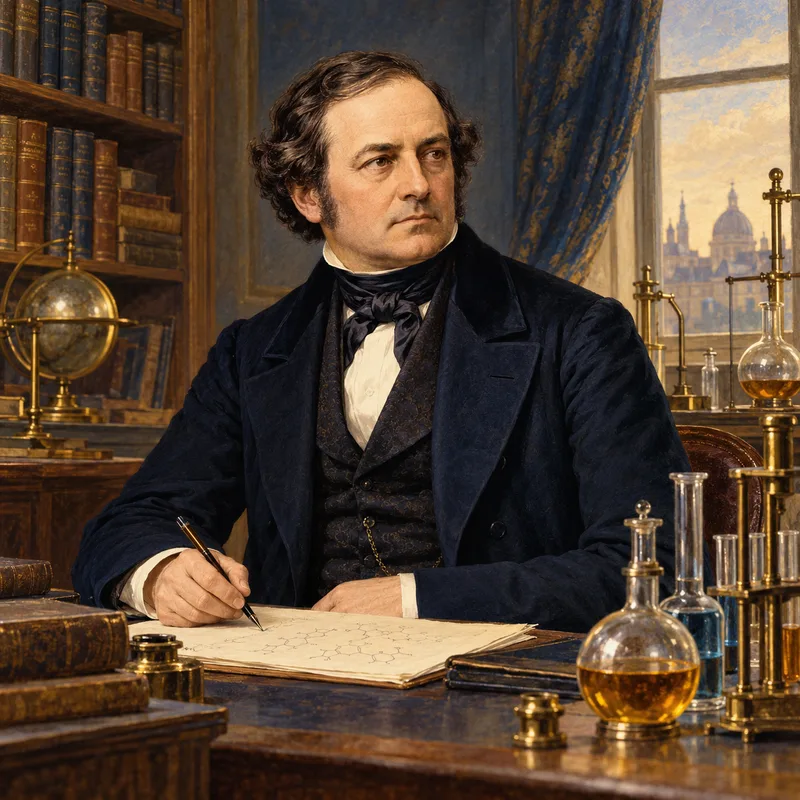
Charles Gerhardt
1816-1856 · France
Type theory; acid anhydrides