The discovery, explained · Chemist no. 246 of 350
Charles Gerhardt: Acid Anhydrides, Types and the First Aspirin
When you prepare aspirin in a practical class by heating salicylic acid with acetic anhydride, you are following a path first opened by the French chemist Charles Frederic Gerhardt (1816-1856). In 1852 Gerhardt discovered the acid anhydrides, a family of compounds that includes acetic anhydride, and he soon used them to make acetylsalicylic acid. He also introduced the idea of homologous series, proposed the type theory that organised organic compounds, and corrected the atomic weights used for organic formulas. His work helped to give organic chemistry a system. This post describes the situation before him, his experiments in order, the concepts and the exam facts.
The Scientific Problem Before the Discovery
In the 1840s organic chemistry was in confusion. Formulas of the same compound were written in several ways because chemists used different atomic weights and different ideas about the water molecule. Berzelius thought that compounds had positive and negative parts, and the radical theory said groups of atoms moved unchanged from one compound to another, but there were too many exceptions.
There was also a specific question about acids. Organic acids such as acetic acid were known, and so were their salts and chlorides, but nobody knew if the "anhydrous acid", the acid with water removed, could exist as a separate substance. By analogy with the oxides of inorganic acids (SO3 from H2SO4), one might expect such compounds, but nobody had made one from a simple monobasic organic acid.
The Discovery / Experiment
1. Homologous series and the correction of formulas (1843-1846)
Gerhardt noticed that organic compounds fall into series in which each member differs from the next by CH2, such as methane, ethane, propane or the fatty acids. He called these homologous series in 1843. He also showed that many formulas in use, based on the value C = 6 and O = 8, were double what they should be for water and carbon dioxide. By using H2O (not HO) and CO2, with C = 12 and O = 16, formulas became consistent and analytical data made sense.
Homologous series (alkanols):  CH3OH, C2H5OH, C3H7OH ...   general formula CnH2n+1OH
Each member differs by CH2 (mass 14)
2. Acid anhydrides (1852)
- Gerhardt prepared acetyl chloride from acetic acid (using phosphorus oxychloride or a related reagent).
- He then reacted acetyl chloride with dry potassium acetate.
- The two combined with loss of potassium chloride, and a new, pungent liquid distilled over. It was acetic anhydride, which does not give a salt with water but reacts slowly to give acetic acid again.
CH3COCl + CH3COOK  ->  (CH3CO)2O + KCl
(CH3CO)2O + H2O    ->  2 CH3COOH
He prepared several other anhydrides, including those of benzoic acid and of mixed acids, showing that the anhydride is a general class: two acid molecules joined with loss of one H2O.
3. Acetylsalicylic acid (1853)
Gerhardt treated sodium salicylate with acetyl chloride and obtained a product he called "acetylsalicylic anhydride". It was an impure and unstable form of what we know as aspirin. He did not test it as a drug and did not pursue it. The pure compound was made by Hoffmann and the Bayer company chemists in 1897. This is why aspirin is credited to Gerhardt as a first synthesis only.
C6H4(OH)COOH + (CH3CO)2O  ->  C6H4(OCOCH3)COOH + CH3COOH
 salicylic acid + acetic anhydride -> aspirin + acetic acid
4. Type theory (1853)
In his "Traite de chimie organique" (1853-1856), Gerhardt grouped organic compounds as derived from four basic types: hydrogen (H2), hydrogen chloride (HCl), water (H2O) and ammonia (NH3). Replacing hydrogen with a group gave other members of the family.
Water type:     H-O-H   ->  CH3CO-O-H (acetic acid),  CH3CO-O-COCH3 (anhydride)
Ammonia type:   H-N-H2  ->  CH3CO-NH2 (acetamide)
HCl type:       H-Cl    ->  CH3CO-Cl (acetyl chloride)
The Chemistry Behind It
The formation of acetic anhydride is a nucleophilic acyl substitution. The acetate ion, a nucleophile, attacks the carbonyl carbon of acetyl chloride. A tetrahedral intermediate forms, and the chloride ion is lost as the best leaving group.
CH3COO(-) + CH3-C(=O)-Cl -> [CH3-C(O-)(Cl)-OCOCH3] -> CH3-C(=O)-O-C(=O)-CH3 + Cl(-)
The order of reactivity of acid derivatives is a favourite exam topic: acid chloride > acid anhydride > ester > amide. Acid chlorides are the most reactive because chloride is a weak base and a good leaving group, and the carbonyl carbon is strongly electrophilic. Amides are the least reactive due to resonance donation from nitrogen.
In aspirin synthesis, the phenolic OH of salicylic acid attacks the anhydride (acid catalysis by H2SO4 or H3PO4 speeds it up). Acetic acid is the by-product. The type theory did not show how atoms are bonded, but it pointed to the idea of a molecule as a pattern of substituents, which led to valence ideas.
Applications Today
- Medicines: Aspirin is made by acetylation of salicylic acid. Paracetamol is made by acetylating p-aminophenol with acetic anhydride, a reaction used in Indian pharma plants.
- Fibres and plastics: Acetic anhydride is used for cellulose acetate, used in photographic film base, cigarette filters and rayon-like fibres.
- Organic synthesis: Anhydrides are used for Friedel-Crafts acylation, protection of alcohols and amines, and making esters and amides.
- Homologous series: The idea is the basis of how we teach alkanes, alcohols and acids.
Exam Corner
- Acetic anhydride from acetyl chloride and sodium (or potassium) acetate: first made by Gerhardt, 1852.
- Reactivity towards nucleophiles: RCOCl > (RCO)2O > RCOOR' > RCONH2.
- Aspirin: salicylic acid + acetic anhydride; the by-product is acetic acid; the test for free phenol with FeCl3 is negative for pure aspirin.
- Homologous series: consecutive members differ by CH2, same functional group, general formula, gradation in physical properties.
- Gerhardt's types: H2, HCl, H2O, NH3.
Common Misconceptions
- "Gerhardt invented aspirin as a medicine." He made an impure acetylsalicylic compound but never tested it. Bayer's team made the pure drug in 1897.
- "Anhydrides are made only by dehydrating acids." Acetic acid does not simply lose water to give the anhydride on heating; reagents like ketene, or acyl chloride with a carboxylate, are used. Dicarboxylic acids such as phthalic or succinic can cyclise by heating.
- "Type theory is the same as structure theory." No. Types described similarity of reactions, not the actual connections of atoms.
Quick Revision Box
- Charles Gerhardt (1816-1856), French chemist from Strasbourg.
- 1843: coined the homologous series; fixed C = 12, O = 16 with H2O.
- 1852: prepared acetic anhydride, CH3COCl + CH3COOK.
- 1853: first (impure) acetylsalicylic acid; type theory in his Traite.
- Four types: hydrogen, hydrogen chloride, water, ammonia.
- Pure aspirin: Bayer, 1897.
FAQ
What is Gerhardt famous for?
He is known for the discovery of acid anhydrides, the type theory, the term homologous series and the first impure preparation of acetylsalicylic acid.
How is acetic anhydride made in the lab by Gerhardt's method?
By heating acetyl chloride with anhydrous sodium or potassium acetate, then distilling the anhydride.
Why are acid chlorides more reactive than anhydrides?
Chloride is a better leaving group than carboxylate, and the carbonyl carbon is more electrophilic, so nucleophiles attack faster.
Did Gerhardt win a Nobel Prize?
No. He died in 1856, long before the Nobel Prizes began in 1901.
Published by ABC Chemistry — IIT-JAM | CSIR-NET | GATE Chemistry Coaching. Visit abcchemistry.com
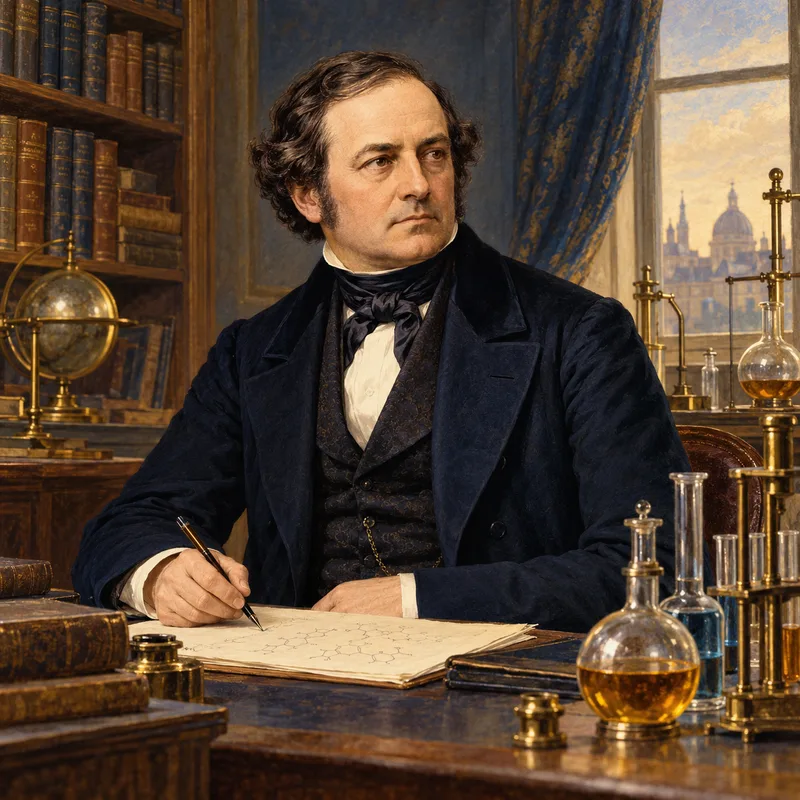
About the chemist
Charles Gerhardt
1816-1856 · France
Type theory; acid anhydrides