Biography · Chemist no. 334 of 350
Charles Goodyear: The Persistent Inventor Who Tamed Rubber
Introduction
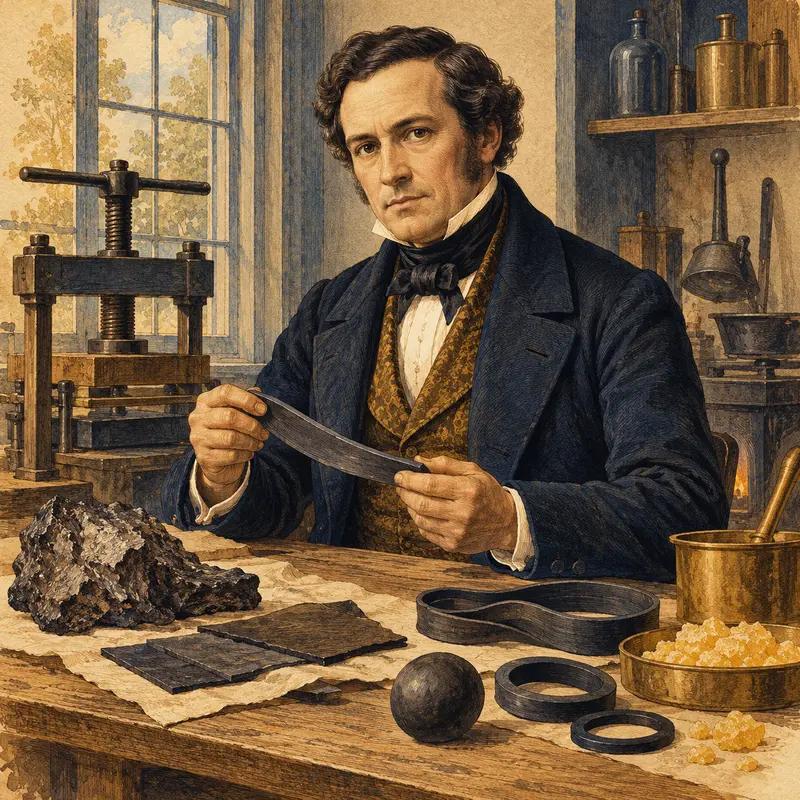
Charles Goodyear (1800–1860) was an American self-taught inventor who discovered the vulcanization of rubber. He was not a trained chemist and he was never rich. He spent most of his adult life in debt and was imprisoned for unpaid bills several times, yet his process created the modern rubber industry. His legacy in one line: persistence turned a failed material into one of the most useful substances of the modern world.
Early Life and Family
Goodyear was born on 29 December 1800 in New Haven, Connecticut. His father, Amasa Goodyear, was an inventor and hardware manufacturer, who made farm tools and buttons, and held a patent for a type of hay fork. Charles was one of several children. As a young man he worked in his father's business and was sent to Philadelphia to learn the hardware trade. In 1824 he married Clarissa Beecher, and the couple had a number of children, though some died young. The family's life was marked by constant money trouble.
Education and Mentors
Goodyear had little formal scientific training, and he had no university degree. His education was the workshop. He learnt about materials by working with metal goods and by trial and error. His father's example taught him to think of invention as a path to income. He had no teacher in chemistry, and in his years of rubber experiments he sometimes asked chemists for help, and relied on the practical help of friends and partners. In his own words, written later, the problem seized his attention and never left it.
Career Timeline
| Year | Event |
|---|---|
| 1800 | Born in New Haven, Connecticut |
| 1820s | Works in the family hardware business; marries Clarissa Beecher in 1824 |
| 1830 | The hardware business fails; he is imprisoned for debt for the first time |
| 1834 | Begins experiments with India rubber after seeing a failed rubber life-preserver |
| 1839 | Observes the effect of heat on rubber and sulphur in Woburn, Massachusetts |
| 1844 | Receives a US patent for vulcanization |
| 1851 | Displays rubber goods at the Great Exhibition in London |
| 1853 | Publishes Gum-Elastic and Its Varieties |
| 1855 | Honoured at the Paris Exposition |
| 1860 | Dies in New York City on 1 July |
Major Scientific Contributions
Vulcanization. Heating natural rubber with sulphur to create cross-links, giving a durable, elastic material. Details of the chemistry are in the companion discovery post.
Hard rubber. Using larger amounts of sulphur gives a hard material later known as ebonite or vulcanite. A related patent was obtained by his brother Nelson Goodyear.
Wide range of products. He made or promoted rubber shoes, clothing, hoses, toys, balls, inflatable boats and even furniture and jewellery. His products were shown at exhibitions to demonstrate how many uses rubber could have. (A famous suit made entirely of rubber is often described in accounts of his life.)
Awards, Honours and Nobel Prize
Goodyear received medals at the Great Exhibition in London (1851) and the Paris Exposition (1855), where he was given the Grand Medal of Honour. Napoleon III also awarded him the Cross of the Legion of Honour, but Goodyear himself was in a debtors' prison in Paris and could not collect it. The Nobel Prize did not exist in his lifetime, as the first prizes were awarded in 1901.
Personality, Struggles and Lesser-Known Facts
- Debtors' prison. He was imprisoned more than once for debts, and at times he pawned household items, including his children's schoolbooks, to pay for experiments.
- Health risks. Rubber fumes and chemicals made him ill during his work. He suffered from frequent illness.
- Patent battles. He spent a large amount of money on lawsuits to defend his patent. In 1852 the famous lawyer Daniel Webster represented him in the case in the case Goodyear v. Day against a rival manufacturer, and the patent was upheld.
- Unusual book. His book on rubber was printed on rubber pages with rubber covers, a copy of which is still preserved.
- Died in debt. When he died in 1860 he owed large sums of money, although his invention had made fortunes for others. Reports say he was heading to see his sick daughter when he fell ill.
Legacy and Influence on Modern Chemistry
Vulcanization is the first major example of changing the properties of a polymer by cross-linking. Long before the theory of polymers existed, it showed that the nature of a material is determined by how its molecules are connected. Natural and synthetic rubbers are still vulcanised in modern industry. The Goodyear Tire and Rubber Company, founded in Akron, Ohio, in 1898, took his name, though he had no connection with it. His story is a favourite example in history-of-chemistry lectures, together with the story of Bakelite and nylon, as proof that polymer science began with practical invention.
Lessons for Students
- Persistence matters. He worked for roughly a decade on one problem under hard conditions.
- Observe carefully. A chance event helps only the prepared mind.
- Record and protect your work. Patent disputes cost him dearly.
- Understand the chemistry. Goodyear had a process without a theory, and later science explained why it worked.
Quick Facts Box
- Born: 29 December 1800, New Haven, Connecticut, USA
- Died: 1 July 1860, New York City
- Nationality: American
- Field: Materials and polymer chemistry (rubber)
- Famous for: Vulcanization of rubber (patent 1844)
- Nobel: None (prize established 1901)
FAQ
Was Charles Goodyear a chemist?
He was a self-taught inventor with no formal chemical training, but his work established an important chemical process.
Did he found the Goodyear tyre company?
No. The company named after him was founded in 1898, decades after his death.
What was the connection with Thomas Hancock?
Hancock in England patented a similar process in 1843 after examining Goodyear's samples. The two men's claims have been debated, but Goodyear is generally credited with the discovery.
Why is he in a list of chemists?
Because vulcanization is a core concept in polymer chemistry and appears in school and university syllabi.
Published by ABC Chemistry — IIT-JAM | CSIR-NET | GATE Chemistry Coaching. Visit abcchemistry.com
About the chemist
Charles Goodyear
1800-1860 · United States
Vulcanization of rubber