The discovery, explained · Chemist no. 334 of 350
Vulcanization: How Charles Goodyear Turned Sticky Rubber into a Useful Material
Every vehicle tyre, rubber band, shoe sole and cricket ball owes something to a discovery made in the 1830s and 1840s by Charles Goodyear: vulcanization. Raw natural rubber is soft and sticky in the heat and brittle and hard in the cold. Goodyear found that heating rubber with sulphur changes it into a material that is elastic, strong and stable over a wide range of temperature. In chemical terms, vulcanization creates cross-links between long polymer chains. It is one of the earliest examples of the deliberate chemical modification of a polymer, and a standard topic in polymer chemistry courses.
The Scientific Problem Before the Discovery
Europeans came to know natural rubber, the latex of the tree Hevea brasiliensis, in the eighteenth century. It was used to rub out pencil marks (hence the name "rubber"), and in the early 1830s rubber shoes and coats from Brazil became fashionable in the United States. The business collapsed quickly. In summer the goods turned into sticky, foul-smelling masses, and in winter they became hard and cracked. Nobody understood why, because the concept of a polymer, a very long molecule, did not exist until the 1920s, when Hermann Staudinger proposed it. Inventors, including Goodyear, tried to cure rubber with magnesia, lime, quicklime, nitric acid and other additives, but no process was reliable.
The Discovery: Step by Step
- Step 1: Years of trials. Goodyear, who was in debt and worked in poor conditions, experimented with many additives to dry the surface of rubber. A nitric acid treatment (the "acid gas" process) improved the surface but not the body of the material.
- Step 2: Sulphur. In the late 1830s he mixed rubber with sulphur. The mixture was better but still not satisfactory at first.
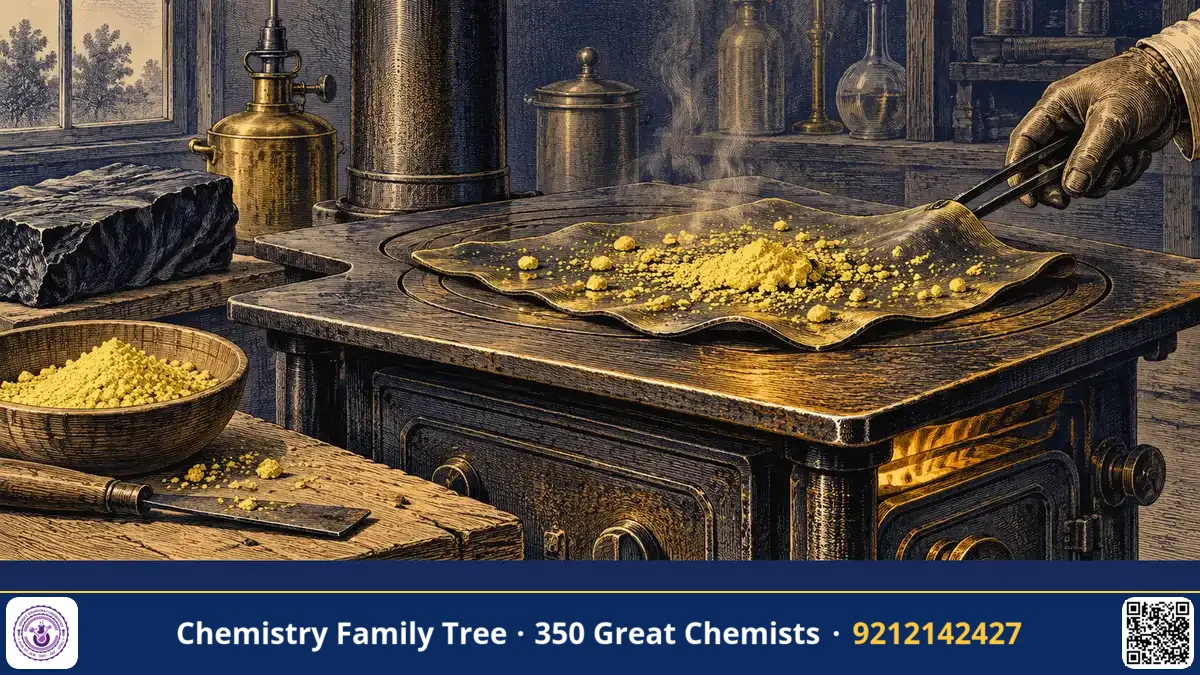
- Step 3: Accidental heating (1839). According to Goodyear's own later account, in Woburn, Massachusetts, he dropped a piece of rubber mixed with sulphur (and a white lead pigment) onto a hot stove. Instead of melting, it charred like leather, with a dry, elastic edge.
- Step 4: Systematic work. He realised that heat plus sulphur was the key and found that the right temperature and time gave a uniform cured product. In 1844 he received a US patent for the process.
The name "vulcanization" was given later, reportedly by the English inventor Thomas Hancock's associate William Brockedon, after Vulcan, the Roman god of fire. Hancock himself had examined samples of Goodyear's rubber and obtained a British patent in 1843, before Goodyear's, which led to a long dispute. Goodyear is nevertheless credited as the discoverer.
The Chemistry Behind It
Natural rubber is mainly cis-1,4-polyisoprene, a polymer of isoprene (2-methylbuta-1,3-diene), with molar mass of hundreds of thousands of g/mol.
n CH₂=C(CH₃)–CH=CH₂ → [–CH₂–C(CH₃)=CH–CH₂–]n (cis-1,4-polyisoprene)
The long chains are coiled and can slip past each other when stretched or heated, which is why raw rubber flows and deforms permanently. During vulcanization, sulphur reacts at the C=C double bonds and at the allylic positions (the CH₂ next to the double bond), forming sulphur bridges between neighbouring chains:
chain–CH₂–C(CH₃)=CH–CH(–S–Sₓ–S–)–chain' (mono-, di- and polysulphide cross-links)
This creates a three-dimensional network. When rubber is stretched, the chains are pulled out of their random coils, and the cross-links prevent them from sliding apart. When the force is released, entropy drives the chains back into coils and the rubber snaps back. This is called entropic elasticity.
| Sulphur content | Product | Properties |
|---|---|---|
| Nil | Raw rubber | Sticky, soft, weak |
| About 1 to 3 per cent | Soft vulcanised rubber | Elastic, strong, used for tyres, bands |
| About 25 to 40 per cent | Ebonite (hard rubber) | Hard, rigid, insulating |
Pure sulphur vulcanization is slow and takes hours. Modern processes use accelerators (for example organic sulphur compounds such as mercaptobenzothiazole) and activators (zinc oxide with stearic acid), which reduce the time to minutes. Fillers such as carbon black strengthen tyre rubber, and antioxidants protect against ozone and ageing. Aniline as an accelerator was introduced in the early twentieth century, and George Oenslager's work is well known in this connection.
Applications Today
- Tyres. The largest use of rubber. Tyres of bicycles, scooters, cars, trucks and aircraft are vulcanised and reinforced.
- Industrial goods. Hoses, belts, gaskets, seals, conveyor belts and shock absorbers.
- Consumer goods. Footwear, balloons, gloves, sports balls and erasers.
- Ebonite. Used for battery cases, electrical insulation and old-style fountain pen bodies.
- Indian context. India is one of the world's major producers of natural rubber, mainly from Kerala, and the Rubber Board is based at Kottayam. Rubber goods and tyre manufacture is a big Indian industry.
Exam Corner
- Vulcanization is the heating of natural rubber with sulphur (1 to 3 per cent) to introduce S–S cross-links between chains.
- Natural rubber is cis-1,4-polyisoprene; gutta-percha is the trans isomer and is hard and non-elastic.
- Ebonite contains a large proportion of sulphur (about 25 to 40 per cent).
- Neoprene is a polymer of chloroprene; Buna-S is a copolymer of butadiene and styrene (SBR); both are synthetic rubbers.
- Accelerators and ZnO speed up vulcanization; carbon black improves strength and abrasion resistance.
Common Misconceptions
- "Vulcanization is just melting rubber." It is a chemical reaction that forms new covalent bonds, and the product cannot be remelted like a thermoplastic.
- "More sulphur always gives better rubber." Too much makes the rubber hard and brittle (ebonite).
- "Goodyear Tyre Company was founded by Charles Goodyear." No. The company was founded in 1898, long after his death, and named in his honour.
Quick Revision Box
- Discovered about 1839; patent 1844.
- Natural rubber: cis-1,4-polyisoprene.
- Vulcanization: sulphur cross-links (–S–, –S–S–, –Sₓ–).
- Elasticity is entropic.
- Ebonite: heavily sulphured hard rubber.
- Accelerators: ZnO, benzothiazoles; filler: carbon black.
FAQ
Was vulcanization really an accident?
Goodyear's account says the key observation, rubber and sulphur on a hot stove, was accidental. But he had worked for years on the problem, and he followed up systematically.
Who else claimed the invention?
Thomas Hancock in England patented a similar process in 1843, and Nathaniel Hayward in the US had worked on sulphur-treated rubber earlier. Goodyear's patent was upheld in the United States.
Why is vulcanised rubber not recyclable like plastic?
The cross-linked network is thermoset. It does not melt, so recycling needs grinding or devulcanization processes.
What is the difference between natural and synthetic rubber?
Natural rubber comes from latex and is polyisoprene. Synthetic rubbers, such as SBR and neoprene, are made from petrochemical monomers.
Published by ABC Chemistry — IIT-JAM | CSIR-NET | GATE Chemistry Coaching. Visit abcchemistry.com
About the chemist
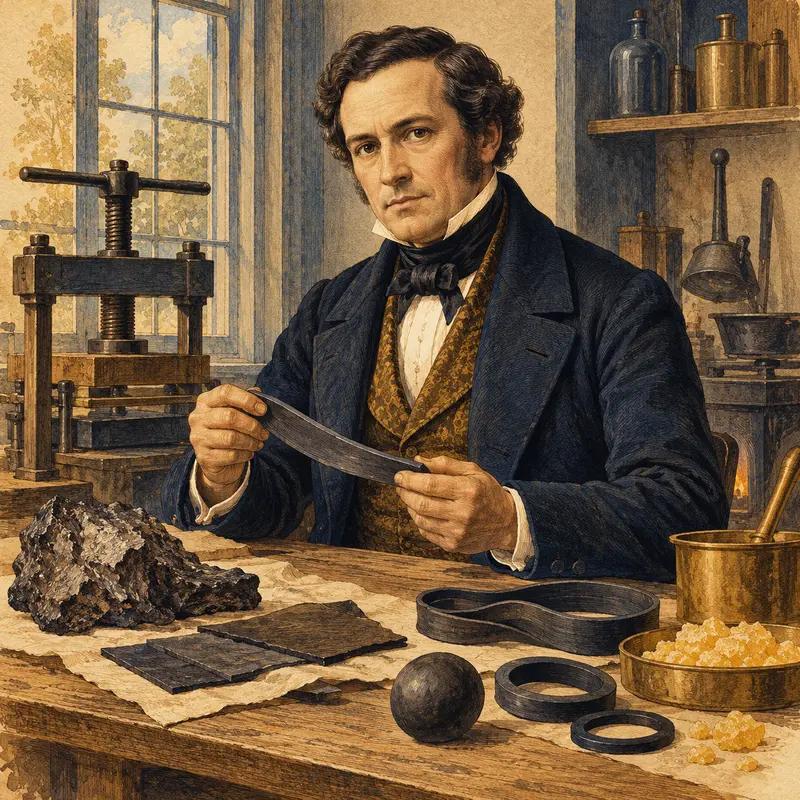
Charles Goodyear
1800-1860 · United States
Vulcanization of rubber