Biography · Chemist no. 335 of 350
Charles Martin Hall: The Young Chemist Who Made Aluminium Affordable
Introduction
Charles Martin Hall (1863–1914) was an American chemist and industrialist who, at the age of 22, discovered the electrolytic process for producing aluminium. The method, found independently by Paul Héroult in France, made aluminium from a luxury metal into an everyday material. Hall became wealthy as a founder of the company that became Alcoa, but he lived modestly and left most of his fortune to education. His legacy in one line: a student's experiment in a woodshed changed the metal industry of the world.
Early Life and Family
Hall was born on 6 December 1863 in Thompson, Ohio, the youngest son of a Congregational minister, Heman Bassett Hall, and his wife Sophronia Brooks Hall. The family moved to Oberlin, Ohio, when he was a boy, so that the children could be educated there. His elder sister Julia became his closest supporter, helping him in the experiments, and she continued to look after his interests all her life.
Education and Mentors
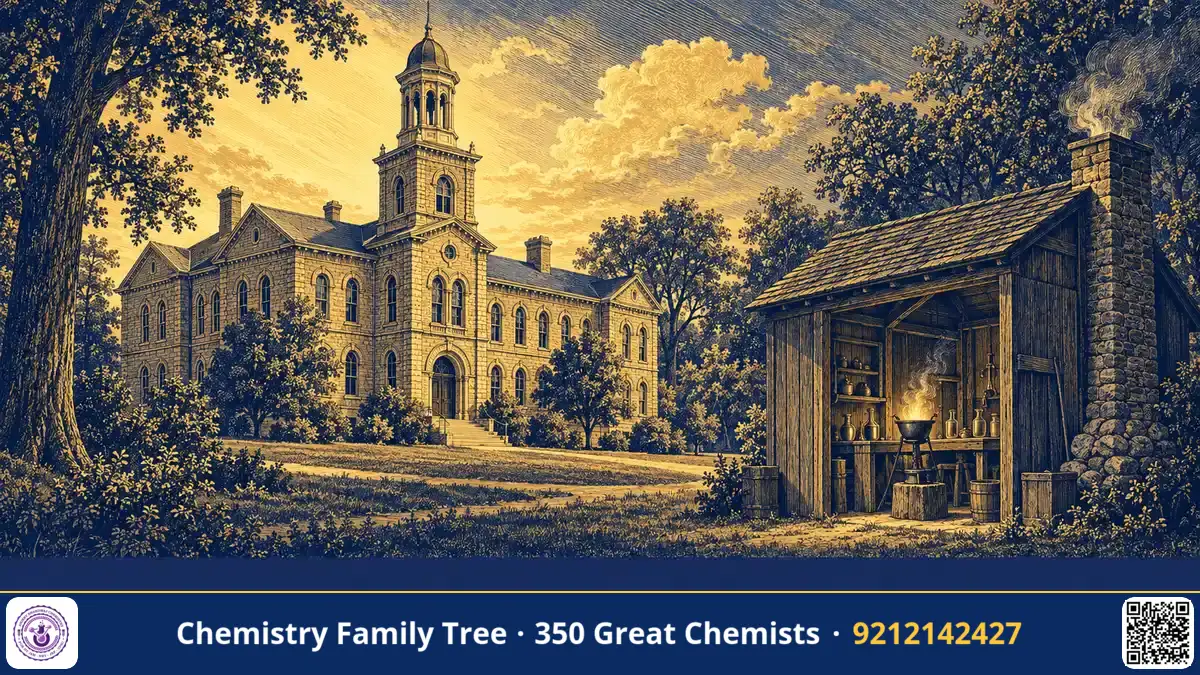
He entered Oberlin College in 1880, where he studied under Professor Frank Fanning Jewett, who had studied in Germany under Friedrich Wöhler, the man who first isolated aluminium. Jewett showed his class a small sample of aluminium and told them that whoever discovered a cheap method of making it would become rich and would benefit the world. Hall, who was a bright and determined student, decided to attempt it. He graduated with a BA in 1885, and then continued his experiments at home in a woodshed laboratory with Julia.
Career Timeline
| Year | Event |
|---|---|
| 1863 | Born in Thompson, Ohio |
| 1880 | Enters Oberlin College |
| 1885 | Graduates from Oberlin |
| 1886 | Obtains aluminium by electrolysis (February) |
| 1888 | Pittsburgh Reduction Company founded with his involvement |
| 1889 | US patent granted |
| 1907 | Company renamed Aluminum Company of America (Alcoa) in 1907 |
| 1911 | Awarded the Perkin Medal |
| 1914 | Dies in Daytona, Florida, on 27 December |
Major Scientific Contributions
Electrolytic reduction of alumina. Hall found that alumina dissolved in molten cryolite could be electrolysed to give aluminium, which became the Hall-Heroult process. See the companion discovery post for the reactions and the cell.
Industrial development. He worked on improving the process after 1888: better furnaces, electrodes and materials. He also developed ways to make the process commercially reliable, and the price of aluminium dropped from about 8 dollars per pound in the 1880s to well under a dollar by the early 1900s (approximate figures from many historical accounts).
Patents. He held a number of patents related to aluminium production.
Awards, Honours and Nobel Prize
Hall received the Perkin Medal of the Society of Chemical Industry (American section) in 1911, one of the major honours in industrial chemistry. In later life he was a trustee of Oberlin College. He did not receive a Nobel Prize. The Nobel Prizes were created in 1901 and electrolytic aluminium was not recognised by them.
Personality, Struggles and Lesser-Known Facts
- Same year, same discovery. Paul Héroult, born in the same year (1863) and dying in the same year (1914), made the same discovery in 1886. This remarkable coincidence is often mentioned in textbooks.
- Family workshop. His sister Julia assisted him with the experiments, took notes and defended his priority in later years.
- Early Alcoa difficulties. The first years of the company were tough. Investors were wary, and the first successful plant came with backing from the Mellon family of Pittsburgh. Even so, the early product was costly to produce.
- A quiet bachelor. He never married. His main interests were chemistry, music and collecting minerals and he lived simply.
- Generous will. He left a large share of his estate, a few million dollars, to educational institutions, including Oberlin College, and to the cause of education abroad, including missions and schools.
- Surviving first globules. The first small aluminium buttons he obtained are preserved, and are displayed at institutions in the USA.
Legacy and Influence on Modern Chemistry
Almost all primary aluminium made today, tens of millions of tonnes each year, is produced by the Hall-Heroult process. Aluminium has transformed aircraft, packaging, power transmission and construction. The process is a model example in electrochemistry: Faraday's laws, electrode reactions, molten salt electrolysis and the use of a flux to lower melting point. In India, plants of NALCO and others operate on the same principle. Today's research aims at reducing the energy consumption and carbon emissions of aluminium smelting, for example through inert anodes that give O₂ rather than CO₂.
Lessons for Students
- A good teacher's remark can set a life's direction. Be open to challenges.
- Great discoveries do not need large laboratories. A good idea and patient work are enough.
- Use theory. Hall chose cryolite as solvent because he understood solubility and melting point depression.
- Give back. He devoted his wealth to education.
Quick Facts Box
- Born: 6 December 1863, Thompson, Ohio, USA
- Died: 27 December 1914, Daytona, Florida
- Nationality: American
- Field: Electrochemistry, metallurgy
- Famous for: Hall-Heroult process for aluminium
- Nobel: None
FAQ
Who discovered the process first, Hall or Héroult?
Both found it independently in 1886. Héroult filed his French patent in April; Hall obtained his results in February and filed in July. The credit is shared.
What is Alcoa?
The Aluminum Company of America, which grew from the Pittsburgh Reduction Company founded in 1888.
Where did Hall do his first experiments?
In a woodshed laboratory at his family home in Oberlin, Ohio.
Why is this important for exams?
Questions on extraction of aluminium, electrode reactions and the role of cryolite are very common in school boards, JAM and GATE.
Published by ABC Chemistry — IIT-JAM | CSIR-NET | GATE Chemistry Coaching. Visit abcchemistry.com

About the chemist
Charles Martin Hall
1863-1914 · United States
Hall-Héroult aluminium electrolysis