The discovery, explained · Chemist no. 335 of 350
The Hall-Heroult Process: How Electrolysis Made Aluminium Cheap
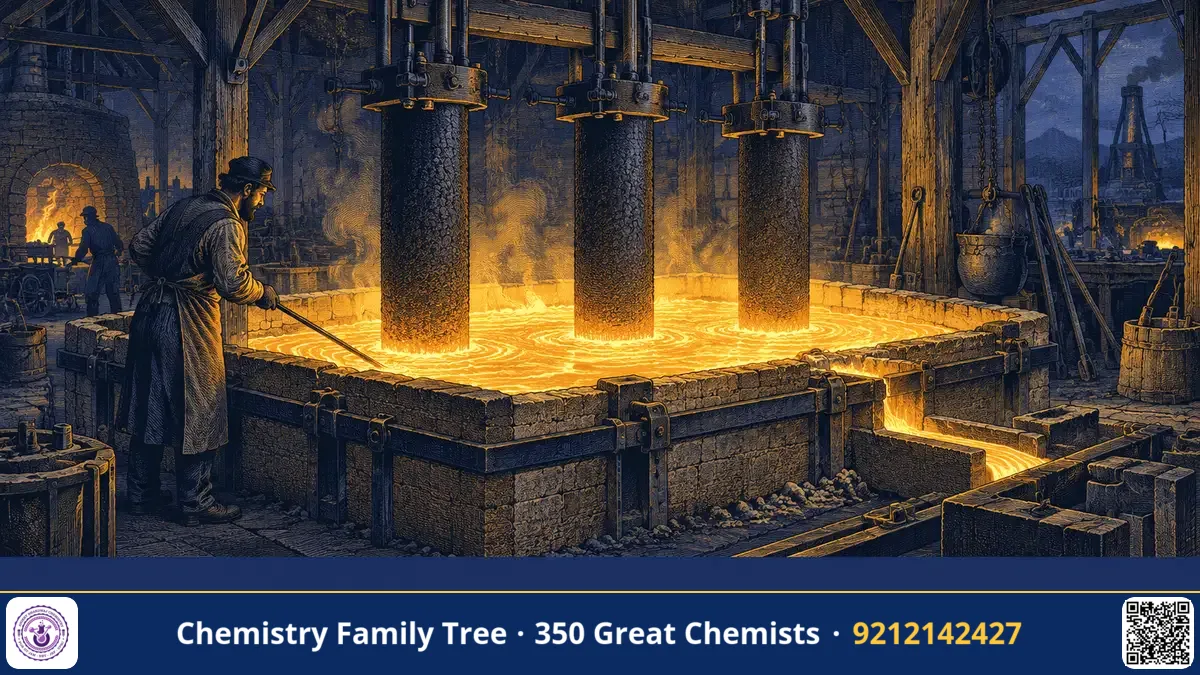
In the 1850s, aluminium was more precious than gold. Napoleon III is said to have served his most honoured guests with aluminium cutlery, while lesser guests used gold. Then, in 1886, two young men on two continents, working independently and within a few months of each other, found how to extract the metal cheaply by electrolysis. They were Charles Martin Hall in Ohio, USA, and Paul Héroult in France. The method, called the Hall-Heroult process, is still the only major industrial route to primary aluminium. It is also a favourite topic in exams on metallurgy and electrochemistry.
The Scientific Problem Before the Discovery
Aluminium is the most abundant metal in the Earth's crust (about 8 per cent by mass), but it never occurs free. It is present as aluminosilicates and as bauxite, hydrated aluminium oxide. The metal is highly electropositive and forms a very stable oxide (ΔG°f of Al₂O₃ is large and negative), so carbon cannot reduce it at practical temperatures. Electrolysis of aqueous solutions fails because water is reduced in preference to Al³⁺, giving hydrogen instead of aluminium.
Friedrich Wöhler had isolated aluminium in 1827 and Henri Sainte-Claire Deville had developed a chemical method in 1854, which used sodium to reduce aluminium chloride (AlCl₃ + 3Na → Al + 3NaCl). The process worked but sodium was expensive, and the price of aluminium stayed very high. Alumina (Al₂O₃) melts at about 2072 °C, too high for direct electrolysis. A new idea was needed.
The Discovery: Step by Step
Hall was a young graduate of Oberlin College, Ohio. His teacher, Frank Fanning Jewett, had remarked that anyone who could find a cheap way to make aluminium would become rich and a benefactor of humanity. Hall took this as a challenge.
- Step 1: Find a solvent for alumina. He searched for a molten salt that would dissolve alumina at a moderate temperature. He found that cryolite (Na₃AlF₆) dissolves alumina well when molten at around 1000 °C.
- Step 2: Build a cell. In a woodshed laboratory behind his family home, he used a clay crucible lined with carbon, carbon electrodes, a furnace and a home-made battery.
- Step 3: Electrolyse. Passing a direct current through the molten mixture he obtained small globules of aluminium on 23 February 1886 (the date is given in most accounts).
- Step 4: Patent and scale up. He applied for a patent in 1886, which was granted in 1889, and in 1888 he helped to start the Pittsburgh Reduction Company, which later became the Aluminum Company of America (Alcoa).
Héroult applied for his French patent in April 1886 and had come to the same method independently. This is why it is called the Hall-Heroult process.
The Chemistry Behind It
The electrolyte is a molten mixture of purified alumina (3 to 5 per cent) in cryolite, usually with added fluorides like AlF₃ and CaF₂ to lower the melting point and improve conductivity. The cell operates at about 950 to 980 °C, in a steel box lined with carbon, which is the cathode. Large carbon blocks dipping into the melt act as anodes.
Cathode (reduction):   Al³⁺ + 3e⁻ → Al(l)
Anode (oxidation):     2O²⁻ + C → CO₂ + 4e⁻     (also some CO)
Overall:               2Al₂O₃ + 3C → 4Al + 3CO₂
Molten aluminium is denser than the electrolyte, so it collects at the bottom of the cell and is siphoned off. Oxygen released at the anode reacts with the carbon to form CO₂, so the anodes burn away and must be replaced regularly. The process needs about 13 to 15 kWh of electricity per kilogram of aluminium, which is why aluminium smelters are placed near cheap power.
| Step | Process | Purpose |
|---|---|---|
| 1 | Bayer process | Purify bauxite to pure alumina |
| 2 | Hall-Heroult electrolysis | Reduce alumina to aluminium |
| 3 | Refining (Hoopes or fractional crystallisation) | Obtain ultra-pure aluminium if needed |
The Bayer process (Karl Josef Bayer, 1887–1888) first dissolves alumina from bauxite in hot concentrated NaOH, leaving behind the iron oxide residue called red mud: Al₂O₃·xH₂O + 2NaOH + 3H₂O → 2Na[Al(OH)₄]. On cooling and seeding, Al(OH)₃ precipitates, and is heated to give pure alumina: 2Al(OH)₃ → Al₂O₃ + 3H₂O.
Applications Today
- Transport. Aluminium alloys are used in aircraft, cars, trains and ships because of their low density (2.7 g/cm³) and good strength.
- Packaging. Foils, cans and containers.
- Electrical. Overhead transmission cables, because aluminium is a good conductor and light.
- Construction. Window frames, roofing and building panels.
- Indian context. India produces aluminium at smelters in states such as Odisha, Jharkhand, Chhattisgarh and Uttar Pradesh, drawing on large bauxite reserves in Odisha and Andhra Pradesh. Companies like NALCO, Hindalco and Vedanta operate in this sector.
- Environment. Recycling aluminium needs only a small part of the energy of primary production. The process also emits perfluorocarbons (CF₄, C₂F₆) during anode effects, and red mud disposal is an issue.
Exam Corner
- Cryolite Na₃AlF₆ lowers the melting point of the electrolyte (from about 2000 °C to about 950 °C), dissolves alumina and increases conductivity.
- Cathode: Al³⁺ + 3e⁻ → Al; anode: carbon burns to CO and CO₂.
- Bauxite is purified by the Bayer process; red mud contains Fe₂O₃.
- Aluminium cannot be extracted by carbon reduction or by electrolysis of aqueous solution.
- Hoope's process is used for electrolytic refining of aluminium using three layers of molten material.
Common Misconceptions
- "Cryolite is the source of aluminium." It is only the solvent and flux. Aluminium comes from alumina.
- "Hall alone invented the process." Héroult discovered it independently. Both are credited.
- "The anodes are inert." Carbon anodes are consumed during the process.
Quick Revision Box
- Discovered in 1886 by Hall (USA) and Héroult (France).
- Electrolyte: Al₂O₃ dissolved in molten cryolite at about 950 °C.
- Cathode: Al³⁺ + 3e⁻ → Al.
- Anode: carbon consumed, giving CO₂ and CO.
- Bauxite purified by Bayer process.
- Energy intensive: about 13 to 15 kWh per kg.
FAQ
Why not electrolyse molten alumina directly?
Alumina melts at over 2000 °C, which is costly and hard to handle. Dissolving it in cryolite allows operation near 950 °C.
Why not aqueous electrolysis?
Water is reduced more easily than Al³⁺, so hydrogen would be formed at the cathode.
Why is aluminium production so electricity-intensive?
The Al–O bond is very strong, and 3 moles of electrons are needed per mole of aluminium (Faraday's laws).
How much aluminium can 1 faraday deposit?
One faraday (96,500 C) deposits 9 g of aluminium (27 g divided by 3).
Published by ABC Chemistry — IIT-JAM | CSIR-NET | GATE Chemistry Coaching. Visit abcchemistry.com

About the chemist
Charles Martin Hall
1863-1914 · United States
Hall-Héroult aluminium electrolysis