Biography · Chemist no. 91 of 350
Charles J. Pedersen (1904-1989): The Industrial Chemist Who Found the Molecular Crown
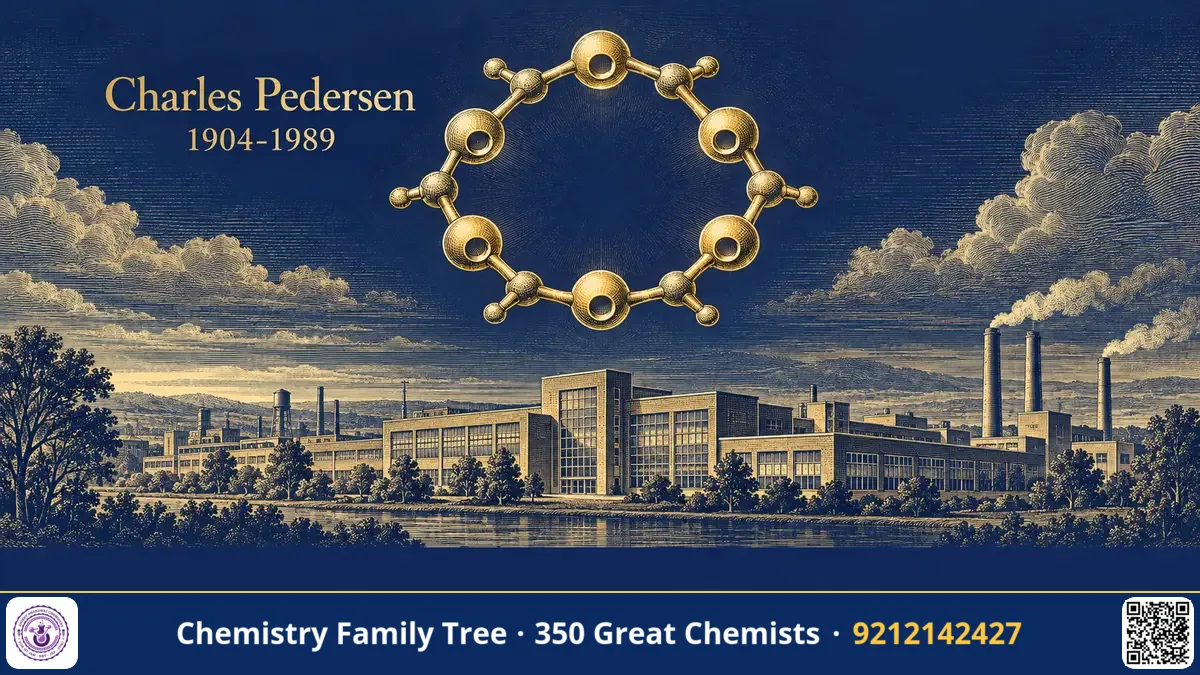
Charles John Pedersen was a chemist who spent his whole working life as an industrial researcher at the DuPont company in the United States, and who still won a Nobel Prize. He discovered crown ethers in 1967, at the age of 63, when he noticed an unexpected by-product in one of his reactions. His legacy in one line: he opened the field of host-guest chemistry, and proved that careful curiosity about an "accident" can be worth more than a planned experiment. He shared the 1987 Nobel Prize in Chemistry with Donald Cram and Jean-Marie Lehn.
Early Life & Family
Pedersen was born on 3 October 1904 in Busan (then spelled Fusan), Korea. His father, Brede Pedersen, was a Norwegian engineer who worked in Korea, and his mother, Takino Yasui, was Japanese. This mix of Norwegian, Japanese and Korean surroundings made his childhood unusual for the time. As a child he lived in Korea, and at about the age of eight he was sent to Japan to attend school, first in Nagasaki and then at a Catholic school in Yokohama, St. Joseph College, where lessons were taught in English. This international education gave him a good command of English, which became important when he later moved to the United States. Even as a young boy, he had a taste for practical science and technology, and he decided that he wanted to study in America.
Education & Mentors
Pedersen went to the United States to study chemical engineering at the University of Dayton in Ohio, where he received his bachelor's degree in 1926. He then moved to the Massachusetts Institute of Technology (MIT) and earned a master's degree in organic chemistry in 1927. He had planned to go on to a doctorate, but he was offered a job at the DuPont company and decided to accept it. He therefore never earned a PhD, which makes him one of the very few Nobel Prize winners in science without a doctoral degree. The self-taught habits he gained in industry, such as careful notebook keeping and reading the literature widely, served him well for the next forty years.
Career Timeline
| Year | Event |
|---|---|
| 1904 | Born in Busan, Korea (3 October) |
| c. 1912 | Sent to Japan for schooling (Nagasaki, then Yokohama) |
| 1926 | Bachelor's degree in chemical engineering, University of Dayton |
| 1927 | Master's degree in organic chemistry, MIT; joins DuPont at the Jackson Laboratory in New Jersey |
| 1930s-1950s | Works on antioxidants, metal deactivators and polymer-related chemistry; obtains many patents |
| 1960s | Studies vanadium and copper complexes and ligands |
| 1967 | Discovers dibenzo-18-crown-6 and publishes the first papers on crown ethers |
| 1969 | Retires from DuPont |
| 1987 | Nobel Prize in Chemistry, at age 83 |
| 1989 | Dies in Salem, New Jersey (26 October) |
Major Scientific Contributions
- Crown ethers: the discovery of macrocyclic polyethers that bind alkali metal and ammonium cations, with selectivity based on size.
- Systematic study of the family: he made dozens of crown ethers of different ring sizes and studied their complexes with metal salts.
- Industrial chemistry: he developed additives, such as metal deactivators and antioxidants, that improve the stability of petroleum products and rubber.
- Foundation of host-guest chemistry: the work led others, notably Cram and Lehn, to design more complex hosts.
The reaction, the selectivity table and the applications are covered in the companion discovery blog on crown ethers.
Awards, Honours & Nobel Prize
The Nobel Prize in Chemistry 1987 was awarded jointly to Donald J. Cram, Jean-Marie Lehn and Charles J. Pedersen "for their development and use of molecules with structure-specific interactions of high selectivity". Pedersen was 83 years old when he received it, and he was one of the oldest chemistry laureates of his time. He was the only one of the three who had spent his whole career in industry.
Personality, Struggles & Lesser-Known Facts
- He was born in Korea to a Norwegian father and a Japanese mother, studied in Japan and finally built his career in the United States. His life crossed four countries.
- His discovery came from an impure starting material. The catechol he used contained some unprotected catechol, which allowed the ring to close in about 0.4% yield. A careless chemist might have discarded the sticky mixture.
- He noticed that the white crystals dissolved in methanol only when sodium hydroxide was added, and he followed up on that small oddity until he understood it.
- He wrote his first papers on crown ethers while still working in industry, not in a university.
- He retired in 1969 but continued to be interested in crown ethers. He saw his discovery grow into a worldwide research field.
Legacy & Influence on Modern Chemistry
Crown ethers are now standard reagents in organic and inorganic chemistry. They make it possible to dissolve salts in organic solvents and to generate reactive "naked" anions. They are the structural ancestors of cryptands, calixarenes, cavitands and many receptors for ions and organic molecules. Ion sensors in medical laboratories, phase-transfer catalysts in industry and separation methods for metals all use the same principle of selective binding. Pedersen's discovery also shows that industrial laboratories can generate fundamental science. For students in India, where many chemists work in industry and pharmaceutical research, his career is an encouraging example.
Lessons for Students
- Study your by-products. An unexpected result can be a discovery.
- Follow up systematically. After the first surprise, Pedersen made many related compounds to understand the effect.
- Do not wait for a PhD or a famous institution to do good science.
- Stay curious for life. He made his famous discovery in his sixties.
Quick Facts Box
- Born: 3 October 1904, Busan, Korea
- Died: 26 October 1989, Salem, New Jersey, USA
- Nationality: American (born in Korea to a Norwegian father and Japanese mother)
- Field: Organic and industrial chemistry
- Famous for: Discovery of crown ethers (dibenzo-18-crown-6)
- Nobel Prize: Chemistry, 1987 (with D. J. Cram and J.-M. Lehn)
FAQ
Did Pedersen have a PhD?
No. He had a master's degree from MIT and went straight into industry at DuPont.
Where was Pedersen born?
In Busan, Korea, to a Norwegian father and a Japanese mother.
How old was he when he won the Nobel Prize?
He was 83 years old in 1987.
Why are they called crown ethers?
Because molecular models of the ring holding a metal ion look like a crown resting on a head.
Published by ABC Chemistry — IIT-JAM | CSIR-NET | GATE Chemistry Coaching. Visit abcchemistry.com
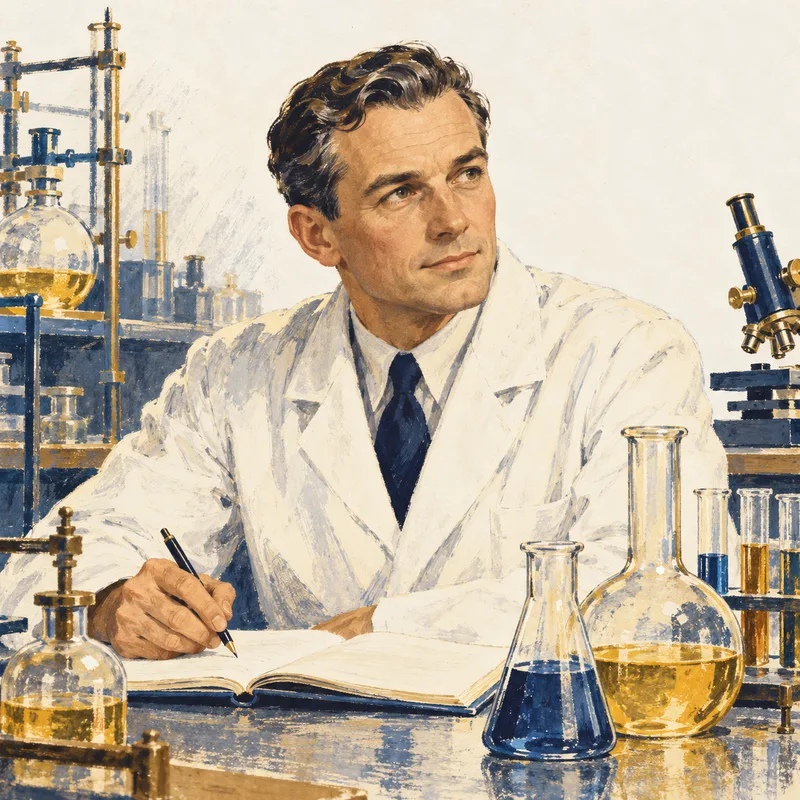
About the chemist
Charles Pedersen
1904-1989 · United States · Nobel Chemistry 1987
Discovery of crown ethers