The discovery, explained · Chemist no. 91 of 350
Crown Ethers: Charles Pedersen's Accidental Discovery of Molecules That Wear Ions Like Jewels
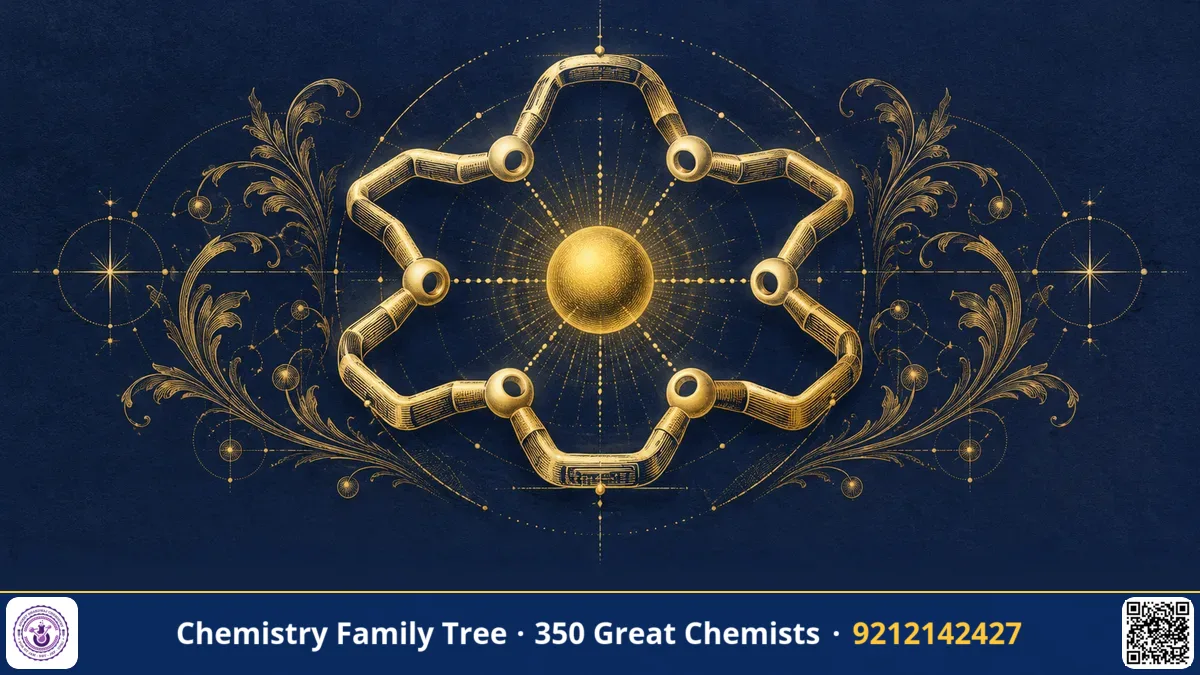
Some of the best discoveries in science start with an unwanted by-product. In 1967 Charles Pedersen, an industrial chemist at the DuPont company in the United States, was trying to prepare a ligand for a catalyst. At the end of the reaction he found a small amount of white, fibrous crystals that he had not expected. Instead of throwing them away, he investigated them carefully. They turned out to be the first crown ether: a ring of repeated -CH2CH2O- units that can hold a metal ion in its centre, like a crown on a head. This discovery started the field of host-guest chemistry and, in 1987, earned Pedersen a share of the Nobel Prize in Chemistry with Donald Cram and Jean-Marie Lehn. This blog explains how it happened and the chemistry that follows.
The Scientific Problem Before the Discovery
Before 1967, chemists knew that ionic salts such as KMnO4, KF or NaOH dissolve in water but not in non-polar organic solvents such as benzene or toluene. The reason is that water molecules solvate the ions (ion-dipole interactions), but non-polar solvents cannot. This is a practical problem, because many organic reactions need an anion as a reagent, while the organic substrate dissolves only in an organic solvent.
Nature had solved the problem of carrying ions across non-polar membranes. Antibiotics such as valinomycin and nonactin wrap around K+ and carry it through the fatty membrane of a cell. But these natural carriers were large and complex. Chemists did not know that a simple synthetic molecule could do the same.
The Discovery / Experiment — Step by Step
- The goal. Pedersen was studying vanadium complexes and wanted to make a bisphenol ligand, bis[2-(o-hydroxyphenoxy)ethyl] ether. For this, he reacted catechol (1,2-dihydroxybenzene), with one hydroxyl group protected as a tetrahydropyranyl (THP) ether, with bis(2-chloroethyl) ether and sodium hydroxide.
- The impurity. The catechol used contained a little unprotected catechol, so both hydroxyl groups of some molecules could react. This allowed a ring to close in a small fraction of the material.
- The by-product. After the reaction, Pedersen obtained a sticky, unattractive product mixture. From it he isolated about 0.4% of white crystals that were poorly soluble in methanol.
- The surprise. When he added sodium hydroxide to the methanol, the crystals dissolved. Adding other sodium salts also helped. This was strange for a neutral organic compound. He concluded that the compound was binding sodium ions, and the resulting complex was more soluble.
- Structure proof. He used the ultraviolet spectrum, which changed on adding sodium, and elemental analysis and other tests to show that the compound was a cyclic polyether: dibenzo-18-crown-6.
2 C6H4(OH)2 + 2 O(CH2CH2Cl)2 + 4 NaOH → dibenzo-18-crown-6 + 4 NaCl + 4 H2O
Crown + M+ ⇌ [Crown·M]+
Pedersen then worked fast. Over the next months he prepared dozens of related macrocyclic polyethers with ring sizes from 9 to 60 atoms and with 3 to 20 oxygen atoms. He published the results in two papers in the Journal of the American Chemical Society in 1967. He used the term "crown" because the molecular models look like a crown sitting on the metal ion.
The Chemistry Behind It
Naming
The name 18-crown-6 tells us that the ring has 18 atoms in total and 6 of them are oxygen atoms. So 12-crown-4 has 12 atoms (4 oxygens), and 15-crown-5 has 15 atoms (5 oxygens). The prefix "dibenzo" shows two benzene rings fused to the ring.
Size-fit selectivity
The oxygen atoms point their lone pairs towards the centre of the ring. The metal ion sits in the cavity, held by ion-dipole attractions with all the oxygens. The binding is strongest when the ion diameter matches the cavity.
| Crown ether | Cavity diameter (approx.) | Best-fitting cation (ionic diameter) |
|---|---|---|
| 12-crown-4 | 1.2 to 1.5 Å | Li+ (about 1.5 Å) |
| 15-crown-5 | 1.7 to 2.2 Å | Na+ (about 2.0 Å) |
| 18-crown-6 | 2.6 to 3.2 Å | K+ (about 2.8 Å) |
Ions that are too small rattle in the cavity and bind weakly, while ions that are too large cannot enter. In addition to alkali metals, 18-crown-6 binds ammonium ions (NH4+) and alkylammonium ions (RNH3+) through three N-H···O hydrogen bonds.
Why do crown ethers solubilise salts in organic solvents?
When 18-crown-6 binds K+, the ion is wrapped inside and the outside of the complex is a hydrocarbon surface (CH2 groups). The complex is therefore soluble in non-polar solvents. The counter-anion is carried with it, but it is poorly solvated, so it is very reactive. This is called a "naked anion". For example, KF with 18-crown-6 in acetonitrile or benzene is a strong nucleophile, and KMnO4 with 18-crown-6 dissolves in benzene to make the "purple benzene" oxidising solution.
Template effect
Crown ethers are made efficiently when the metal ion acts as a template. In the synthesis of 18-crown-6 from triethylene glycol and the corresponding dichloride with KOH, the K+ ion organises the chain around itself so that the ring closes in high yield.
Applications Today
- Phase-transfer catalysis: bringing ionic reagents into organic phases for substitution, oxidation and elimination reactions. Related quaternary ammonium salts are widely used in Indian pharmaceutical and fine-chemical industries.
- Ion-selective electrodes and sensors: crown ether derivatives in membranes detect K+ and Na+ in clinical analysis.
- Separation of isotopes and metals: crown ethers are used in solvent extraction of strontium, caesium and other ions from solutions, including studies on nuclear waste.
- Organic synthesis: activating anions such as F-, CN- and OH- for reactions in non-polar solvents.
- Chiral recognition and supramolecular chemistry: crown ethers are the starting point of Cram's chiral hosts and Lehn's cryptands.
Exam Corner — 5 Likely Points
- 18-crown-6: 18-membered ring with 6 oxygen atoms; best binds K+.
- 12-crown-4 prefers Li+; 15-crown-5 prefers Na+.
- Crown ether complexes are soluble in non-polar solvents; the anion becomes "naked" and more reactive.
- Crown ethers also bind NH4+ and RNH3+ by N-H···O hydrogen bonds.
- Template effect: the metal ion organises reactants and improves ring closure.
Common Misconceptions
- "Crown ethers bind any metal equally." The binding is selective and depends on ion size, charge and solvent.
- "A neutral molecule cannot dissolve an ionic salt." A crown ether can, because it surrounds the cation with a hydrophobic shell.
- "Pedersen planned to make crown ethers." He discovered them by chance, but he recognised the importance and studied them systematically.
Quick Revision Box
- Crown ethers were found by Pedersen at DuPont in 1967.
- First compound: dibenzo-18-crown-6, from a low-yield by-product.
- Name x-crown-y: x ring atoms, y oxygen atoms.
- Size-fit: 12-crown-4 for Li+; 15-crown-5 for Na+; 18-crown-6 for K+.
- Use: phase-transfer catalysis, "naked" anions, ion sensors.
- Nobel Prize in Chemistry 1987 with Cram and Lehn.
FAQ
Why do crown ethers dissolve in methanol only with salt present?
Dibenzo-18-crown-6 alone is sparingly soluble in methanol, but its complex with Na+ is ionic and dissolves more easily.
Are crown ethers toxic?
Many are toxic and should be handled with care, since they can move ions across biological membranes. They are used mainly in laboratories and industry, not in consumer products.
How are crown ethers related to cryptands?
Cryptands, discovered by Lehn in 1969, are three-dimensional versions of crown ethers and bind ions even more strongly.
What does "dibenzo" mean?
It means that two benzene rings are fused into the macrocycle, which makes the ring more rigid.
Published by ABC Chemistry — IIT-JAM | CSIR-NET | GATE Chemistry Coaching. Visit abcchemistry.com

About the chemist
Charles Pedersen
1904-1989 · United States · Nobel Chemistry 1987
Discovery of crown ethers