Biography · Chemist no. 65 of 350
Sir Christopher Ingold: The Man Who Gave Organic Chemistry Its Mechanisms
Sir Christopher Kelk Ingold (1893-1970) was a British chemist who changed organic chemistry from a descriptive science into a science of mechanisms. Working at University College London (UCL), he introduced terms that every student now uses: nucleophile, electrophile, mesomeric effect and inductive effect. With Edward Hughes he established the mechanisms of SN1, SN2, E1 and E2 reactions, and with R. S. Cahn and Vladimir Prelog he helped create the CIP priority rules. He did not win a Nobel Prize, but his influence on how chemistry is taught and understood is hard to overstate.
Early Life and Family
Christopher Ingold was born on 28 October 1893 in Ilford, then in Essex, near London. His father died when Christopher was a small child, and his mother had to bring up the children by herself. The family later lived in Southampton on the south coast of England. Growing up with limited means, Ingold relied on scholarships and good schooling to move ahead in life.
Education and Mentors
Ingold studied at Hartley University College in Southampton, and then at Imperial College London, where he received his B.Sc. in 1913 and later a D.Sc. in 1918. At Imperial College he worked under Jocelyn Thorpe, a leading organic chemist, who introduced him to the study of ring formation and the effects of substituents on reactivity (the Thorpe-Ingold effect, or gem-dialkyl effect, is named after them). During the First World War he worked in industry at the Cassel Cyanide Company in Glasgow, and in 1920 he went back to Imperial College as a lecturer. Meanwhile, he married Hilda Usherwood, also a chemist, in 1923.
Career Timeline
| Year | Event |
|---|---|
| 1893 | Born in Ilford, England (28 October) |
| 1913 | B.Sc., Imperial College London |
| 1918 | D.Sc., Imperial College London |
| 1920 | Lecturer at Imperial College |
| 1923 | Married Hilda Usherwood |
| 1924 | Professor of organic chemistry at the University of Leeds; elected Fellow of the Royal Society |
| 1929 | Introduced the terms nucleophile and electrophile |
| 1930 | Professor at University College London |
| 1933 | Introduced the term mesomerism |
| 1930s | With Hughes, established SN1, SN2, E1 and E2 mechanisms |
| 1946 | Evidence for the nitronium ion in aromatic nitration |
| 1953 | Published Structure and Mechanism in Organic Chemistry |
| 1956 | First CIP paper with Cahn and Prelog |
| 1958 | Knighted |
| 1970 | Died in Edgware, London (8 December) |
Major Scientific Contributions
1. Reaction mechanisms
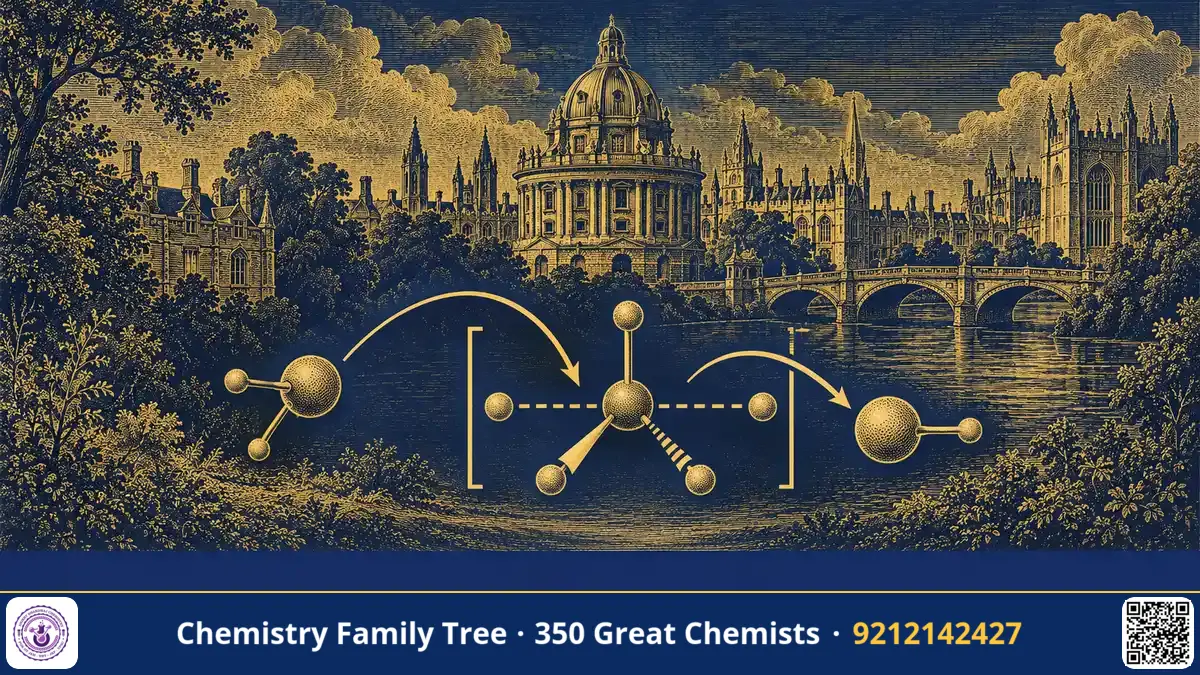
Ingold and Hughes studied the kinetics and stereochemistry of nucleophilic substitution and elimination, and created the SN1/SN2/E1/E2 classification. See our companion post for details.
2. Electronic theory of organic chemistry
Ingold developed and popularised the idea that the reactivity of organic compounds can be explained by the movement of electrons. He distinguished the inductive effect (through σ bonds), the mesomeric effect (through π bonds), the electromeric effect (a temporary polarisation during a reaction) and hyperconjugation:
-I groups: -NO2, -CN, -COOH, -F, -Cl        +I groups: -CH3, -C2H5, -C(CH3)3
-M groups: -NO2, -CHO, -COR, -CN            +M groups: -OH, -OR, -NH2, -Cl, -Br
3. Nucleophile and electrophile
In 1929 he suggested the terms nucleophilic ("nucleus-loving") and electrophilic ("electron-loving") reagents. Today every textbook of organic chemistry classifies reagents in this way.
4. Aromatic substitution
With Hughes and colleagues, he demonstrated that nitration of benzene with a mixture of nitric and sulfuric acids involves the nitronium ion NO2+, which was identified by cryoscopic and spectroscopic methods:
HNO3 + 2 H2SO4 ⇌ NO2+ + H3O+ + 2 HSO4-
C6H6 + NO2+ → C6H5NO2 + H+
5. Structure of benzene and CIP rules
Ingold studied the vibrational spectra of benzene and deuterated benzenes, which confirmed the planar, symmetrical D6h structure of the molecule. He also contributed to the Cahn-Ingold-Prelog sequence rules for R/S and E/Z naming.
Awards, Honours and Nobel Prize
Ingold was elected a Fellow of the Royal Society in 1924 and received many other honours from scientific societies. He was knighted in 1958. He held honorary degrees from several universities. He never received a Nobel Prize, although many chemists felt that he deserved one. His contribution was instead recognised through the universal use of his terms and ideas.
Personality, Struggles and Lesser-Known Facts
- Fatherless early: Ingold lost his father at an early age and grew up with a single mother, so scholarships were essential to him.
- A family of chemists: His wife Hilda was a chemist, and his son Keith Ingold became a leading researcher in free radical chemistry, working in Canada.
- Credit shared with Hughes: Ingold often acknowledged his close colleague Edward D. Hughes, with whom he published many papers. The pair is known as "Hughes-Ingold" in textbooks.
- Disputes about priority: Ingold's ideas about electronic effects were developed in parallel with Robert Robinson at Oxford, and the two had a long and sometimes bitter dispute about priority and terminology. Robinson's curved arrow notation and Ingold's terminology are both used today.
- Leader of a big department: He built UCL's chemistry department into one of the most active in the world, and attracted researchers from many countries.
Legacy and Influence on Modern Chemistry
Almost every organic chemistry course across the world is built on Ingold's mechanistic framework: nucleophiles and electrophiles, SN1 and SN2, E1 and E2, electrophilic aromatic substitution, inductive and mesomeric effects. His book Structure and Mechanism in Organic Chemistry was a standard text for decades. He helped to turn organic chemistry from a collection of facts into a predictive science, and his methods led to the field of physical organic chemistry that includes kinetics, isotope effects and linear free energy relationships.
Lessons for Students
- Learn the mechanism, not just the product: Understanding how a reaction occurs lets you predict many reactions.
- Use experiments to test ideas: Ingold combined kinetics and stereochemistry to prove his mechanisms.
- Language matters: Clear terms such as nucleophile and electrophile make thinking clearer.
- Success does not depend on awards: Ingold's ideas shaped chemistry even without a Nobel Prize.
Quick Facts Box
- Born: 28 October 1893, Ilford, England
- Died: 8 December 1970, Edgware, London, England
- Nationality: British
- Field: Physical organic chemistry
- Famous for: SN1/SN2 mechanisms, nucleophile and electrophile, mesomeric effect, CIP rules
- Nobel Prize: None
FAQ
Did Christopher Ingold win a Nobel Prize?
No. Despite his immense influence, he was never awarded a Nobel Prize.
What is the Thorpe-Ingold effect?
It is the observation that gem-dialkyl substitution on a chain increases the rate of ring closure, named after Jocelyn Thorpe and Ingold.
Where did Ingold work most of his career?
At University College London, where he was professor and head of the chemistry department from 1930 until his retirement in 1961.
What is mesomerism?
It is Ingold's term for the delocalisation of electrons in a molecule, equivalent to resonance. The resulting effect on reactivity is called the mesomeric effect (M effect).
Published by ABC Chemistry — IIT-JAM | CSIR-NET | GATE Chemistry Coaching. Visit abcchemistry.com
About the chemist
Christopher Kelk Ingold
1893-1970 · United Kingdom
Physical organic chemistry; reaction mechanisms