The discovery, explained · Chemist no. 65 of 350
SN1 and SN2: How Christopher Ingold Turned Organic Chemistry into a Science of Mechanisms
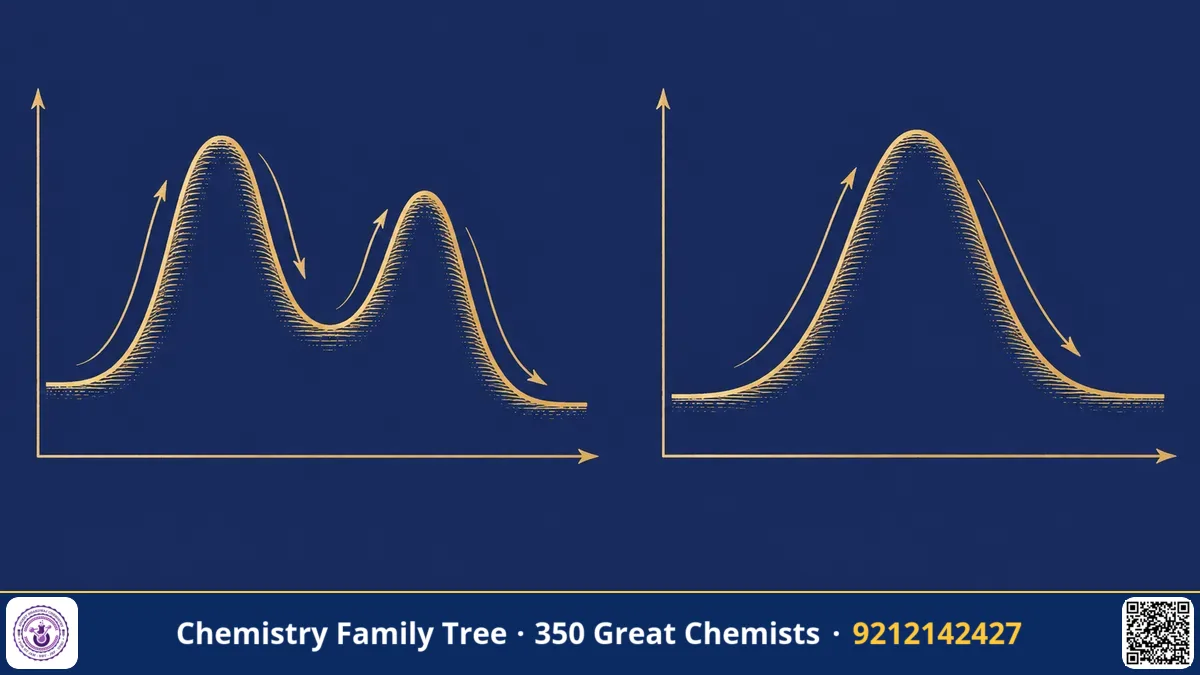
If you have studied organic chemistry, you have certainly met SN1 and SN2 reactions. These two labels, along with E1 and E2, are the foundation on which the whole subject of reaction mechanisms is built. They were developed in the 1930s at University College London by Christopher Kelk Ingold and his colleague Edward David Hughes. Ingold also gave us the terms nucleophile and electrophile, the idea of mesomerism and the arrow-pushing language of modern organic chemistry. Although he never received the Nobel Prize, he is regarded as the founder of physical organic chemistry. In this post we look at the Hughes-Ingold mechanisms of nucleophilic substitution in a way that helps you in JAM, NET and GATE.
The Scientific Problem Before the Discovery
In the early twentieth century, organic chemistry was mostly a catalogue of reactions and recipes. Chemists knew that an alkyl halide could be converted into an alcohol with hydroxide, but not how. Some experiments showed that optically active compounds reacted with inversion of configuration (the Walden inversion, discovered by Paul Walden in 1896), while others gave racemic products. Rates of reactions were sometimes first order and sometimes second order. There was no single theory that tied together kinetics, stereochemistry, structure and solvent. The question was: what actually happens, step by step, when a nucleophile replaces a leaving group at a saturated carbon?
The Discovery: Step by Step
- Measure the rate: Hughes and Ingold measured how the rate of reaction of alkyl halides depends on the concentration of the halide and the nucleophile, in different solvents.
- Two kinetic patterns: Some reactions had rate = k[RX][Nu]-, second order. Others had rate = k[RX], first order and independent of the nucleophile.
- Link to stereochemistry: Studies with optically active halides such as 2-iodooctane and 2-bromooctane showed that second-order substitution proceeds with inversion. In 1935, in a famous experiment by Hughes and co-workers, exchange of radioactive iodide with optically active 2-iodooctane showed that the rate of loss of optical activity was exactly twice the rate of exchange, because each substitution inverts the configuration.
- Naming the mechanisms: They proposed the labels SN2 (substitution, nucleophilic, bimolecular) and SN1 (unimolecular), and similarly E2 and E1 for eliminations. These were published as a series of papers from 1933 and summarised in the book Structure and Mechanism in Organic Chemistry (1953).
The Chemistry Behind It
SN2 mechanism
HO- + CH3-Br  →  [HO···CH3···Br]-‡  →  CH3-OH + Br-
Rate = k [CH3Br][OH-]
The nucleophile attacks from the side opposite to the leaving group (backside attack) in a single concerted step. The carbon undergoes inversion of configuration (Walden inversion), like an umbrella turning inside out. The transition state has five-coordinate carbon with partial bonds to both the nucleophile and the leaving group. Substrate reactivity: CH3X > 1° > 2° >> 3° (steric hindrance).
SN1 mechanism
(CH3)3C-Br  →  (CH3)3C+ + Br-       (slow, rate-determining)
(CH3)3C+ + H2O  →  (CH3)3C-OH2+  →  (CH3)3C-OH + H+     (fast)
Rate = k [(CH3)3CBr]
The leaving group first departs to give a planar carbocation. The nucleophile then attacks from either face, giving a mixture of retention and inversion, i.e. racemisation (often with some excess of inversion because of ion-pair effects). Reactivity: 3° > 2° >> 1° (carbocation stability). Rearrangements of the carbocation can occur.
Comparison table
| Feature | SN1 | SN2 |
|---|---|---|
| Rate law | First order: k[RX] | Second order: k[RX][Nu] |
| Steps | Two (carbocation intermediate) | One (concerted) |
| Stereochemistry | Racemisation | Inversion |
| Substrate | 3° > 2°; allylic and benzylic | CH3 > 1° > 2° |
| Nucleophile | Weak nucleophile is enough | Strong nucleophile needed |
| Solvent | Polar protic (water, alcohols) | Polar aprotic (DMSO, DMF, acetone) |
| Leaving group | Good LG essential (I > Br > Cl > F) | Good LG essential |
Solvent effects (Hughes-Ingold rules)
Hughes and Ingold used simple electrostatic reasoning. Increasing solvent polarity speeds up reactions in which charge is created or concentrated in the transition state (SN1 of neutral RX), and slows reactions in which charge is dispersed (SN2 of anionic nucleophile with neutral RX). Polar protic solvents solvate anions by hydrogen bonding and reduce nucleophilicity, so polar aprotic solvents make SN2 faster.
Related Ingold contributions
- Nucleophile and electrophile (1929): Ingold introduced these terms to replace the older "anionoid" and "cationoid" ideas of Lapworth.
- Mesomeric and inductive effects: He introduced the term mesomerism (1933), closely related to Pauling's resonance, and classified electronic effects as +I/-I and +M/-M.
- Nitronium ion: Ingold and Hughes showed that the electrophile in aromatic nitration with nitric and sulfuric acids is NO2+: HNO3 + 2H2SO4 ⇌ NO2+ + H3O+ + 2HSO4-.
- Elimination E1/E2: Same style of analysis applied to elimination reactions, linking Zaitsev and Hofmann orientation to mechanism.
- CIP rules: Ingold co-created the Cahn-Ingold-Prelog priority rules for R/S naming.
Applications Today
- Drug synthesis: Chemists choose SN2 conditions to make amines, ethers and thioethers with predictable inversion. For example, many pharmaceuticals are made by alkylation of amines with alkyl halides.
- Industrial chemistry: Williamson ether synthesis, quaternary ammonium compound production (disinfectants and surfactants) and the hydrolysis of tert-butyl chloride are examples of mechanisms controlled using these principles.
- Biochemistry: Methyl transfer from S-adenosylmethionine to biological nucleophiles is a biological SN2 reaction with inversion at the methyl group, as shown with chiral methyl groups.
- Environmental chemistry: The breakdown of alkyl halide pesticides and solvents in water follows SN1 or SN2 patterns depending on structure.
- Teaching and computation: Reaction mechanisms are the framework used to train students and to build modern computational models of reactions.
Exam Corner
- SN2: second order, one step, inversion, favoured by 1°/methyl, strong Nu, polar aprotic solvents. SN1: first order, two steps, racemisation, favoured by 3°, polar protic solvents.
- Reactivity order of leaving groups: I- > Br- > Cl- > F-; better leaving groups: tosylate, mesylate.
- Neopentyl halides are very slow in SN2 (steric hindrance) and rearrange in SN1.
- Allyl and benzyl halides react fast by both SN1 and SN2.
- Ingold coined "nucleophile" and "electrophile" and introduced the mesomeric effect.
Common Misconceptions
- "SN1 always gives 50:50 racemic mixture." Often some excess of the inversion product is seen, because the leaving group stays close to the carbocation as an ion pair.
- "Tertiary halides never undergo SN2." They do not in practice because of steric hindrance, but the reason is steric, not electronic.
- "Ingold won the Nobel Prize." He did not, though he was nominated, and is considered one of the most influential chemists never to have received it.
Quick Revision Box
- SN2: rate = k[RX][Nu]; Walden inversion; 1° > 2°; polar aprotic solvent.
- SN1: rate = k[RX]; carbocation; racemisation; 3° > 2°; polar protic solvent.
- Hughes and Ingold, University College London, 1930s.
- Ingold introduced nucleophile, electrophile, mesomerism, inductive effect (+I/-I).
- Nitronium ion NO2+ is the electrophile in nitration.
- Book: Structure and Mechanism in Organic Chemistry (1953).
FAQ
Who developed the SN1 and SN2 mechanisms?
Edward D. Hughes and Christopher K. Ingold at University College London in the 1930s, building on earlier work on Walden inversion.
What does the "2" in SN2 mean?
It means bimolecular: the rate-determining step involves two species, the substrate and the nucleophile.
Why do polar aprotic solvents favour SN2?
They solvate cations well but leave anions relatively "naked" and highly nucleophilic, so the SN2 rate increases.
Is the Walden inversion the same as SN2?
Walden inversion is the stereochemical outcome (inversion of configuration), which is the characteristic result of an SN2 reaction at a stereocentre.
Published by ABC Chemistry — IIT-JAM | CSIR-NET | GATE Chemistry Coaching. Visit abcchemistry.com
About the chemist
Christopher Kelk Ingold
1893-1970 · United Kingdom
Physical organic chemistry; reaction mechanisms