The discovery, explained · Chemist no. 347 of 350
Clair Patterson: How Lead Isotopes Revealed the Age of the Earth

How old is the Earth? For centuries, scientists and theologians gave very different answers, from a few thousand years to many millions. In 1953 a young geochemist named Clair Cameron Patterson, working at the California Institute of Technology, used the radioactive decay of uranium into lead, and measured the isotopes of lead in meteorites, to show that the Earth is about 4.55 billion years old. This number is still accepted today. But Patterson's greatest challenge was not the measurement itself; it was the lead contamination that spoilt every sample in the laboratory. Tracking that contamination to its source, he found that modern human activities, above all leaded petrol, had spread lead through the planet. This is a story of radioactive decay, isotopes, careful measurement and public service.
The Scientific Problem Before the Discovery
In the early twentieth century, radioactivity gave scientists a natural clock. Ernest Rutherford and others suggested that the ratio of a parent radioactive element to its stable daughter product in a rock could be used to date it. By the 1940s, rocks had been dated at up to a couple of billion years. But the Earth itself could not be dated directly. Its original crust has been destroyed and recycled by geological processes, so no rock from its formation survives for measurement.
The key idea, suggested by Harrison Brown, Patterson's supervisor at the University of Chicago, was to use meteorites. Meteorites are leftover material from the formation of the solar system, and are thought to have formed at the same time as the Earth, from the same cloud of gas and dust. If one could date meteorites accurately, one could date the Earth. The problem was a technical one: measuring tiny amounts of lead in meteoritic minerals needed extremely sensitive mass spectrometry and extremely clean conditions.
The Discovery: Step by Step
- Choose the samples. Patterson used fragments from the Canyon Diablo meteorite, which formed the Meteor Crater in Arizona. Its sulphide mineral troilite (FeS) has almost no uranium, so its lead should be primordial, that is, the original lead of the solar system.
- Measure stony meteorites. Other meteorites contain uranium and lead in different proportions. In them, uranium has been decaying for the age of the solar system, so extra radiogenic lead has accumulated.
- Clean the laboratory. Patterson found that ordinary laboratory dust, glassware, reagents and air contained far more lead than his samples. He rebuilt his work area as one of the first ultra-clean laboratories, with filtered air, specially purified acids and careful cleaning, to remove contamination.
- Use a mass spectrometer. With the help of George Tilton and the Argonne National Laboratory's equipment and a method for measuring isotope ratios, he separated and measured isotopes of lead: Pb-204, Pb-206, Pb-207 and Pb-208.
- Plot an isochron. He plotted 207Pb/204Pb against 206Pb/204Pb for the samples. They fell on a straight line whose slope depends on the age.
- Calculate. The slope gave an age of about 4.55 billion years, which he published in 1956.
The Chemistry Behind It
The decay series
Two isotopes of uranium decay by chains of alpha and beta emissions to different stable lead isotopes:
²³⁸U  →  ²⁰⁶Pb    (8 α, 6 β⁻)    half-life ≈ 4.47 × 10⁹ years
²³⁵U  →  ²⁰⁷Pb    (7 α, 4 β⁻)    half-life ≈ 7.04 × 10⁸ years
²³²Th →  ²⁰⁸Pb    (6 α, 4 β⁻)    half-life ≈ 1.4 × 10¹⁰ years
Lead-204 is not formed by any decay chain. It is "primordial" lead, and acts as a reference isotope: its amount stays constant, so ratios to Pb-204 show how much lead has been added by decay.
The radioactive decay law
For a parent isotope, N = N₀e−λt, where λ = 0.693/t½. The amount of daughter lead grown is:
²⁰⁶Pb/²⁰⁴Pb = (²⁰⁶Pb/²⁰⁴Pb)₀ + (²³⁸U/²⁰⁴Pb)(e^(λ₂₃₈t) − 1)
²⁰⁷Pb/²⁰⁴Pb = (²⁰⁷Pb/²⁰⁴Pb)₀ + (²³⁵U/²⁰⁴Pb)(e^(λ₂₃₅t) − 1)
Dividing the second equation by the first gives the Pb-Pb isochron equation, in which the slope of the line is:
slope = (1/137.88) × (e^(λ₂₃₅t) − 1) / (e^(λ₂₃₈t) − 1)
Here 137.88 is the present ratio of 238U to 235U. Notice that this method needs no knowledge of the individual U/Pb ratios of samples, and only needs isotopic ratios of lead, which is its strength.
Why was lead contamination so important?
Patterson's samples contained parts per billion of lead. Even tiny amounts of industrial lead, with a different isotope ratio, would give wrong ages. His work on laboratory contamination led him to study the lead in air, sea water and ice, and he found that environmental lead had increased enormously since the industrial age. By measuring Greenland ice layers and ocean water, he showed that natural levels of lead are very low, and that modern levels in people were many times higher than natural background levels.
Applications Today
- Geochronology: U-Pb dating of zircon crystals is the most precise method for dating ancient rocks, including the oldest minerals on Earth, about 4.4 billion years old.
- Planetary science: ages of Moon rocks, Martian meteorites and asteroids are measured by Pb-Pb methods.
- Clean-room science: his methods are the basis of trace-element analysis and clean laboratory practice in environmental science and semiconductor manufacture.
- Public health: his findings supported the removal of lead from petrol, paint and solder. India completed the phase-out of leaded petrol in 2000.
- Archaeology and forensics: lead isotope fingerprints help to trace the origins of ores, metals and pollutants.
Exam Corner
- Age of the Earth: about 4.54 to 4.55 billion years, from Pb-Pb dating of meteorites.
- Pb-204 is non-radiogenic; Pb-206, 207 and 208 are end products of the U-238, U-235 and Th-232 series.
- Number of α and β particles: for ²³⁸U → ²⁰⁶Pb, mass change 32 = 4 × 8, so 8 α; charge: 92 − 16 = 76, but Pb is 82, so 6 β⁻.
- Radioactive decay is first order: t½ = 0.693/λ; N = N₀e−λt.
- Isochron method needs several samples with the same age but different parent/daughter ratios.
Common Misconceptions
- "The oldest rock on Earth shows the age of the planet." Earth's oldest surviving rocks and minerals are younger than the planet, so meteorites are used.
- "Carbon-14 dating gives the age of the Earth." C-14 has a half-life of 5,730 years and works only to about 50,000 years.
- "Lead in the environment is natural." Patterson showed that most lead in modern bodies and environments comes from human activities.
Quick Revision Box
- Patterson dated the Earth at about 4.55 billion years in 1953 (published 1956).
- He used Canyon Diablo meteorite lead and Pb-Pb isochron dating.
- U-238 → Pb-206 (t½ 4.47 Gy); U-235 → Pb-207 (t½ 0.704 Gy).
- Pb-204 is the stable reference isotope.
- He pioneered ultra-clean laboratories to avoid lead contamination.
- His work led to the removal of lead from petrol.
FAQ
Why use meteorites to date the Earth?
Meteorites formed with the solar system and have not been recycled by geology as Earth's crust has.
What is an isochron?
A line on a plot joining samples of the same age that have different parent/daughter ratios; its slope gives the age.
Which isotope is used as reference in lead dating?
Lead-204, because it is not produced by radioactive decay.
Why is U-Pb dating reliable?
It has two independent decay systems with long half-lives, which can cross-check each other.
Published by ABC Chemistry — IIT-JAM | CSIR-NET | GATE Chemistry Coaching. Visit abcchemistry.com
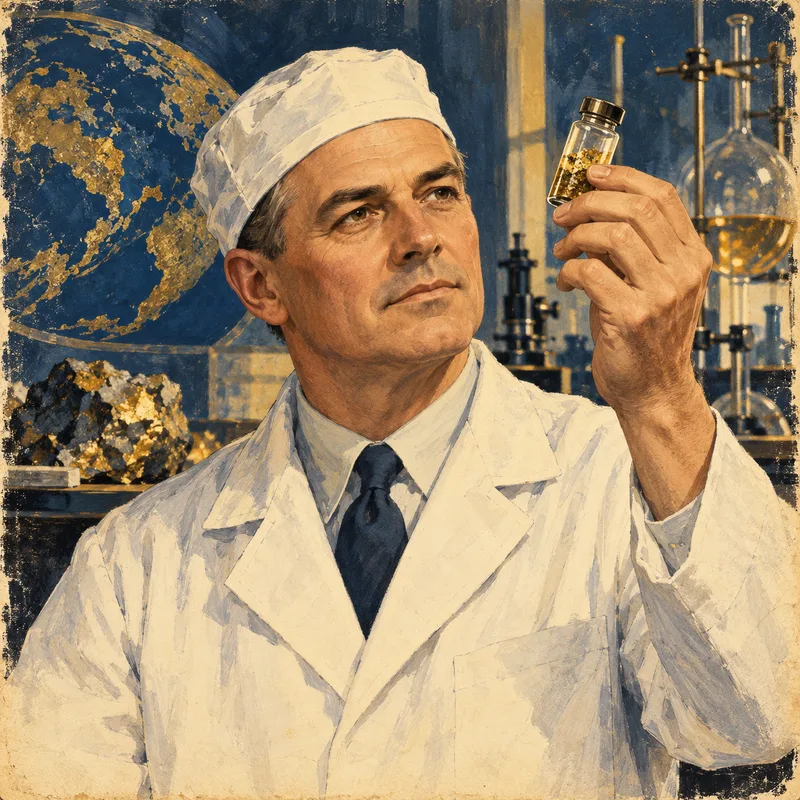
About the chemist
Clair Patterson
1922-1995 · United States
Dated Earth's age; lead pollution