Biography · Chemist no. 347 of 350
Clair Patterson: The Scientist Who Weighed the Age of the Earth and Fought Lead

Clair Cameron Patterson (1922-1995) was an American geochemist who determined the age of the Earth as 4.55 billion years, a figure that still stands. He later spent decades showing that industrial lead, in particular from leaded petrol, had polluted the planet and people's bodies. His one-line legacy: a precise measurer who refused to ignore an inconvenient result, and who turned a laboratory problem into a public-health victory. His life is a valuable lesson for students about the link between careful analytical chemistry and the welfare of society.
Early Life and Family
Clair Patterson was born on 2 June 1922 in Mitchellville, Iowa, a small farming community near Des Moines. He grew up in the Midwest during the Great Depression, in a modest household. As a young man he developed interests in science and in practical subjects, and he showed particular skill in chemistry and in building apparatus. His rural background gave him a love of the outdoors and a straightforward approach to problems, qualities that stayed with him throughout his life.
Education and Mentors
Patterson studied chemistry and mathematics at Grinnell College in Iowa, where he earned his bachelor's degree in 1943. At Grinnell he met Lorna "Laurie" McCleary, who became his wife and was his lifelong partner and collaborator. During the Second World War he worked on the Manhattan Project, first at the University of Chicago and then at Oak Ridge, Tennessee, where he operated mass spectrometers and learned the techniques of isotope analysis. After the war, he did graduate work at the University of Chicago, where his supervisor was Harrison Brown, a geochemist with a strong interest in the origin of the Earth. Patterson completed his PhD in 1951. He then moved with Brown to the California Institute of Technology (Caltech), which became his scientific home.
Career Timeline
| Year | Event |
|---|---|
| 1922 | Born in Mitchellville, Iowa |
| 1943 | Bachelor's degree from Grinnell College |
| 1940s | Works on the Manhattan Project (mass spectrometry) |
| 1951 | PhD, University of Chicago, with Harrison Brown |
| 1952 | Moves to Caltech |
| 1953 | Measures lead isotopes in meteorites at Argonne National Laboratory, giving Earth's age of about 4.55 billion years |
| 1956 | Publishes the age of the Earth |
| 1960s | Documents widespread lead contamination in air, ocean and ice |
| 1970s | Campaigns for lead removal from petrol; US phase-down begins |
| 1995 | Dies in Sea Ranch, California |
Major Scientific Contributions
- Age of the Earth: using lead isotopes in the Canyon Diablo meteorite and others, he established an age of about 4.55 billion years.
- Clean-laboratory techniques: he designed ultra-clean procedures to prevent lead contamination, which became standard for trace analysis.
- Natural lead levels: by studying ocean water, sediments and ice, he showed that preindustrial levels of lead were far lower than modern ones.
- Lead and public health: his data challenged claims that high lead levels in people were normal.
The key relations are the decay series ²³⁸U → ²⁰⁶Pb and ²³⁵U → ²⁰⁷Pb. The discovery article explains the isochron method in detail.
Awards, Honours and Nobel Prize
Patterson did not win a Nobel Prize. Notable honours include:
- The V. M. Goldschmidt Award of the Geochemical Society (1980).
- The Tyler Prize for Environmental Achievement (1995), awarded shortly before his death.
- Recognition by scientific societies as one of the great earth scientists of the century.
Personality, Struggles and Lesser-Known Facts
- Frustration turned into discovery. His dating work was repeatedly spoiled by lead contamination. Rather than ignore it, he made it a research question.
- Industry pressure. When he argued that leaded petrol was spreading poison, the lead industry opposed him. He lost some research funding and was criticised by scientists tied to industry. He kept working with support from Caltech.
- Ice and ocean cores. To prove his point, he analysed ice layers from Greenland, showing lead rising sharply with the use of leaded petrol, and sampled ocean waters that showed very high lead near the surface.
- A hands-on scientist. He built much of his own equipment and insisted on extreme cleanliness. Colleagues described his laboratory as the cleanest of its time.
- Outspoken and tough. He was known for his sharp criticism, direct manner and strong dislike of misleading data.
Legacy and Influence on Modern Chemistry
The age he found, 4.55 billion years, underpins all studies of planetary formation and Earth history. His clean-lab methods spread through geochemistry, oceanography and environmental science, and are the ancestors of the clean rooms used today in semiconductor manufacturing and trace-element laboratories. The United States started to phase out leaded petrol in the 1970s and banned it for road vehicles in 1996. Many countries, including India, followed. Studies since then show a major fall in blood lead levels in children. Scientists often cite Patterson as proof that a single careful analytical chemist can protect the health of millions.
Lessons for Students
- Treat contamination seriously. A good analyst controls blanks and background signals.
- Follow the anomaly. The trouble in his lab revealed a global pollution problem.
- Stand by your data. He kept to the evidence under pressure.
- Learn mathematics along with chemistry. Isochron dating uses decay law and ratios.
- Science serves society. His research led to cleaner air for everyone.
Quick Facts Box
- Born: 2 June 1922, Mitchellville, Iowa, USA
- Died: 5 December 1995, Sea Ranch, California, USA
- Nationality: American
- Field: Geochemistry, isotope chemistry
- Famous for: Age of the Earth (4.55 billion years); fight against lead pollution
- Nobel Prize: None; Goldschmidt Award 1980, Tyler Prize 1995
FAQ
What age of the Earth did Patterson find?
About 4.55 billion years, using lead isotope ratios in meteorites.
Why did he campaign against leaded petrol?
His measurements showed that lead from petrol had spread over the planet, raising lead levels in air, oceans and people far above natural ones.
Did Patterson win a Nobel Prize?
No, but he received the Goldschmidt Award and the Tyler Prize for Environmental Achievement.
Where did he work?
He worked at Caltech from 1952 until his later years, after earlier work at Chicago and Oak Ridge.
Published by ABC Chemistry — IIT-JAM | CSIR-NET | GATE Chemistry Coaching. Visit abcchemistry.com
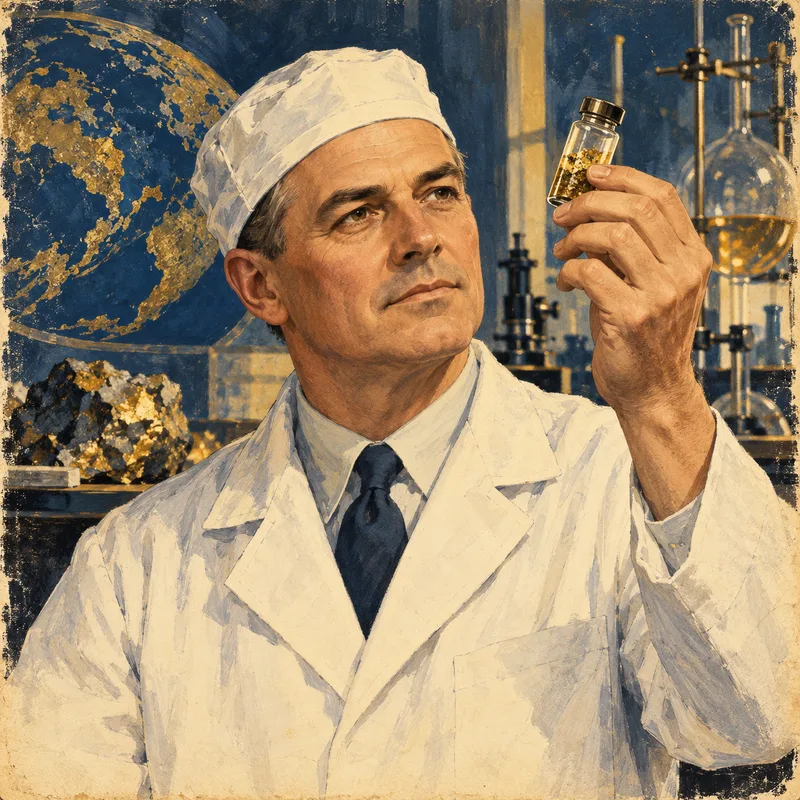
About the chemist
Clair Patterson
1922-1995 · United States
Dated Earth's age; lead pollution