Biography · Chemist no. 238 of 350
Claude Louis Berthollet: The French Savant Who Saw Chemistry in Both Directions
Claude Louis Berthollet (1748–1822) lived through the final years of the French monarchy, the Revolution and the Napoleonic empire, and he remained a leading chemist throughout. A close colleague of Lavoisier, he helped to create the modern system of chemical nomenclature, introduced chlorine bleaching, and argued that chemical reactions depend on the quantities of reactants and can be reversible. His one-line legacy: the first to see clearly that chemical change can go both ways.
Early Life and Family
Berthollet was born on 9 December 1748 in Talloires, near Annecy, in Savoy, which was then part of the Kingdom of Sardinia and is now in France. His family was of modest standing, and from his early education he showed an aptitude for study. Because of his place of birth, he is sometimes described as Savoyard, French or Italian-born, depending on the source. He spent his early years in a mountain region on Lake Annecy, which may have encouraged his interest in natural science.
Education and Mentors
He studied in Chambéry and then at the University of Turin, where he took a medical degree in 1770. He then went to Paris around 1772, where he continued his medical studies and became physician to the household of the Duke of Orléans, which gave him access to a laboratory and a good position. In Paris he turned from medicine to chemistry and came under the influence of Pierre-Joseph Macquer, the leading French chemist, and later of Antoine Lavoisier. Berthollet was admitted to the Academy of Sciences in 1780.
Career Timeline
| Year | Event |
|---|---|
| 1748 | Born in Talloires, Savoy. |
| 1770 | Takes a medical degree at Turin. |
| c. 1772 | Moves to Paris. |
| 1780 | Elected to the Academy of Sciences. |
| 1785 | Announces his conversion to Lavoisier's oxygen theory. |
| 1786 | Introduces chlorine bleaching, with James Watt's interest in the process. |
| 1787 | Publishes the Méthode de nomenclature chimique with Lavoisier, Guyton de Morveau and Fourcroy. |
| 1794 | Helps to found the École Polytechnique and the École Normale during the Revolution. |
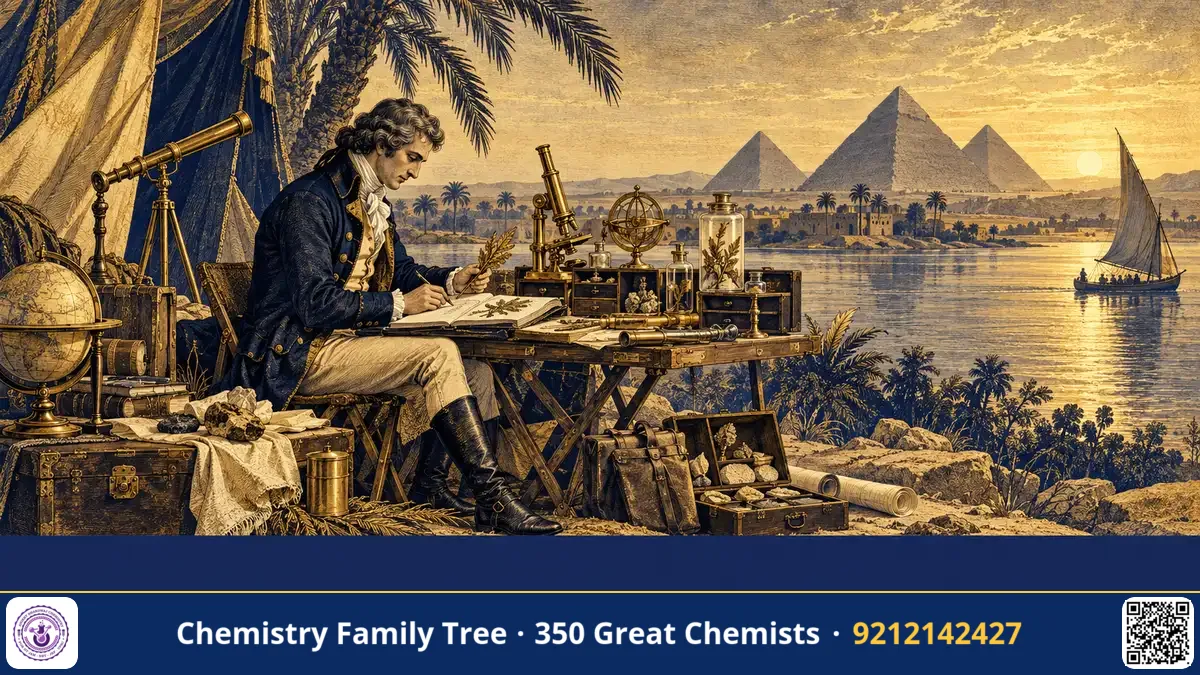
| 1798–1799 | Accompanies Napoleon's expedition to Egypt. |
| 1803 | Publishes Essai de statique chimique, his major work on chemical reactions. |
| 1807 | Founds the Society of Arcueil together with Laplace. |
| 1822 | Dies at Arcueil on 6 November. |
Major Scientific Contributions
- Reversible reactions and mass action: in Essai de statique chimique he argued that the direction and extent of reactions depend on the masses of the reactants. See our discovery blog for details.
- Berthollet's rules: double decompositions go to completion if a precipitate or gas is formed.
- Chlorine bleaching: use of Cl₂ in aqueous solution to bleach cloth and paper. His liquid, known as eau de Javel, was an early hypochlorite bleach.
- Potassium chlorate: prepared by passing chlorine through hot potassium hydroxide.
- Acids without oxygen: he showed that hydrogen sulfide and hydrocyanic acid are acids without oxygen, which contradicted Lavoisier's view.
- Composition of ammonia: he established that ammonia is composed of nitrogen and hydrogen in 1785.
- Nomenclature: co-author of the new naming system in which names reflect composition.
Awards, Honours and Nobel Prize
There was no Nobel Prize in his time. Napoleon gave him honours that included a senatorship and the title of Count (comte), and he was a grand officer of the Legion of Honour. After the restoration of the monarchy in 1814 he was made a peer of France. He was a member of the Academy of Sciences and other learned societies. His name is also remembered in "Berthollet's salt" (potassium chlorate) and "berthollide" compounds.
Personality, Struggles and Lesser-Known Facts
- Independent mind. He accepted Lavoisier's oxygen theory but publicly disagreed on points such as the nature of acids. Contemporaries described him as modest and kind, and he was known for being gentle in debate.
- Surviving the Revolution. Lavoisier was executed in 1794, but Berthollet avoided that fate and worked for the revolutionary government on matters such as gunpowder production and the manufacture of saltpetre for the war effort.
- Egyptian expedition. He travelled with Napoleon and was in the Institute of Egypt. He is also said to have been part of the group of savants that Napoleon trusted personally.
- The Proust debate. His debate with Proust over the law of definite proportions was conducted in a polite tone for several years, and Berthollet accepted Proust's results largely, though he never fully gave up his view.
- Arcueil. He created a private scientific circle with Laplace at his country house in Arcueil, where younger scientists such as Gay-Lussac and Thénard gathered.
- Quiet last years. In his final years he withdrew largely to Arcueil, continuing his experiments and supporting younger colleagues.
Legacy and Influence on Modern Chemistry
The mathematical form of equilibrium was worked out later by Guldberg and Waage, and later by Van 't Hoff and Le Chatelier, but Berthollet had opened the field. The Arcueil circle shaped French chemistry and physics in the early 19th century. His emphasis on conditions such as temperature, quantity and solubility remains standard in the teaching of reactions. Every time you ask, "Which way will this reaction go?", you are using his basic question.
Lessons for Students
- Respect your data over fashion. He followed his Egyptian observations even when affinity tables said otherwise.
- Disagree politely. His debates were civil and productive.
- Support younger scientists. Arcueil trained a generation.
- Partial right is still right. He lost the composition debate in most cases, but his idea of non-stoichiometry returned in solid-state chemistry.
Quick Facts Box
- Born: 9 December 1748, Talloires, Savoy
- Died: 6 November 1822, Arcueil, near Paris
- Nationality: French (Savoyard-born)
- Field: Chemistry
- Famous for: Reversible reactions, chlorine bleaching, chlorates, nomenclature
- Nobel Prize: None (pre-dates the prize)
FAQ
Was Berthollet a student of Lavoisier?
He was more a colleague and ally. He joined Lavoisier's circle and later co-authored the nomenclature.
Why did he go to Egypt?
He was invited as one of the scientists in Napoleon's expedition, where he studied natron lakes and the production of sodium carbonate.
What is Essai de statique chimique?
It is his 1803 book on chemical statics, in which he set out the role of mass and conditions in chemical reactions.
Is Berthollet related to the Haber process?
Indirectly. The ideas of reversible reactions and equilibrium that he promoted were later applied to design processes such as ammonia synthesis.
Published by ABC Chemistry — IIT-JAM | CSIR-NET | GATE Chemistry Coaching. Visit abcchemistry.com
About the chemist
Claude Louis Berthollet
1748-1822 · France
Chemical affinity; bleaching with chlorine