The discovery, explained · Chemist no. 238 of 350
Claude Louis Berthollet: Reversible Reactions, Equilibrium and Chlorine Bleach
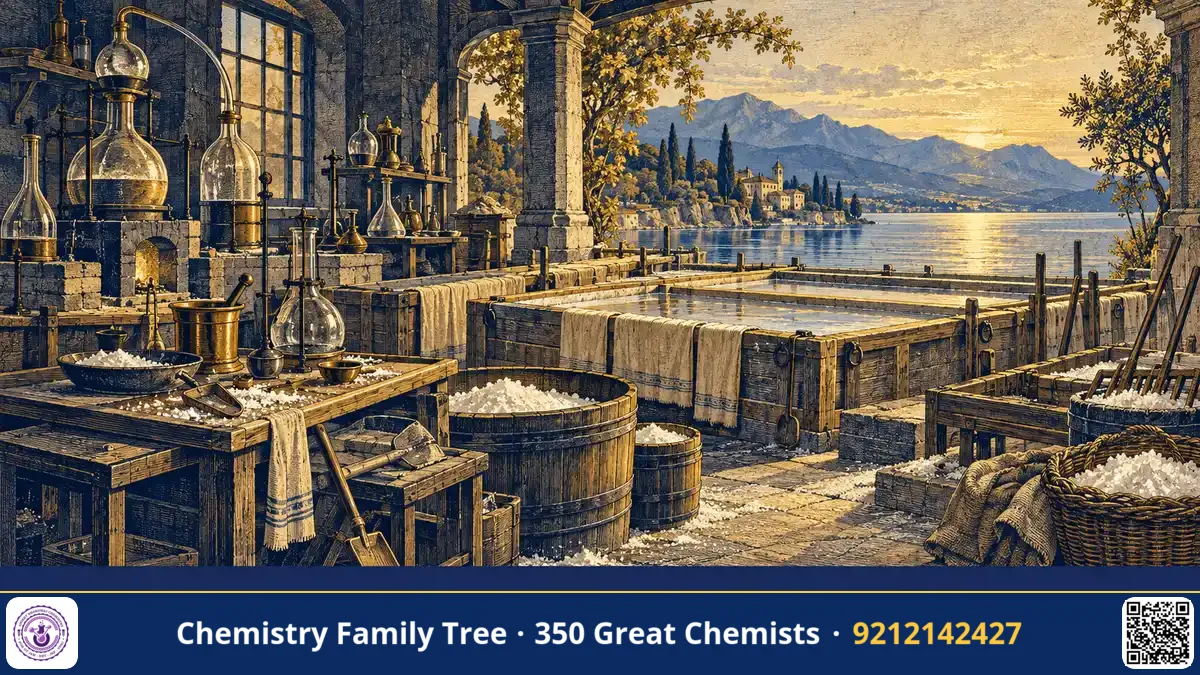
A reaction does not always run to completion. Sometimes it stops with reactants and products both present, and shifting the conditions can push it forwards or backwards. Today this idea of chemical equilibrium is on every JAM, NET and GATE syllabus. One of its earliest champions was the French chemist Claude Louis Berthollet. Walking in Egypt with Napoleon's expedition, he noticed sodium carbonate crystals along the edge of salt lakes, and he proposed that the reaction between salt and limestone can run backwards when salt is in large excess. He also introduced chlorine bleaching to industry and prepared potassium chlorate. In this post we follow these ideas and show how they fit modern chemistry.
The Scientific Problem Before the Discovery
Eighteenth-century chemistry used "affinity tables", which ranked substances by how strongly they combined. For instance, if substance A had a greater affinity than B for substance C, then A would displace B from its compound with C, completely and always. Such tables were compiled by Etienne François Geoffroy and refined by Torbern Bergman. They worked well in many cases, but they could not explain why some reactions go partly, or in either direction depending on conditions. The tables also assumed that affinity was a fixed property of each pair of substances, independent of the quantities present. Berthollet challenged this assumption with data.
The Discovery: Step by Step
Step 1: Observation in Egypt (1798–1799)
Berthollet accompanied Napoleon's expedition to Egypt as a scientist. Near the natron lakes of Wadi Natrun, he saw deposits of sodium carbonate (natron) forming at the lake margins, where seawater-like brine rich in sodium chloride contacted limestone (calcium carbonate). In the laboratory, the known reaction goes the other way:
Na₂CO₃ + CaCl₂ → 2NaCl + CaCO₃↓
In Egypt, the same reaction apparently ran in reverse, because of the high concentration of salt and the evaporation of water:
2NaCl + CaCO₃ ⇌ Na₂CO₃ + CaCl₂
Step 2: The principle of mass action
Berthollet concluded that the outcome of a reaction depends on the relative quantities (the "mass") of the reacting substances as well as their affinities. A large excess of one reactant can drive a reaction in an unexpected direction. This is the core of the law of mass action, which was later put on a mathematical basis by Guldberg and Waage in 1864.
Step 3: Conditions that complete a reaction
He listed the factors that make a reaction go to completion: formation of an insoluble solid (precipitation), release of a gas, and removal of a product by other means such as volatility. Without such a removal, the reaction would be partial. This idea is still known as Berthollet's rules or Berthollet's law for double decomposition: a double displacement reaction between two salts in solution goes to completion if an insoluble or volatile product is formed.
AgNO₃ + NaCl → AgCl↓ + NaNO₃
Na₂CO₃ + 2HCl → 2NaCl + H₂O + CO₂↑
Step 4: Variable composition claim
Berthollet also argued that compounds could have variable composition, depending on the proportions of the reactants. In a famous debate (1799–1808) with Joseph Louis Proust, who maintained that compounds have fixed composition, Proust's law of definite proportions was supported by better analyses and won. Berthollet was correct, however, about some substances now called non-stoichiometric (berthollide) compounds, such as FeO, which is actually Fe₀.₉₅O, and many metal sulfides and hydrides.
The Chemistry Behind It
- Reversible reactions: N₂ + 3H₂ ⇌ 2NH₃. At equilibrium the forward and backward rates are equal, and the equilibrium constant K = [NH₃]² / ([N₂][H₂]³).
- Le Chatelier's principle: adding more reactant shifts the equilibrium to the right. This is Berthollet's observation about excess salt, stated in modern language. Removing a product by precipitation or as a gas has the same effect, since Q becomes less than K.
- Reaction quotient: if Q < K, the reaction proceeds forward; if Q > K, it goes backward. ΔG = ΔG° + RT ln Q.
- Chlorine bleaching: Cl₂ + H₂O ⇌ HCl + HOCl. The hypochlorous acid is an oxidising agent that destroys coloured organic molecules. In alkaline solution: Cl₂ + 2NaOH → NaCl + NaOCl + H₂O, which gives household bleach.
- Potassium chlorate ("Berthollet's salt"): 3Cl₂ + 6KOH (hot) → 5KCl + KClO₃ + 3H₂O. On heating with MnO₂ as a catalyst: 2KClO₃ → 2KCl + 3O₂.
- Berthollet's fulminating silver: a dangerously explosive compound; it is mentioned as a historical fact only.
Applications Today
Equilibrium thinking is the base of industrial process design. In the Haber process, the Contact process (2SO₂ + O₂ ⇌ 2SO₃), and the ammonia–soda (Solvay) process, pressure, temperature and concentration are chosen to shift equilibrium toward the products. In the Solvay process, NaHCO₃ precipitates from a concentrated brine and drives the reaction forward, an industrial application of Berthollet's insight. Hypochlorite and chlorine are used for water disinfection and in paper and textile bleaching, which is important in India's textile and paper industries. Potassium chlorate is used in matchsticks, fireworks and as an oxygen source in labs. Buffer solutions, acid–base titrations and solubility equilibria all follow from the same ideas.
Exam Corner
- Berthollet pointed out that reactions can be reversible and that mass (concentration) affects direction; Guldberg and Waage later gave the law of mass action (1864).
- Double decomposition goes to completion when a precipitate, a gas, or a weak electrolyte is formed.
- Berthollet vs Proust: Berthollet argued for variable composition; Proust's law of definite proportions was accepted, but non-stoichiometric (berthollide) compounds do exist.
- Chlorine bleaching works through HOCl/OCl⁻; with hot concentrated alkali, chlorate forms: 3Cl₂ + 6NaOH → 5NaCl + NaClO₃ + 3H₂O.
- Equilibrium constant K depends only on temperature; the reaction quotient Q compares the current state with K.
Common Misconceptions
- "Equilibrium means the reaction has stopped." Forward and reverse reactions continue at equal rates.
- "Berthollet was wrong about composition." He was wrong for most simple compounds, but right for non-stoichiometric solids.
- "A catalyst shifts equilibrium." A catalyst speeds both directions equally and does not change K.
Quick Revision Box
- Berthollet (1748–1822): French chemist, pioneer of the idea of reversible reactions.
- Egypt observation: NaCl + CaCO₃ ⇌ Na₂CO₃ + CaCl₂ with excess salt.
- Mass of reactant influences reaction direction.
- Reactions complete when a precipitate or gas is formed.
- Chlorine bleaching introduced to industry; KClO₃ is "Berthollet's salt".
- Proust's definite proportions vs Berthollet's variable composition.
FAQ
Did Berthollet invent chemical equilibrium?
He recognised that reactions are reversible and depend on quantity. The mathematical form of the law of mass action came later with Guldberg and Waage.
Why is potassium chlorate called Berthollet's salt?
He studied and prepared it in the 1780s, and it carried his name for a long time.
Did Berthollet accept Lavoisier's oxygen theory?
Yes, he was an early convert and supporter, though he disagreed with Lavoisier that oxygen is the essence of all acids. He showed that hydrogen sulfide and hydrogen cyanide are acids without oxygen.
What is a berthollide compound?
It is a non-stoichiometric compound whose composition varies within a range, such as iron(II) oxide, Fe₁₋ₓO.
Published by ABC Chemistry — IIT-JAM | CSIR-NET | GATE Chemistry Coaching. Visit abcchemistry.com
About the chemist
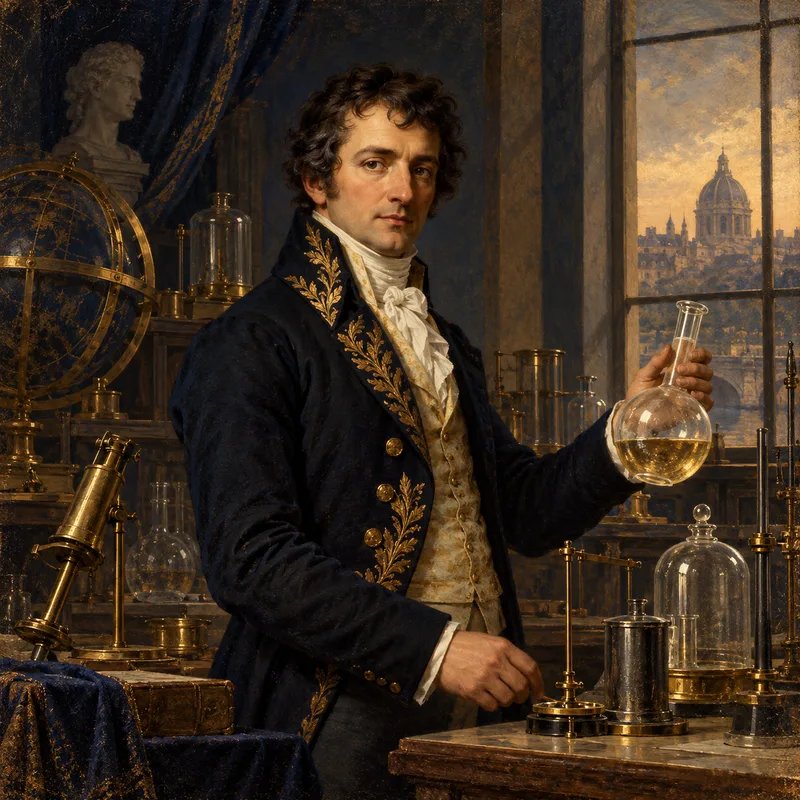
Claude Louis Berthollet
1748-1822 · France
Chemical affinity; bleaching with chlorine