Biography · Chemist no. 267 of 350
Clemens Winkler (1838–1904): The Analyst Who Found Germanium
Clemens Alexander Winkler was a German chemist who spent most of his working life in the Saxon mining town of Freiberg. He is remembered as the discoverer of the element germanium in 1886, the element that confirmed Mendeleev's prediction of eka-silicon. But he was also a gifted analytical and industrial chemist whose methods are still taught. His life shows how careful, patient measurement can lead to a major discovery.
Early Life and Family
Winkler was born on 26 December 1838 in Freiberg, Saxony, which was then a kingdom within the German Confederation. Freiberg was famous for silver mining and for its Mining Academy (Bergakademie), one of the oldest technical universities in the world. His father, Kurt Alexander Winkler, was a chemist who worked in the metallurgical industry, so Clemens grew up close to ores, furnaces and chemical works. This background guided his interest in practical chemistry.
Education and Mentors
Winkler studied at the Freiberg Mining Academy and later at the Freiberg technical institutions, where he trained under noted teachers of analytical and metallurgical chemistry. Freiberg had a strong tradition in analysis. Earlier work there by chemists such as Wilhelm Lampadius and, in the same period, by Ferdinand Reich and Theodor Richter (who discovered indium in 1863 at Freiberg) set an example. Winkler learned that every gram of material had to be accounted for.
Career Timeline
| Year | Event |
|---|---|
| 1838 | Born in Freiberg, Saxony (26 December). |
| 1860s | Studies and begins work in chemical industry in Saxony; works on industrial analysis. |
| 1873 | Appointed professor of chemistry and head of the analytical laboratory at the Freiberg Mining Academy. |
| 1875 onwards | Publishes widely on gas analysis and technical chemistry. |
| 1885 | Analyses the new mineral argyrodite found at the Himmelsfürst mine. |
| 1886 | Announces the discovery of germanium. |
| 1888 | Introduces a method for determining dissolved oxygen in water (the Winkler method). |
| 1890s | Continues work on gas analysis and industrial chemistry. |
| 1902 | Moves to Dresden after retirement. |
| 1904 | Dies in Dresden (8 October). |
Major Scientific Contributions
1. Germanium. From argyrodite (Ag₈GeS₆), Winkler isolated the new element and showed its properties matched Mendeleev's eka-silicon. See our discovery article for the full details of the analysis.
2. Winkler titration for dissolved oxygen. This method is still a standard in environmental chemistry. Manganese(II) hydroxide is oxidised by dissolved oxygen in alkaline solution; on acidification, the oxidised manganese releases iodine from iodide, which is titrated with sodium thiosulfate.
2Mn(OH)₂ + O₂ → 2MnO(OH)₂
MnO(OH)₂ + 2I⁻ + 4H⁺ → Mn²⁺ + I₂ + 3H₂O
I₂ + 2S₂O₃²⁻ → 2I⁻ + S₄O₆²⁻
Indian students meet this in water-quality testing as the DO (dissolved oxygen) determination, usually in a modified form.
3. Technical gas analysis. Winkler wrote an important textbook on the analysis of industrial gases and developed apparatus for it, helping industries that burned coal and made chemicals.
4. Industrial chemistry. He worked on the contact process for making sulfuric acid, where SO₂ is oxidised to SO₃ over a catalyst (platinum at the time, today V₂O₅):
2SO₂ + O₂ ⇌ 2SO₃ (ΔH negative)
He also studied the reduction of metals, including work on magnesium reduction, and published on the chemistry of cobalt and nickel.
Awards, Honours and Nobel Prize
Winkler was widely honoured in Germany and abroad for the discovery of germanium and for his work in analytical and technical chemistry, and he was a member of several learned societies. He did not receive a Nobel Prize; he died in 1904, only a few years after the prizes began.
Personality, Struggles and Lesser-Known Facts
- A debate over the name. Winkler proposed the name "germanium" for his homeland. Some chemists felt that naming an element after a country was unsuitable, but his choice was finally accepted.
- He worried about the periodic law. Winkler did not at first see his element as eka-silicon. Lothar Meyer and Mendeleev pointed out the connection, and Winkler then agreed that the properties matched. He later wrote openly about this, showing scientific honesty.
- Family of chemists. His father worked in industry, and Winkler's own work remained strongly tied to practical problems of mining and metallurgy.
- Method over luck. The discovery depended on his refusal to accept an incomplete analysis total. A small mass deficit became a new element.
- A prolific teacher. He trained many analysts and his laboratory at Freiberg became a model for technical chemical education.
Legacy and Influence on Modern Chemistry
Germanium opened the semiconductor era. The first point-contact transistor in 1947 used germanium crystals, and zone refining of germanium in the 1950s produced some of the purest materials ever made. Today germanium is essential for fibre-optic cables and infrared optics. The Winkler method remains the reference method for dissolved oxygen, used to check lakes, rivers and aquaculture. Freiberg's tradition of precise analysis continues at the Technical University Bergakademie Freiberg. Winkler's work also added strong support to the periodic law, which every chemistry student uses.
Lessons for Students
- Never ignore a small discrepancy in your results. A "missing" 6% led to a new element.
- Theory and experiment work together. Mendeleev's table guided the interpretation of Winkler's data.
- Practical analytical skill (titration, gravimetry, gas analysis) is the base of great chemistry.
- Be honest about your first interpretation if later evidence changes it.
Quick Facts
- Born: 26 December 1838, Freiberg, Saxony.
- Died: 8 October 1904, Dresden, Germany.
- Nationality: German.
- Field: Analytical and inorganic chemistry.
- Famous for: Discovery of germanium (1886); Winkler titration for dissolved oxygen.
- Nobel Prize: None.
FAQ
Where did Clemens Winkler work?
Almost his entire career was at the Freiberg Mining Academy in Saxony, where he led the analytical chemistry laboratory.
What is the Winkler method used for today?
It measures dissolved oxygen in water, an important indicator of water quality for rivers, lakes, wastewater and fish farming.
Did Winkler win a Nobel Prize?
No. He died in 1904, and the early Nobel Prizes in Chemistry went to other scientists.
Why is his discovery important for students?
Germanium confirmed the predictive power of Mendeleev's periodic law and is a key Group 14 semiconductor element in the syllabus.
Published by ABC Chemistry — IIT-JAM | CSIR-NET | GATE Chemistry Coaching. Visit abcchemistry.com
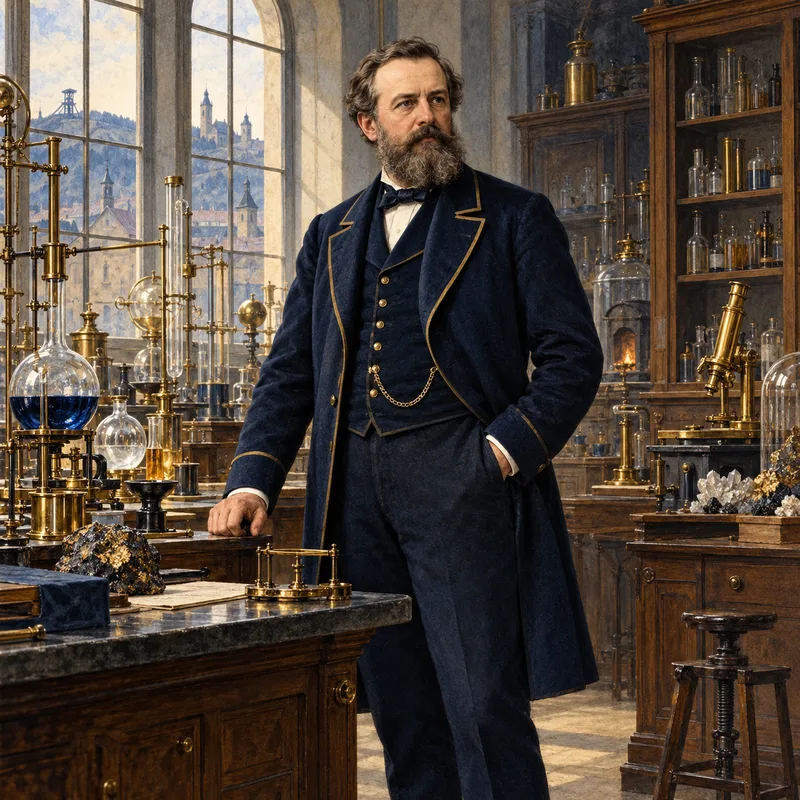
About the chemist
Clemens Winkler
1838-1904 · Germany
Discovered germanium