The discovery, explained · Chemist no. 267 of 350
Clemens Winkler and the Discovery of Germanium: The Element Mendeleev Predicted
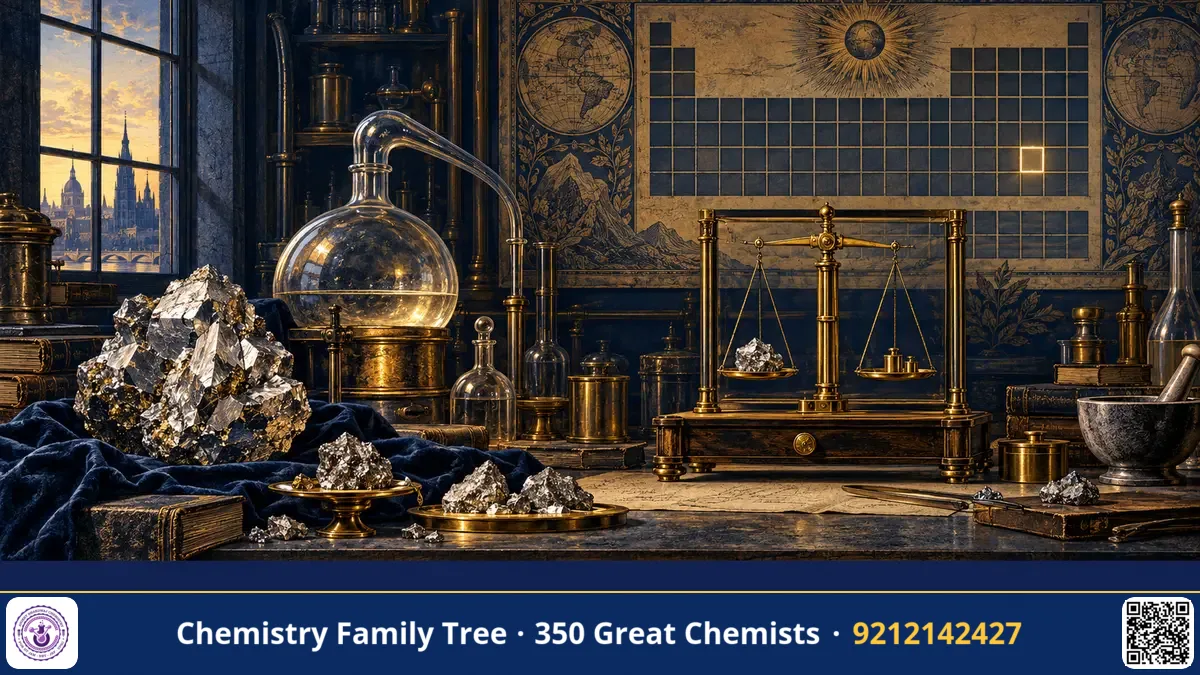
In 1886, a German chemist working in a small mining town in Saxony isolated a new element that did not surprise the periodic table at all. In fact, the table had been waiting for it. Clemens Winkler discovered germanium (symbol Ge, atomic number 32) in a silver mineral called argyrodite, and its properties matched, almost line by line, those that Dmitri Mendeleev had predicted fifteen years earlier for a missing element he called eka-silicon. This was one of the three great confirmations of the periodic law, along with gallium and scandium. For students, germanium is the textbook example of how a good scientific theory predicts the unknown.
The Scientific Problem Before the Discovery
By the 1870s, chemists knew about 63 elements. Mendeleev (1869) had arranged them by atomic mass and chemical behaviour and, in doing so, had left gaps. He boldly stated that these gaps were undiscovered elements and described three of them in detail: eka-boron, eka-aluminium and eka-silicon. Eka is Sanskrit for "one", so eka-silicon means "the element one place below silicon".
Gallium (1875, eka-aluminium) and scandium (1879, eka-boron) had already been found and matched the predictions. Eka-silicon was still missing. Many chemists remained doubtful about the periodic law. A new element that fitted the gap between silicon and tin would be strong evidence that periodicity was real and not a coincidence.
The Discovery: Step by Step
The story begins in September 1885 at the Himmelsfürst silver mine near Freiberg, Saxony. Miners found an unusual silver-grey mineral with a metallic lustre. Professor Albin Weisbach of the Freiberg Mining Academy examined it and passed it to his colleague Clemens Winkler for chemical analysis. Weisbach later named the mineral argyrodite, from Greek words meaning "rich in silver".
Winkler followed careful quantitative analysis. He found silver (about 75%), sulfur (about 17%) and small amounts of iron, zinc and mercury. But the percentages never added up to 100. About 6–7% was always missing. Winkler repeated the analysis many times, and the same deficit appeared. Instead of blaming experimental error, he concluded that a new element was hiding in the mineral.
- Decomposition: He heated the mineral with other reagents to break it down and bring the unknown element into solution.
- Separation: He removed silver and other metals as insoluble compounds. The unknown remained in solution until it was deliberately precipitated as a sulfide.
- Conversion to oxide: The sulfide was roasted to make the white oxide, GeO₂.
- Reduction to metal: Heating the oxide with hydrogen gave the grey-white metal.
GeS₂ + 3O₂ → GeO₂ + 2SO₂
GeO₂ + 2H₂ → Ge + 2H₂O
By February 1886, Winkler had enough pure material to study it. He first thought the element might be a metal resembling antimony, and some scientists (including Lothar Meyer) suggested it might be eka-silicon. Winkler's measurements settled the matter: the atomic mass was about 72, and the element belonged to Group 14 below silicon.
Winkler proposed the name germanium in honour of his homeland, Germany. Some critics did not like naming an element after a country, but the name was accepted. Argyrodite is now known to have the formula Ag₈GeS₆.
The Chemistry Behind It
The match between prediction and result was striking:
| Property | Mendeleev's eka-silicon (1871) | Germanium (measured) |
|---|---|---|
| Atomic mass | about 72 | about 72.6 |
| Density (g/cm³) | about 5.5 | 5.35 |
| Oxide formula | EsO₂ | GeO₂ |
| Oxide density | about 4.7 | about 4.7 |
| Chloride | EsCl₄, boiling below 100 °C | GeCl₄, boiling at about 84–86 °C |
| Colour | dark grey metal | grey-white, brittle, metallic lustre |
Germanium is a metalloid in Group 14, with the electronic configuration [Ar] 3d¹⁰ 4s² 4p². It forms compounds in the +4 state mainly, and the +2 state is less stable than for tin and lead (an example of the inert-pair trend going down the group, which becomes strong only from tin onward). Its oxide GeO₂ is amphoteric, and GeCl₄ is hydrolysed by water:
GeCl₄ + 2H₂O → GeO₂ + 4HCl
As a semiconductor, pure germanium has a band gap of about 0.67 eV, smaller than silicon's 1.1 eV. It crystallises in the diamond cubic structure.
Applications Today
- Early electronics: The first transistor (Bell Labs, 1947) used germanium. Silicon later replaced it for most uses.
- Fibre optics: GeO₂ is added to the silica core of optical fibres to raise the refractive index. Fibre networks in India depend on this.
- Infrared optics: Germanium is transparent to infrared light, so it is used in thermal-imaging lenses and night-vision cameras.
- Solar cells: Germanium substrates are used in high-efficiency multi-junction cells for satellites.
- Catalysts and alloys: Germanium compounds are used in some polymerisation catalysts, and Si–Ge alloys are used in fast chips.
Germanium is rare and is obtained mainly as a by-product of zinc ore processing and from coal fly ash.
Exam Corner
- Germanium was discovered by Clemens Winkler in 1886 from argyrodite, Ag₈GeS₆; it is Mendeleev's eka-silicon.
- Predicted and observed properties agree closely; this supports the periodic law (frequently asked in boards and JAM).
- Ge is a metalloid and an intrinsic semiconductor with a diamond cubic lattice; band gap about 0.67 eV.
- Stability of +2 versus +4 oxidation state: Ge(+4) is more stable, Pb(+2) more stable than Pb(+4) because of the inert pair effect.
- GeO₂ is amphoteric; GeCl₄ is a volatile liquid that is hydrolysed by water, a covalent tetrahedral molecule.
Common Misconceptions
- "Mendeleev discovered germanium." No. Mendeleev predicted it; Winkler discovered and isolated it.
- "Winkler knew what he was looking for." Not at first. He noticed the missing mass in his analysis and only later realised the new element fitted the prediction.
- "Germanium is still the main semiconductor." Silicon dominates today, though germanium is important in special devices and optics.
Quick Revision Box
- Element: germanium, Ge, Z = 32, Group 14, Period 4.
- Discoverer: Clemens Winkler, Freiberg, Germany, 1886.
- Source mineral: argyrodite, Ag₈GeS₆.
- Predicted by Mendeleev as eka-silicon (1871).
- Oxide GeO₂ is amphoteric; chloride GeCl₄ is volatile and hydrolysed.
- Uses: transistors (early), optical fibre, infrared lenses, solar cells.
FAQ
Why is the element called germanium?
Winkler named it after Germany ("Germania" in Latin), his native country.
What does "eka" mean in eka-silicon?
Eka means "one" in Sanskrit. Mendeleev used it to indicate an element one place below a known element in the same group.
How did Winkler know there was a new element in argyrodite?
His quantitative analysis kept giving a total of only 93–94%. The missing 6–7% was due to an unknown element, which he then isolated.
Is germanium important for the IIT-JAM or GATE syllabus?
Yes. Questions come up on Group 14 trends, inert pair effect, semiconductors and Mendeleev's predictions, so know the properties and the story well.
Published by ABC Chemistry — IIT-JAM | CSIR-NET | GATE Chemistry Coaching. Visit abcchemistry.com
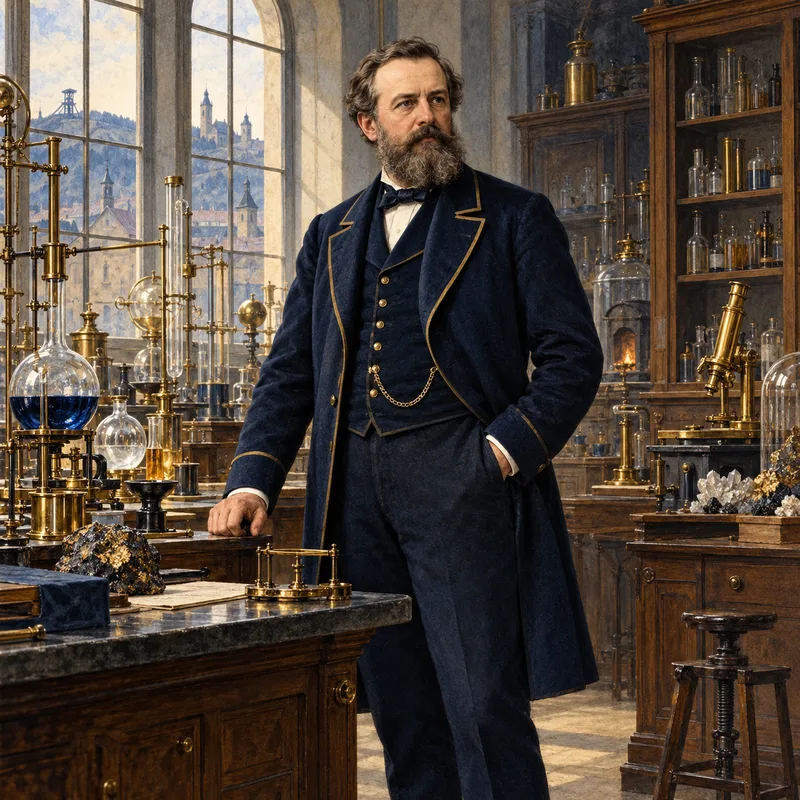
About the chemist
Clemens Winkler
1838-1904 · Germany
Discovered germanium