Biography · Chemist no. 100 of 350
C. N. R. Rao: India's Great Builder of Solid State and Materials Chemistry
Chintamani Nagesa Ramachandra Rao, widely known as C. N. R. Rao (born 1934), is an Indian chemist who has spent his life studying the chemistry of solids and nurturing science in India. He worked on transition metal oxides, superconductors, nanomaterials and graphene, wrote many books and has published an enormous number of research papers. He served as Director of the Indian Institute of Science (IISc), founded the Jawaharlal Nehru Centre for Advanced Scientific Research (JNCASR) and was awarded the Bharat Ratna, India's highest civilian honour, in 2013. His legacy in one line: he showed that a scientist from India could build a world-class research school at home.
Early Life and Family
Rao was born on 30 June 1934 in Bangalore (now Bengaluru), Karnataka, then part of the Princely State of Mysore. He grew up in a Kannada-speaking family that valued education. He was a bright student and moved quickly through school. He completed school early and moved quickly through his degrees, which made him one of the youngest university graduates of his time. His early years in Bangalore also meant that he was close to IISc, the institution that would later become the centre of his professional life.
Education and Mentors
Rao earned a BSc from Mysore University in 1951, when he was only 17. He then studied for an MSc in chemistry at Banaras Hindu University, completing it in 1953. For his PhD he went to Purdue University in the United States, where he obtained the degree in 1958. At Purdue he worked on spectroscopy and physical chemistry, and the experience of an American research university shaped his belief that rigorous science needs excellent facilities, serious students and constant discussion. After a postdoctoral period, he returned to India. His training in spectroscopy gave him a tool kit that he later applied to solids: infrared, Raman, electronic and photoelectron spectroscopy.
Career Timeline
| Year | Event |
|---|---|
| 1934 | Born in Bangalore, Karnataka |
| 1951 | BSc, Mysore University |
| 1953 | MSc, Banaras Hindu University |
| 1958 | PhD, Purdue University, USA |
| 1960s | Returned to India; began work at IISc Bangalore |
| 1963 | Joined the Indian Institute of Technology Kanpur |
| 1976 | Returned to IISc as Professor of Solid State and Structural Chemistry |
| 1982 | Elected Fellow of the Royal Society (FRS) |
| 1984-1994 | Director of the Indian Institute of Science |
| 1989 | Helped to establish JNCASR, Bangalore |
| 2005 | Padma Vibhushan |
| 2013 | Bharat Ratna |
Major Scientific Contributions
1. Solid state chemistry of oxides. Rao studied how composition and structure determine properties in transition metal oxides: metal-insulator transitions in V₂O₃ and VO₂, perovskites ABO₃ and layered oxides. He used chemical thinking, for example valence and bonding, to explain physical properties. His book, New Directions in Solid State Chemistry, co-authored with J. Gopalakrishnan, became a classic.
2. Superconductors and magnetoresistance. After the discovery of high-temperature superconductivity in 1986, he and his group studied YBa₂Cu₃O₇ and related materials. They also investigated colossal magnetoresistance in manganites such as La₁₋ₓCaₓMnO₃, where the Mn³⁺–O–Mn⁴⁺ double exchange mechanism plays a key role.
3. Nanomaterials. From the late 1990s, his group developed chemical routes to metal and semiconductor nanocrystals, nanotubes and nanowires, and later to graphene and inorganic layered analogues of graphene, such as MoS₂. Read more in our discovery post on Rao's solid state chemistry.
4. Spectroscopy. Early in his career he wrote on the application of ultraviolet, infrared and Raman spectroscopy to chemistry, useful for students even today.
Awards, Honours and Nobel Prize
Rao has not won a Nobel Prize, but he has received many of the highest honours in science and public service:
- Bharat Ratna (2013): India's highest civilian award, shared in the same year with the cricketer Sachin Tendulkar.
- Padma Shri (1974) and Padma Vibhushan (2005).
- Fellow of the Royal Society (FRS), 1982, and foreign membership of several national academies of science, including the US National Academy of Sciences.
- Hughes Medal of the Royal Society (2000) and other international prizes for materials research.
- India Science Award (2004) and many honorary doctorates from universities in India and abroad.
He also chaired the Scientific Advisory Council to the Prime Minister of India. For an exact list, consult the official records of the Government of India and the Royal Society.
Personality, Struggles and Lesser-Known Facts
- Young achiever: He took his BSc at 17 and his PhD in his early twenties.
- Return to India: After studying in the United States, he chose to come back to India at a time when many bright students settled abroad, and he built research groups at IIT Kanpur and IISc.
- Prolific writer: He has authored or co-authored dozens of books and a very large number of research papers, which made him one of the most cited chemists from India.
- Institution builder: As Director of IISc, he guided the institute through a decade of growth, and he established JNCASR to give young researchers an environment for advanced work.
- Advisor to the nation: He chaired the Scientific Advisory Council to the Prime Minister, and used that platform to argue for greater public investment in research and education.
Legacy and Influence on Modern Chemistry
Rao's students and collaborators now lead departments across India and the world. His work legitimised solid state chemistry as a central part of Indian inorganic chemistry, and today the topics he championed, perovskite solar cells, 2D materials, nanomaterials and superconductors, are in the syllabus of M.Sc. programmes and in JAM, NET and GATE. He is also known for encouraging young Indians to take up science and for arguing that India should invest more in research. His life shows that scientific excellence and institution building can go together.
Lessons for Students
- Work hard and read widely. His breadth, from spectroscopy to nanoscience, kept his research fresh for decades.
- Link structure and properties. This is the heart of inorganic and materials chemistry.
- Build teams and institutions. Science grows when people share resources.
- Stay curious for life. He remained an active researcher well past the age at which most scientists retire.
Quick Facts Box
- Born: 30 June 1934, Bangalore, Karnataka, India
- Died: Living
- Nationality: Indian
- Field: Solid state chemistry, materials chemistry, nanoscience
- Famous for: Transition metal oxides, superconductors, nanomaterials; Director of IISc; founder of JNCASR
- Nobel: None; Bharat Ratna 2013
FAQ
Which Indian award did C. N. R. Rao receive in 2013?
The Bharat Ratna, the highest civilian honour of India.
Where did Rao do his PhD?
At Purdue University in the United States, where he completed it in 1958.
Which institutes did Rao lead or found?
He was Director of the Indian Institute of Science from 1984 to 1994 and helped to establish the Jawaharlal Nehru Centre for Advanced Scientific Research (JNCASR) in Bangalore.
What is the main field of Rao's research?
Solid state and materials chemistry, including oxides, superconductors, magnetoresistant materials and nanomaterials such as graphene.
Published by ABC Chemistry — IIT-JAM | CSIR-NET | GATE Chemistry Coaching. Visit abcchemistry.com
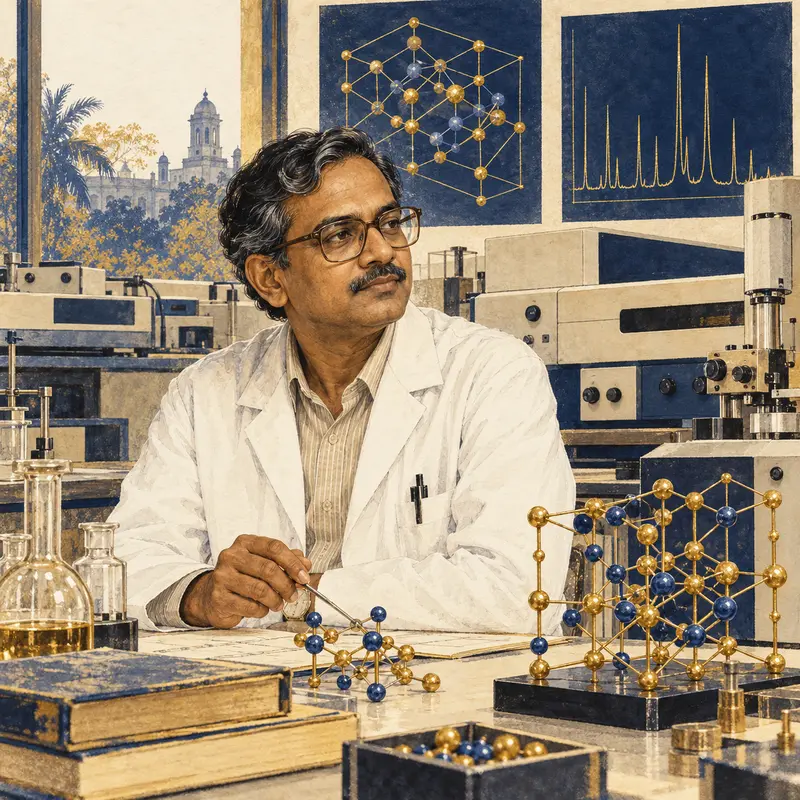
About the chemist
C. N. R. Rao
1934- · India
Solid-state and materials chemistry