The discovery, explained · Chemist no. 100 of 350
C. N. R. Rao and the Chemistry of Solids: From Oxides to Graphene
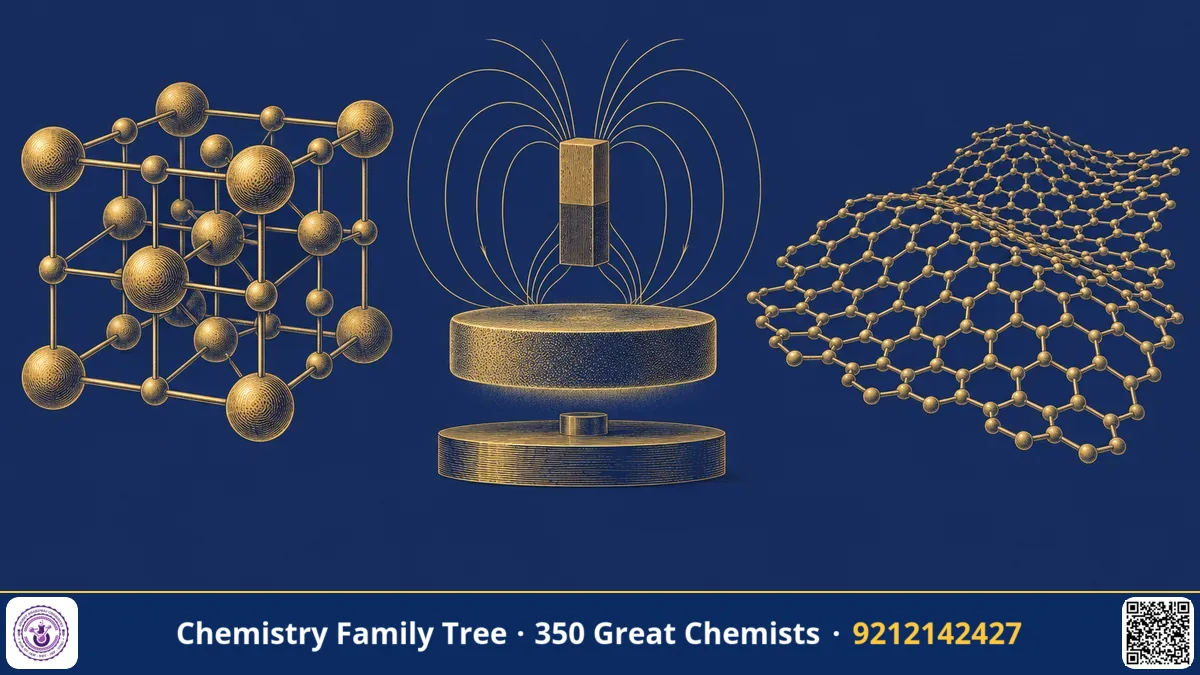
Some chemists find a single reaction. Others build a whole field. Chintamani Nagesa Ramachandra Rao, known as C. N. R. Rao, is in the second group. Over more than six decades he studied how atoms are arranged in solids and how that arrangement controls colour, conductivity, magnetism and superconductivity. His work on transition metal oxides, metal-insulator transitions, high-temperature superconductors, colossal magnetoresistance and nanomaterials helped to shape modern solid state and materials chemistry, and he trained generations of Indian chemists. He is one of India's most decorated scientists, though he did not receive a Nobel Prize. This post explains the central ideas that you meet in your inorganic and solid state chemistry syllabus.
The Scientific Problem Before the Discovery
When Rao started his career, much of inorganic chemistry in textbooks was about molecules and solutions. Solids were treated by physicists, using band theory, or by crystallographers, who described structure but did not ask how to design properties. Chemists could not easily explain why one oxide is an insulator, another a metal, and a third a magnet. For example, vanadium sesquioxide (V₂O₃) changes from metal to insulator on cooling, and nobody had a clear chemical picture of why. Also, the synthesis of new solids was mostly high-temperature trial and error. The challenge was to link chemical bonding, electronic structure and synthesis, and to design solids with desired properties.
The Discovery: Step by Step
- Systematic study of transition metal oxides. In India, starting in the 1960s, Rao's group studied oxides such as VO₂, V₂O₃ and Ti₂O₃, which undergo metal-insulator transitions at specific temperatures. They used spectroscopy, electrical measurements and thermodynamics to relate the transitions to changes in electron correlation and bandwidth.
- Perovskites and layered oxides. He explored the family of perovskite-type oxides (ABO₃) and related layered structures, studying how substituting ions changes structure and properties.
- High-temperature superconductors (from 1986-87). After the discovery of superconductivity in copper oxides by Bednorz and Müller, Rao's group quickly prepared and studied many such materials, including YBa₂Cu₃O₇, and contributed to understanding the roles of oxygen content and structure.
- Colossal magnetoresistance (1990s). His group investigated rare-earth manganites such as La₁₋ₓCaₓMnO₃, where a magnetic field can change electrical resistance by several orders of magnitude, and linked it to charge ordering and double exchange.
- Nanomaterials (from the late 1990s). The group developed chemical routes to nanocrystals, nanotubes and nanowires, and later studied two-dimensional materials such as graphene and MoS₂ analogues, using methods like arc discharge and exfoliation.
The Chemistry Behind It
Perovskite structure
An ideal perovskite ABO₃ has a large A cation (12-coordinate), a smaller B cation (6-coordinate, octahedral) and oxide ions. The Goldschmidt tolerance factor predicts stability:
t = (r_A + r_O) / [ √2 (r_B + r_O) ] (ideal cubic perovskite: t ≈ 1; stable range roughly 0.8 – 1.0)
Examples: CaTiO₃ (the mineral perovskite), SrTiO₃, LaMnO₃.
Metal-insulator transition
Simple band theory says that a partly filled d-band should give a metal. But many oxides such as NiO or V₂O₃ are insulators because strong electron-electron repulsion localises electrons (Mott insulator). Changing temperature, pressure or composition can break this localisation, giving a metal-insulator transition. Rao's group studied how doping and structure control these transitions.
Superconductivity
A superconductor has zero electrical resistance below a critical temperature, Tc, and expels magnetic field (Meissner effect). In La₂₋ₓSrₓCuO₄ and YBa₂Cu₃O₇₋δ, CuO₂ planes are responsible, and Tc depends on hole concentration, which is changed by doping or oxygen content. YBa₂Cu₃O₇ has a Tc of about 90 K, above the boiling point of liquid nitrogen (77 K).
Colossal magnetoresistance and double exchange
In La₁₋ₓCaₓMnO₃, manganese is in a mixture of Mn³⁺ (t₂g³e_g¹) and Mn⁴⁺ (t₂g³). An e_g electron can hop from Mn³⁺ to Mn⁴⁺ through the oxygen between them only if the core spins are aligned (ferromagnetic), a process called double exchange:
Mn³⁺–O²⁻–Mn⁴⁺ ⇌ Mn⁴⁺–O²⁻–Mn³⁺ (electron hops; needs parallel core spins)
An applied magnetic field aligns the spins and lowers the resistance sharply.
Nanomaterials and graphene
When particles shrink to a few nanometres, the band gap and the optical, magnetic and catalytic properties change because of quantum confinement and a very large surface-to-volume ratio. Graphene, a single layer of sp² carbon atoms arranged in a honeycomb lattice, has unusual electronic properties. Rao's group made graphene by several routes, including arc discharge of graphite in a hydrogen atmosphere and chemical exfoliation, and they studied nitrogen- and boron-doped graphene.
Applications Today
- Superconducting magnets and cables: Cuprate and related superconductors are used in cables, magnets and sensors, usually cooled with liquid nitrogen.
- Magnetic storage and sensors: Magnetoresistive materials are used in read heads and sensors.
- Catalysis and energy: Perovskite oxides serve as catalysts and in fuel cells. Hybrid halide perovskites are now popular in solar cells.
- Electronics and composites: Graphene and nanotubes are used in conductive films, sensors and composites.
- Indian science: Rao's work supported the growth of materials research at IISc, IIT Kanpur and the Jawaharlal Nehru Centre for Advanced Scientific Research (JNCASR), and built a base for India's nanoscience programmes.
Exam Corner
- Perovskite ABO₃: A is 12-coordinate, B is 6-coordinate. Goldschmidt tolerance factor t = (rA + rO)/[√2(rB + rO)] close to 1 for cubic.
- YBa₂Cu₃O₇ is a high-Tc superconductor (Tc about 90 K); superconductivity in cuprates depends on CuO₂ planes and hole doping.
- Meissner effect: perfect diamagnetism (expulsion of magnetic field) below Tc.
- La₁₋ₓCaₓMnO₃: mixed valence Mn³⁺/Mn⁴⁺; double exchange; colossal magnetoresistance.
- Mott insulator: an oxide predicted to be a metal by band theory but insulating because of strong electron repulsion (e.g., NiO).
Common Misconceptions
- "Rao won a Nobel Prize." He did not. He has received India's highest civilian honour, the Bharat Ratna, and many international awards.
- "High-temperature superconductors work at room temperature." "High" means above about 30 K, and the best cuprates work at temperatures well below 0 °C.
- "Insulators have empty bands only." A partially filled band can still give an insulator when electron repulsion is strong.
Quick Revision Box
- Rao: pioneer of solid state and materials chemistry in India.
- Studied metal-insulator transitions in V₂O₃, VO₂ and related oxides.
- Perovskite ABO₃ tolerance factor around 0.8 to 1.0.
- YBa₂Cu₃O₇: Tc about 90 K, above liquid nitrogen boiling point.
- Manganites show colossal magnetoresistance by double exchange.
- Later work: nanotubes, graphene and 2D materials.
FAQ
What is C. N. R. Rao famous for?
He is famous for his research in solid state and materials chemistry, particularly transition metal oxides, superconductors, nanomaterials and graphene, and for his leadership in Indian science.
What is a perovskite?
It is a crystal structure with the formula ABO₃, named after the mineral CaTiO₃. Many functional materials have this structure.
What is colossal magnetoresistance?
It is a very large change in electrical resistance of a material under a magnetic field, seen in manganese oxides like La₁₋ₓCaₓMnO₃.
Why do chemistry students need to know about Rao?
His work links bonding, structure and properties of solids, which is the foundation of solid state chemistry questions in JAM, NET and GATE.
Published by ABC Chemistry — IIT-JAM | CSIR-NET | GATE Chemistry Coaching. Visit abcchemistry.com
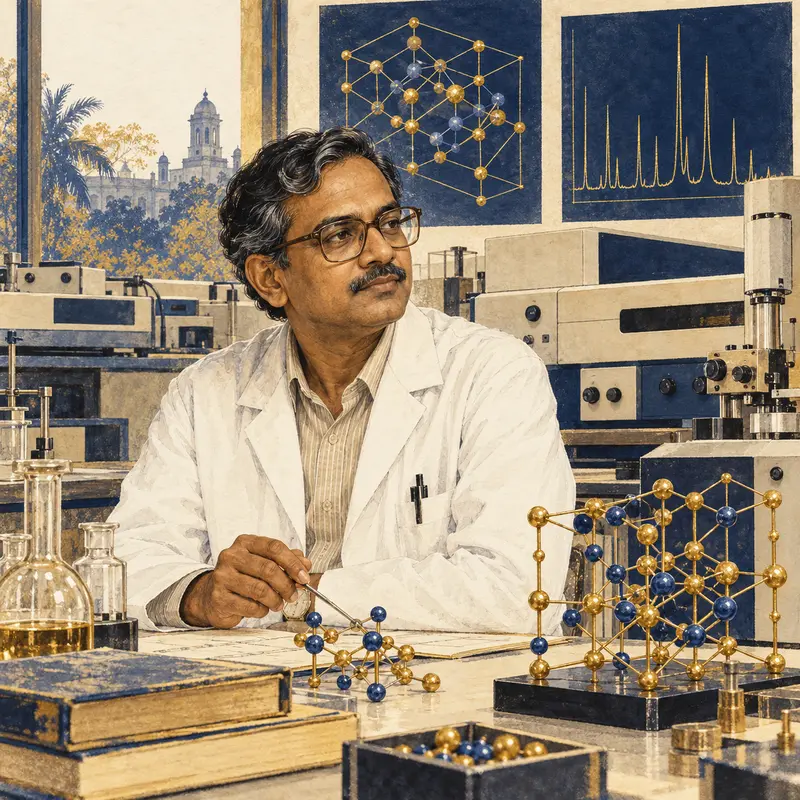
About the chemist
C. N. R. Rao
1934- · India
Solid-state and materials chemistry