Biography · Chemist no. 131 of 350
Sir Cyril Norman Hinshelwood (1897-1967): The Oxford Chemist Who Explained How Reactions Happen
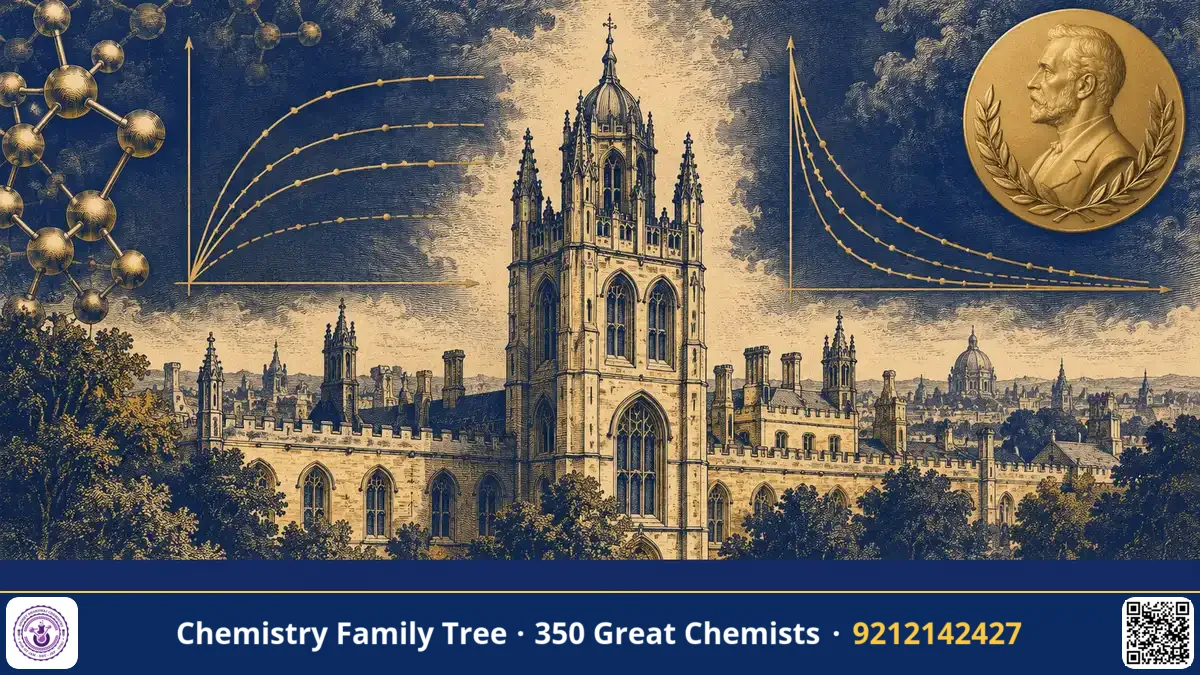
Sir Cyril Hinshelwood was one of the leading physical chemists of the twentieth century. At Oxford he studied the speed and mechanism of chemical reactions, and his work on gas-phase kinetics, unimolecular reactions and chain reactions earned him a share of the 1956 Nobel Prize in Chemistry with the Soviet chemist Nikolay Semenov. He was also a remarkable scholar of languages and literature, and a long-serving President of the Royal Society. His legacy in one line: he made chemical kinetics a rigorous, mechanistic science.
Early Life and Family
Hinshelwood was born on 19 June 1897 in London. His father, an accountant, died when Cyril was a young child, and he was brought up by his mother. They lived in modest circumstances, and he showed unusual ability from an early age. He attended Westminster City School, where he did well in science and languages, and won a scholarship to Oxford.
Education and Mentors
He entered Balliol College, Oxford, in 1916, but his studies were interrupted by the First World War. He spent part of the war working in a government explosives factory on problems of manufacture. He returned to Oxford in 1919 and, took up physical chemistry and kinetics in the Oxford chemistry school. In 1921 he was elected a fellow of Trinity College, Oxford, where he began his long career of research on reaction rates. Frederick Lindemann's ideas on activation by collision were a stimulus for his early work on unimolecular reactions.
Career Timeline
| Year | Event |
|---|---|
| 1897 | Born in London |
| 1916-1919 | Studies at Balliol College, Oxford, with wartime service on explosives work |
| 1921 | Elected fellow of Trinity College, Oxford |
| 1926 | Publishes The Kinetics of Chemical Change in Gaseous Systems |
| 1929 | Elected Fellow of the Royal Society |
| 1937 | Becomes Dr Lee's Professor of Chemistry at Oxford |
| 1948 | Knighted |
| 1955-1960 | President of the Royal Society |
| 1956 | Shares the Nobel Prize in Chemistry with Nikolay Semenov |
| 1960 | Awarded the Order of Merit |
| 1967 | Dies in London |
Major Scientific Contributions
1. Unimolecular reactions. Following Lindemann, Hinshelwood developed the quantitative theory in which a molecule is energised by collision and then decomposes: A + M ⇌ A* + M; A* → products. The theory explains why rate laws change from first order at high pressure to second order at low pressure.
2. Chain reactions and explosions. His studies of the hydrogen-oxygen reaction, with detailed attention to the explosion limits, and the formation of hydrogen bromide, showed how radical chain reactions with initiation, propagation, branching and termination steps control rates. Semenov in the Soviet Union developed the same kind of ideas independently, and the Nobel committee recognised both men.
3. Heterogeneous reactions. He examined how reactions on solid surfaces (for example, decomposition of ammonia on tungsten or gold) follow zero- or first-order kinetics depending on surface coverage.
4. Bacterial growth. In later life, Hinshelwood took kinetic ideas into biology, studying how bacterial cells adapt to drugs and nutrients. These ideas about growth and adaptation were influential, though some of his interpretations were later superseded by molecular genetics.
For the mechanisms, see the companion discovery article on Lindemann-Hinshelwood and chain reactions.
Awards, Honours and Nobel Prize
Hinshelwood and Nikolay Semenov shared the 1956 Nobel Prize in Chemistry "for their researches into the mechanism of chemical reactions". Besides the Nobel Prize he was elected a Fellow of the Royal Society in 1929, received the Royal Society's Royal Medal and Davy Medal, was knighted in 1948, served as President of the Royal Society from 1955 to 1960, and received the Order of Merit in 1960. He was also president of the Chemical Society and received many honorary degrees.
Personality, Struggles and Lesser-Known Facts
- Hinshelwood never married. He lived a scholarly life centred on Oxford and later in London.
- He was a gifted linguist. He read and spoke several languages, including French, German, Italian, Spanish, Russian, Greek and Latin, and he studied Chinese and Hebrew, and he was well known as a scholar of Dante.
- He collected paintings and ceramics and was a president of the Classical Association, showing how deeply he valued the arts beside science.
- His father died when he was a child, and he succeeded through scholarships and hard work rather than family wealth.
- His textbook The Kinetics of Chemical Change in Gaseous Systems was written when he was in his twenties, and became a standard work.
Legacy and Influence on Modern Chemistry
Every kinetics chapter in a physical chemistry textbook carries Hinshelwood's influence: the steady-state approximation, unimolecular fall-off, and chain mechanisms. Modern research in combustion, atmospheric chemistry and polymerisation uses extended forms of these ideas, and computer simulations of flames include hundreds of elementary radical steps of exactly this type. Oxford's physical chemistry school, which he led, trained many leaders of the next generation. For Indian students, topics such as the Lindemann mechanism, chain reactions of H₂ and Br₂, explosion limits and Arrhenius analysis appear again and again in GATE, CSIR-NET and IIT-JAM papers.
Lessons for Students
- Measure carefully before you theorise. Hinshelwood's reputation rested on reliable experiments.
- Learn broadly. A chemist who also loves languages and literature can think and write with exceptional clarity.
- Be open to ideas from other scientists, such as Lindemann and Semenov, and test them honestly.
- Do not fear moving into new fields, but keep checking your ideas against new evidence.
Quick Facts Box
- Born: 19 June 1897, London, England
- Died: 9 October 1967, London
- Nationality: British
- Field: Physical chemistry, chemical kinetics
- Famous for: Lindemann-Hinshelwood mechanism; chain reaction kinetics
- Nobel Prize: Chemistry, 1956 (shared with Nikolay Semenov)
FAQ
Where did Hinshelwood work?
Almost entirely at Oxford University, mainly at Trinity College and in the physical chemistry laboratory.
Why did he share the Nobel Prize with Semenov?
Both men independently worked out the mechanisms of chain reactions and explosions.
Was Hinshelwood only a chemist?
No. He was also a distinguished linguist and art lover, as well as President of the Royal Society.
What is his best-known textbook?
The Kinetics of Chemical Change in Gaseous Systems, published in 1926.
Published by ABC Chemistry — IIT-JAM | CSIR-NET | GATE Chemistry Coaching. Visit abcchemistry.com
About the chemist
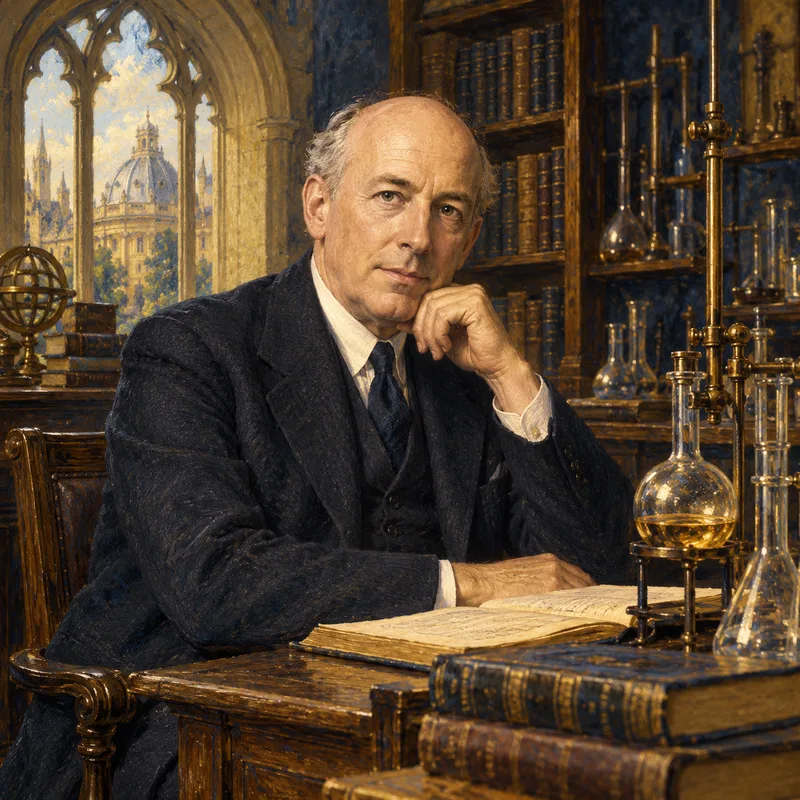
Cyril Hinshelwood
1897-1967 · United Kingdom · Nobel Chemistry 1956
Chemical reaction kinetics and mechanisms