The discovery, explained · Chemist no. 131 of 350
Cyril Hinshelwood and Chemical Kinetics: How Reactions Really Happen
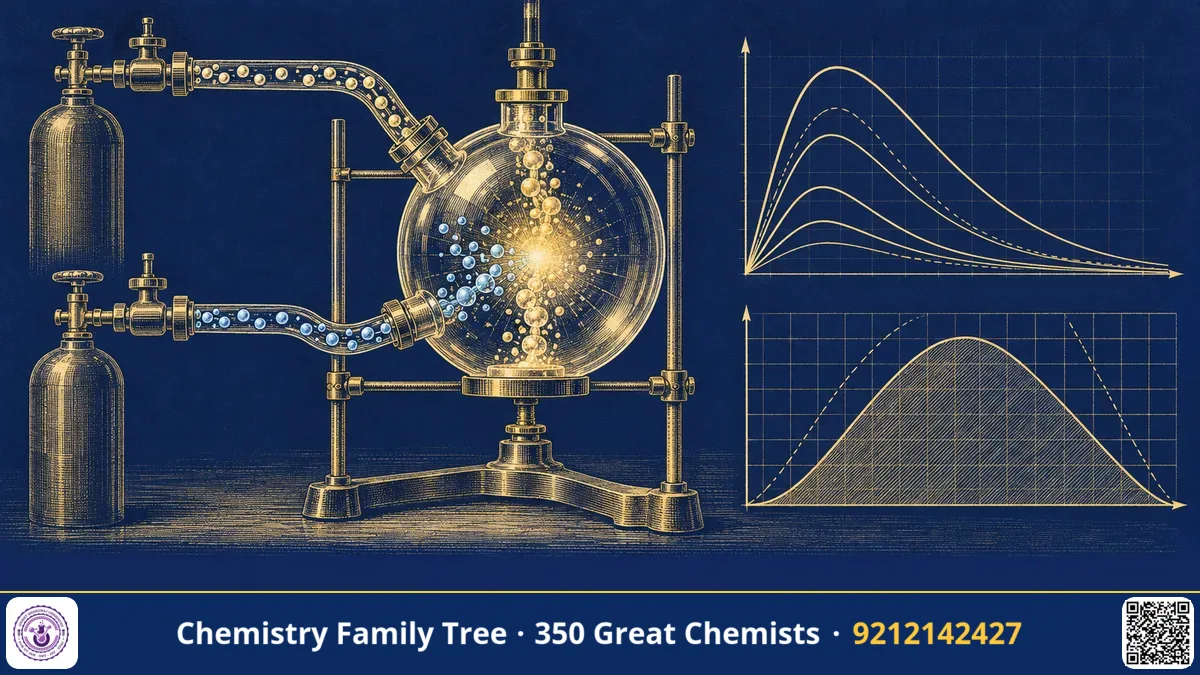
Why does hydrogen burn explosively in oxygen at some pressures and quietly at others? Why does a gas molecule that decomposes on its own follow first-order kinetics at high pressure but second-order at low pressure? These questions troubled chemists in the early twentieth century. The British physical chemist Sir Cyril Norman Hinshelwood spent his career answering them. His careful measurements, and his theoretical treatment of unimolecular reactions and chain reactions, helped turn chemical kinetics into a modern science. In 1956 he shared the Nobel Prize in Chemistry with Nikolay Semenov "for their researches into the mechanism of chemical reactions". This post explains the core ideas in a form useful for JAM, NET and GATE.
The Scientific Problem Before the Discovery
By 1900 chemists knew the rate law, Arrhenius's equation k = A e^(−Ea/RT), and the concept of order. But a basic puzzle remained. A unimolecular reaction, such as the decomposition of a single molecule A → products, should be first-order. Yet if a molecule needs energy Ea to react, where does the energy come from? The only source in a gas is collision with other molecules. But collisions are bimolecular events, so they should give second-order kinetics. Experiments, however, showed first-order behaviour at ordinary pressures. Frederick Lindemann proposed an answer in 1922, and Hinshelwood gave it a firm quantitative form.
A second puzzle concerned reactions such as H₂ + O₂ and H₂ + Br₂. Their rate laws were strange: HBr formation does not follow a simple second-order law, and hydrogen-oxygen mixtures explode within sharp pressure limits.
The Discovery: Step by Step
- Measure carefully. At Oxford, Hinshelwood and his students studied gas reactions in carefully designed vessels by measuring pressure changes over time. They studied the decomposition of nitrogen pentoxide, acetaldehyde, azomethane and ethers, and investigated the effect of vessel surface, added gases and pressure.
- Test the Lindemann idea. They showed that the rate constant of a unimolecular reaction falls at low pressure, as predicted, and they developed the theory (Lindemann-Hinshelwood mechanism) with the idea that internal vibrational energy contributes to the rate.
- Study chain reactions. He examined the hydrogen-oxygen reaction in the 1920s and 1930s, determining the pressure limits where explosion starts. He independently reached many conclusions similar to those of Semenov in Russia, who had worked on the theory of branching chains.
- Write the synthesis. His 1926 book The Kinetics of Chemical Change in Gaseous Systems became a classic textbook for many years.
The Chemistry Behind It
Lindemann-Hinshelwood mechanism. A molecule A is first energised by collision with another molecule M, then it either loses its energy again or reacts:
A + M  ⇌  A* + M     (k₁ forward, k₋₁ back)
A*  →  Products       (k₂)
Applying the steady-state approximation to A*:
[A*] = k₁[A][M] / (k₋₁[M] + k₂)
Rate = k₂[A*] = k₁k₂[A][M] / (k₋₁[M] + k₂)
- High pressure: k₋₁[M] ≫ k₂, so Rate = (k₁k₂/k₋₁)[A], which is first-order in A.
- Low pressure: k₋₁[M] ≪ k₂, so Rate = k₁[A][M], which is second-order overall.
This fall-off from first to second order with falling pressure was confirmed experimentally. The simple theory somewhat under-predicts the pressure at which the change occurs, which led Hinshelwood, and later Rice, Ramsperger, Kassel and Marcus (RRKM), to improve it by allowing energy to be shared among many vibrational modes.
Chain reactions. In the H₂ + Br₂ reaction the observed rate law is complex:
Rate = k[H₂][Br₂]^½ / (1 + k′[HBr]/[Br₂])
This is explained by a chain mechanism with initiation (Br₂ → 2Br•), propagation (Br• + H₂ → HBr + H•; H• + Br₂ → HBr + Br•), inhibition (H• + HBr → H₂ + Br•) and termination (2Br• → Br₂). In the hydrogen-oxygen reaction, chain branching occurs: H• + O₂ → •OH + O: and O: + H₂ → •OH + H•, where one radical produces more than one radical. When branching beats termination, the rate grows exponentially and the mixture explodes. At low pressure radicals reach the wall and are destroyed, and at very high pressure three-body termination wins, giving the lower and upper explosion limits.
Applications Today
- Combustion engineering. Branching and termination steps are the basis of engine knock, flame propagation, and explosion safety in petrochemical plants.
- Atmospheric chemistry. Pressure-dependent rate constants of unimolecular and recombination steps are used in ozone and smog models.
- Industrial kinetics. Cracking of hydrocarbons for petrol, ethylene production and polymerisation follow chain mechanisms.
- Pharmaceutical stability. Free-radical chain oxidation and its inhibition by antioxidants are central to drug shelf life.
- Space and defence. Rocket propellant ignition is analysed using branching kinetics.
Exam Corner
- Lindemann-Hinshelwood: A + M ⇌ A* + M, A* → P. First-order at high pressure, second-order at low pressure.
- The steady-state approximation for A*: d[A*]/dt = 0.
- Chain steps: initiation, propagation, inhibition, termination; branching gives explosion.
- H₂ + Br₂ rate law has [Br₂]^½ from Br₂ dissociation equilibrium and an inhibition term from HBr.
- Hinshelwood and Semenov shared the 1956 Nobel Prize in Chemistry.
Common Misconceptions
- "Molecularity and order are the same thing." Molecularity applies only to elementary steps; order is an experimental quantity. A unimolecular reaction can show second-order kinetics at low pressure.
- "Explosion occurs at the highest pressure." Hydrogen-oxygen has explosion limits: it may not explode at very low or very high pressures at a given temperature.
- "A chain reaction is always an explosion." Only branching chains can explode; a steady chain like HBr formation runs smoothly.
Quick Revision Box
- Lindemann (1922) and Hinshelwood explained unimolecular reactions by collisional activation.
- Rate = k₁k₂[A][M] / (k₋₁[M] + k₂).
- Order changes from 1 to 2 as pressure falls.
- Chain reactions have initiation, propagation, branching, inhibition and termination.
- Hydrogen-oxygen explosion limits depend on pressure and temperature.
- Nobel Prize in Chemistry 1956, shared with N. N. Semenov.
FAQ
What is the Lindemann-Hinshelwood mechanism?
It is a model for unimolecular gas reactions in which a molecule is energised by collision and then reacts, explaining why order shifts with pressure.
Why do reactions have explosion limits?
Because radicals are removed at the vessel wall at low pressure and by three-body collisions at high pressure, while branching increases them in between.
Did Hinshelwood win alone?
No. He shared the 1956 Nobel Prize in Chemistry with Nikolay Semenov.
Which equation does the theory use?
The steady-state approximation applied to the energised molecule, together with the Arrhenius equation for rate constants.
Published by ABC Chemistry — IIT-JAM | CSIR-NET | GATE Chemistry Coaching. Visit abcchemistry.com
About the chemist
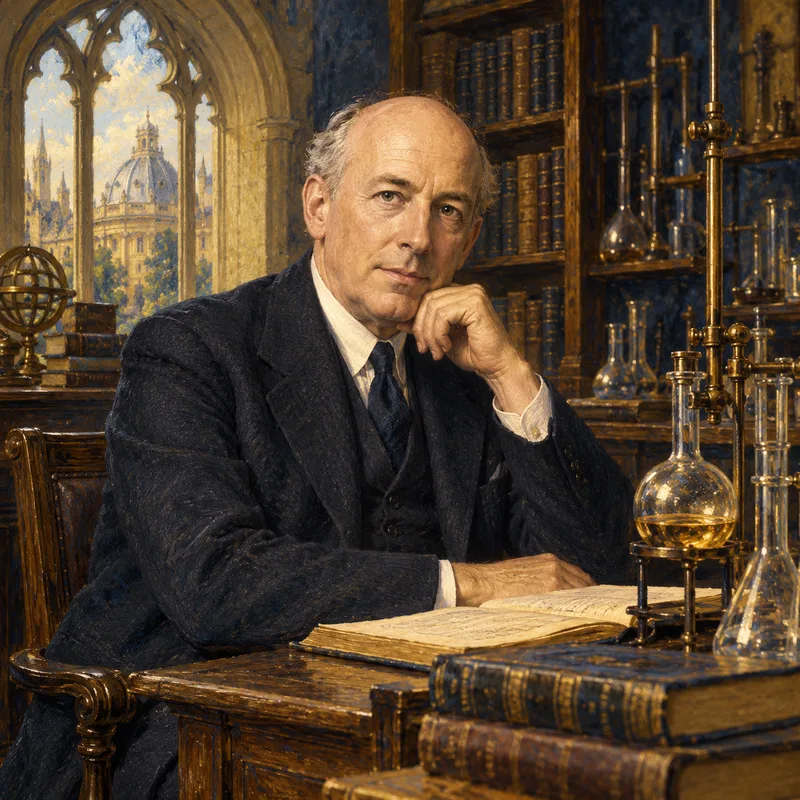
Cyril Hinshelwood
1897-1967 · United Kingdom · Nobel Chemistry 1956
Chemical reaction kinetics and mechanisms