The discovery, explained · Chemist no. 2 of 350
Dalton's Atomic Theory: How John Dalton Made the Atom a Chemical Idea
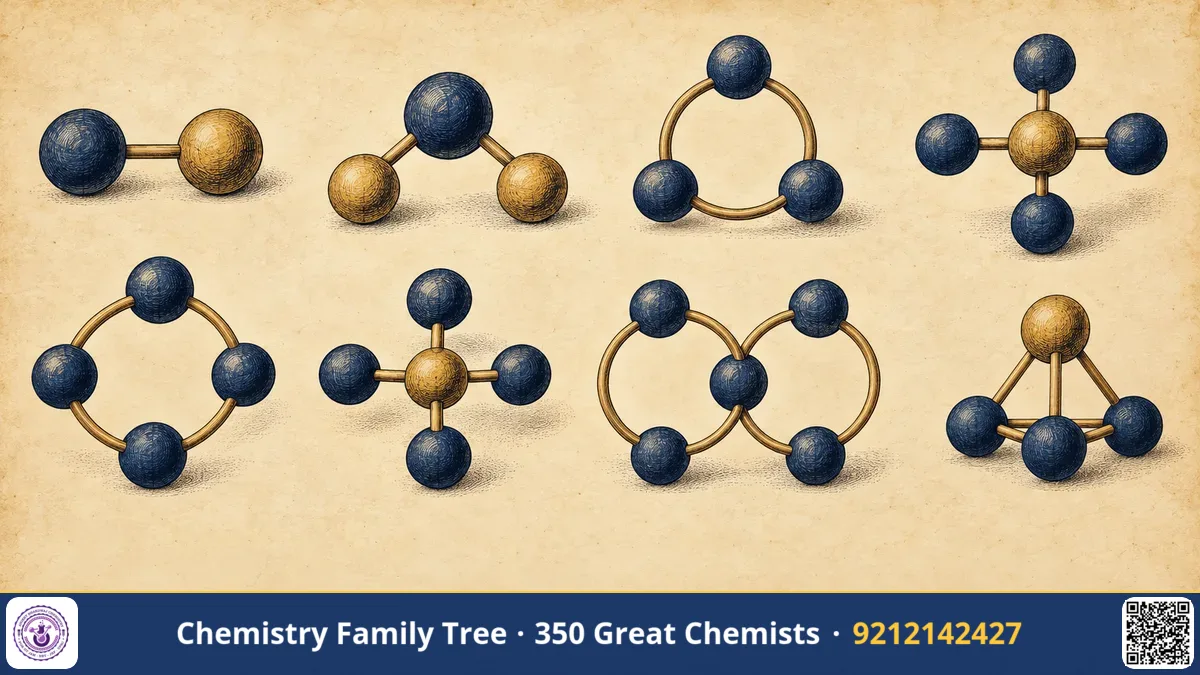
The idea of atoms is very old. Greek thinkers such as Democritus spoke of tiny indivisible particles, and in ancient India the Vaisheshika school of Kanada also proposed that matter is made of indivisible units called paramanu. But these were philosophical ideas. It was John Dalton, an English schoolteacher and scientist, who in the first years of the 1800s turned the atom into a measurable, testable chemical concept. He linked atoms to mass, to chemical formulae and to the experimental laws of combination. Every stoichiometry problem you solve today still stands on his work.
The Scientific Problem Before the Discovery
By 1800, chemists already had several experimental laws, but no single explanation that tied them together.
- Law of conservation of mass (Lavoisier): mass is neither created nor destroyed in a chemical reaction.
- Law of definite proportions (Proust): a given compound always contains the same elements in the same proportion by mass.
The question was: why? Why should compounds have fixed composition, and why should mass be conserved? Chemists did not have a particle picture that could explain these facts in a simple way. Dalton, who was studying gases and the atmosphere, was well placed to see the connection.
The Discovery: Steps in Dalton's Thinking
- Studying the atmosphere (1790s-1801). Dalton kept a daily weather diary for most of his life and asked why the different gases of air do not separate into layers by weight. He concluded that each gas behaves independently in a mixture, and in 1801 he announced the law of partial pressures.
- Gas solubility and particle size. While studying how gases dissolve in water, he proposed that the particles of different gases differ in size and weight, and he began to think of ways to find their relative weights.
- Analysing compounds (1803). He examined oxides of nitrogen and hydrocarbons such as methane (which he called "carburetted hydrogen") and "olefiant gas" (ethene). He noticed that when two elements form more than one compound, the masses of one element that combine with a fixed mass of the other are in small whole-number ratios. This is the law of multiple proportions.
- Table of atomic weights (1803). He prepared the first table of relative atomic weights, using hydrogen as the unit.
- Publication (1808). He presented his ideas fully in A New System of Chemical Philosophy, with circle symbols for atoms.
The Chemistry Behind It
The postulates of Dalton's atomic theory
- Matter is made of extremely small, indivisible particles called atoms.
- Atoms of a given element are identical in mass and properties; atoms of different elements differ in mass and properties.
- Atoms can neither be created nor destroyed in a chemical reaction.
- Compounds are formed when atoms of different elements combine in fixed, simple whole-number ratios.
- A chemical reaction is only a rearrangement of atoms.
How the theory explains the laws
If atoms cannot be created or destroyed, the total mass cannot change (conservation of mass). If every molecule of a compound has the same number of atoms of each kind, and each atom has a fixed mass, the composition by mass must be fixed (definite proportions). If two elements can combine in different whole-number ratios, then the masses will be related by simple whole numbers (multiple proportions).
Law of multiple proportions: worked example
| Compound | Mass of C | Mass of O combined with it | Ratio of O |
|---|---|---|---|
| CO | 12 g | 16 g | 1 |
| CO₂ | 12 g | 32 g | 2 |
The masses of oxygen that combine with a fixed 12 g of carbon are in the ratio 16 : 32 = 1 : 2, a simple whole-number ratio. The same applies to the oxides of nitrogen: N₂O, NO, N₂O₃, NO₂ and N₂O₅ contain 16, 32, 48, 64 and 80 parts of oxygen respectively for 28 parts of nitrogen, a ratio of 1 : 2 : 3 : 4 : 5.
Dalton's law of partial pressures
For a mixture of non-reacting gases, the total pressure is the sum of the pressures each gas would exert alone.
P(total) = P₁ + P₂ + P₃ + ...
P₁ = x₁ × P(total)    (x₁ = mole fraction of gas 1)
Where Dalton was wrong
Dalton assumed that when two elements form only one compound, the compound has a 1 : 1 ratio, which led him to write water as HO and ammonia as NH. This "rule of greatest simplicity" was a mistake, and it gave wrong atomic weights. Later, the work of Gay-Lussac on combining volumes, and Avogadro's hypothesis, helped fix these errors, though Avogadro's ideas were widely accepted only after Cannizzaro in 1860. Today we also know that atoms are not indivisible (they contain protons, neutrons and electrons), and atoms of the same element can have different masses (isotopes).
Applications Today
- Stoichiometry and formulae. Every mole-based calculation assumes that atoms combine in fixed ratios.
- Gas mixtures in industry and medicine. Anaesthetic gas mixtures, scuba diving gases and the oxygen supply at high altitude are designed using partial pressures. Oxygen partial pressure on top of Mount Everest is far lower than at sea level, even though the percentage of oxygen is the same.
- Respiration and blood gases. Gas exchange in the lungs depends on differences in partial pressure.
- Collecting gases over water. In school laboratories, the pressure of dry gas is found by subtracting the water vapour pressure from the total pressure.
- Indian context. Questions on gas mixtures, partial pressure and the mole concept appear in every competitive exam from NEET and JEE to JAM and GATE.
Exam Corner
- Law of multiple proportions is due to Dalton; definite proportions is due to Proust; conservation of mass is due to Lavoisier.
- Dalton's theory could not explain isotopes, isobars, allotropes or Gay-Lussac's law of combining volumes.
- Partial pressure of a gas = mole fraction × total pressure. For a gas mixture, the sum of mole fractions is 1.
- Dalton's atomic theory postulate that atoms are indivisible was disproved after the discovery of the electron (J. J. Thomson, 1897).
- Example problem: if a 10 L container holds 2 mol H₂ and 3 mol N₂ at a total pressure of 5 atm, then p(H₂) = (2/5) × 5 = 2 atm.
Common Misconceptions
- "Dalton invented the idea of the atom." No. The idea is ancient. Dalton's contribution was to connect atoms with measurable masses and chemical laws.
- "Dalton's theory is wrong, so it is useless." Parts of it are outdated, but the core ideas of elements having characteristic atoms, compounds having fixed ratios and reactions rearranging atoms remain valid.
- "Dalton's law applies to all gases." It holds well for ideal gases and for mixtures that do not react with each other. If gases react, the law cannot be applied directly.
Quick Revision Box
- Dalton's atomic theory was published in 1808 in A New System of Chemical Philosophy.
- Law of multiple proportions: for a fixed mass of one element, the masses of the other are in simple whole-number ratios.
- Law of partial pressures (1801): P(total) = sum of partial pressures.
- Dalton's theory explains conservation of mass and definite proportions.
- Limitations: indivisible atom, identical atoms of an element, and the rule of greatest simplicity are wrong.
- Hydrogen was used as the unit for his first atomic weights.
FAQ
What are the main postulates of Dalton's atomic theory?
Matter is made of atoms; atoms of an element are identical; atoms are neither created nor destroyed; compounds are formed by atoms combining in simple whole-number ratios; reactions are rearrangements of atoms.
What is the law of multiple proportions?
When two elements form more than one compound, the different masses of one element that combine with a fixed mass of the other are in a ratio of small whole numbers, as in CO and CO₂.
Why is Dalton's atomic theory called a milestone?
It was the first theory to explain several experimental laws using one idea, and it gave chemists a way to calculate and compare atomic weights.
What is Dalton's law of partial pressures used for?
It is used to calculate the pressure contributed by each gas in a mixture, to correct for water vapour when gases are collected over water, and to design breathing gas mixtures.
Published by ABC Chemistry — IIT-JAM | CSIR-NET | GATE Chemistry Coaching. Visit abcchemistry.com
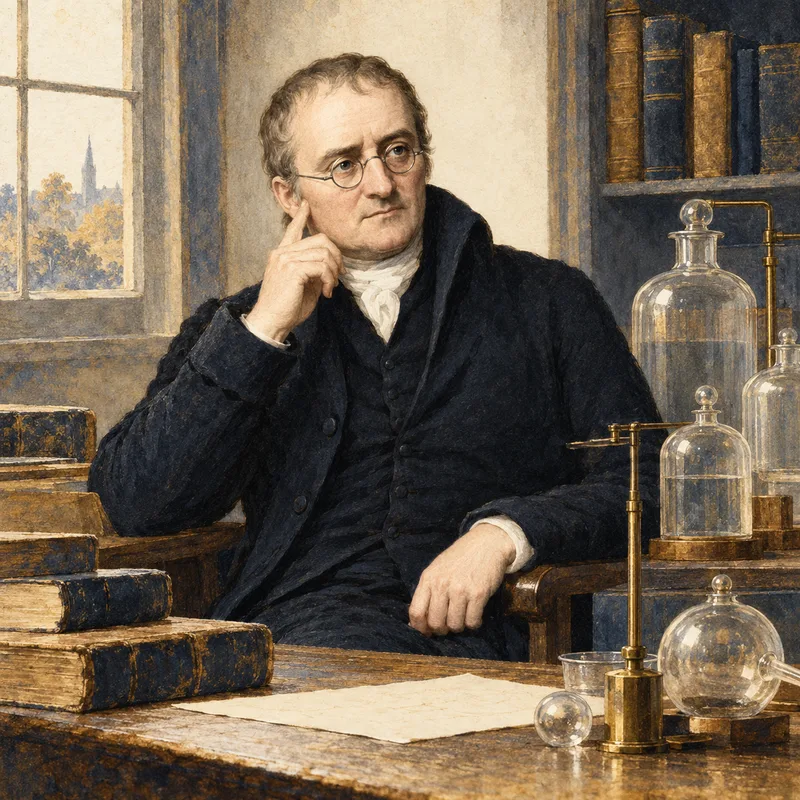
About the chemist
John Dalton
1766-1844 · United Kingdom
Atomic theory; law of partial pressures