Biography · Chemist no. 2 of 350
John Dalton: The Life of the Quaker Teacher Who Gave Chemistry Its Atoms
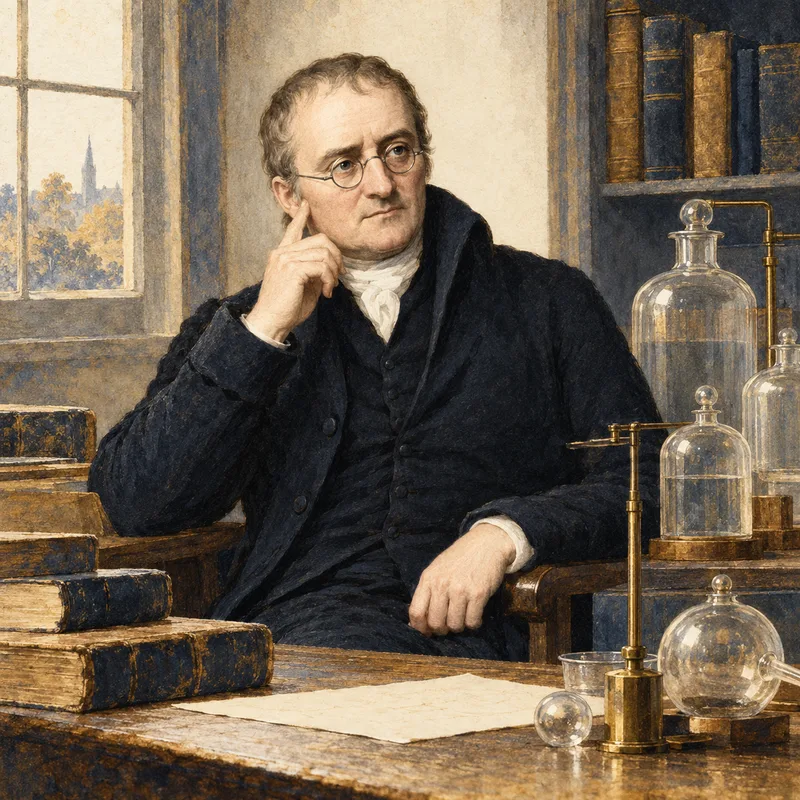
John Dalton (1766-1844) was an English chemist, physicist and meteorologist best known for his atomic theory. Born into a poor Quaker weaving family in a small village, he began teaching at the age of twelve, taught himself mathematics and natural philosophy, and went on to become one of the most respected scientists in Britain. His legacy in one line: he made the atom a measurable idea and gave chemistry its first table of atomic weights.
Early Life and Family
John Dalton was born on 6 September 1766 at Eaglesfield, near Cockermouth in Cumberland, in northern England. His father, Joseph, was a hand-loom weaver and his mother, Deborah, took care of the family. The Daltons were members of the Religious Society of Friends, the Quakers, whose values of simplicity, honesty and plain living stayed with John all his life. The family was poor, and John and his brother Jonathan helped by working on the family's small land and in other jobs. Dalton never married, and he lived a quiet, regular life that was centred on his work, his teaching and his friends.
Education and Mentors
Dalton went to a Quaker school in his village, where he learnt quickly. At just twelve years old, he started teaching in the same village, and some years later he joined his brother in running a Quaker school in Kendal. His most important mentors were:
- Elihu Robinson, a Quaker neighbour in Cumberland, who was interested in meteorology and mathematics and encouraged his early scientific interests.
- John Gough, a blind philosopher and scholar in Kendal, who taught him languages, mathematics and science. Gough's help was very valuable to a young man without formal university education.
Dalton did not attend a university as a student. He was largely self-educated, and this makes his later success even more remarkable.
Career Timeline
| Year | Event |
|---|---|
| 1766 | Born at Eaglesfield, Cumberland on 6 September |
| 1778 | Starts teaching at the village Quaker school at about age 12 |
| 1781 | Moves to Kendal to teach at a school |
| 1787 | Begins keeping a meteorological diary, which he continues until his death |
| 1793 | Moves to Manchester as a teacher of mathematics and natural philosophy at the New College; publishes Meteorological Observations and Essays |
| 1794 | Elected to the Manchester Literary and Philosophical Society; presents the first scientific paper on colour blindness |
| 1801 | Announces the law of partial pressures |
| 1803 | Presents his atomic ideas and first table of atomic weights |
| 1808 | Publishes the first part of A New System of Chemical Philosophy |
| 1822 | Elected Fellow of the Royal Society |
| 1826 | Receives the Royal Medal of the Royal Society |
| 1832 | Receives an honorary degree from Oxford University |
| 1844 | Dies in Manchester on 27 July |
Major Scientific Contributions
Atomic theory. Dalton proposed that each element consists of atoms with a characteristic mass and that compounds form when atoms combine in simple ratios. This explained the laws of conservation of mass, definite proportions and his own law of multiple proportions. See our discovery post on Dalton's atomic theory for the full postulates and limitations.
Law of partial pressures. In a mixture of non-reacting gases, the total pressure equals the sum of the partial pressures: P(total) = P₁ + P₂ + P₃ + ...
Atomic weights. He created the first table of relative atomic weights, though some values were wrong because he assumed wrong formulae such as HO for water.
Gas laws. He studied the thermal expansion of gases and found that gases expand by nearly the same fraction for the same rise in temperature, a result close to Charles's law (also studied by Gay-Lussac).
Meteorology. He kept his weather diary for more than fifty years and made a very large number of observations, studying rainfall, dew point, evaporation and the aurora.
Colour blindness. In 1794 he wrote the first scientific description of colour vision deficiency, after he realised that he and his brother could not see colours as other people did. The condition was long called Daltonism, and the term is still used in some languages today.
Awards, Honours and Nobel Prize
Nobel Prizes began in 1901, long after Dalton's death, so he could not receive one. His honours came in his own lifetime:
- Fellow of the Royal Society (1822).
- Royal Medal of the Royal Society (1826).
- Foreign associate of the French Academy of Sciences (1830).
- Honorary doctorate from Oxford University (1832).
- A government pension, granted in 1833 and later increased, which helped him continue his research.
Personality, Struggles and Lesser-Known Facts
- A plain life. He was known for regular habits. He took the same walks, taught his classes, worked in his laboratory and recorded the weather every day.
- The scarlet gown. Quakers avoid showy dress. When Dalton received his Oxford degree, the academic robe was bright red (scarlet), which would normally be a problem for a Quaker. Since he was colour blind, the robe looked to him like a dull olive-green, and so he could wear it without discomfort.
- A teacher by habit. He earned much of his living by private teaching, and often lectured to students in Manchester and other places, but he was known as a rather plain speaker rather than a showman.
- A brilliant mind, clumsy hands. He was said to be not very skilful in experimental manipulation and made some errors in laboratory work, which partly explains the inaccuracies in some of his atomic weights.
- A famous funeral. When he died in 1844, thousands of people from Manchester came to see his coffin and pay their respects, which shows how much the city valued him.
- A scientific follow-up. After his death, his eyes were preserved. Dalton had believed that the liquid inside his eye was tinted blue. More than 150 years later, in the 1990s, DNA tests on the preserved tissue showed instead that he had a form of colour blindness called deuteranopia, so his own explanation was not correct.
Legacy and Influence on Modern Chemistry
Dalton's atomic theory became the starting point for chemical formulae, atomic weights and, later, the periodic table. Berzelius improved atomic weight measurements and introduced letter symbols that replaced Dalton's circles. Mendeleev's periodic law, which arranged elements by atomic weight, would not have been possible without the atomic weight concept. Even the SI unit "mole" follows from the idea of counting atoms through mass. The atomic mass unit and Avogadro's constant are modern developments built on his basic idea. The Dalton (Da) is even used today as a unit of mass for atoms and large molecules such as proteins.
Lessons for Students
- You do not need an expensive start. Dalton was self-educated and poor, but his habits of study and observation took him to the top.
- Keep records. His daily weather notes led him towards his theory of gases.
- Look for the unifying idea. Several laws became one theory in his mind.
- Be ready to be corrected. Many of his formulae were wrong, but science corrected them and kept the useful core.
- Turn limitations into questions. His own colour blindness led to the first scientific study of the condition.
Quick Facts Box
- Born: 6 September 1766, Eaglesfield, Cumberland, England
- Died: 27 July 1844, Manchester, England
- Nationality: English (British)
- Field: Chemistry, physics, meteorology
- Famous for: Atomic theory, law of multiple proportions, law of partial pressures, colour blindness study
- Nobel Prize: None (died before 1901)
FAQ
Why is John Dalton important for chemistry students?
His atomic theory underlies stoichiometry, the mole concept and the study of chemical formulae. Two gas and combination laws carry his name in your syllabus.
Was Dalton colour blind?
Yes. He wrote the first scientific account of colour blindness in 1794, and the condition was once called Daltonism after him.
Did Dalton go to university?
No. He was largely self-taught, though he later taught at New College in Manchester and received an honorary degree from Oxford.
What is the unit Dalton (Da)?
It is a unit of atomic mass, nearly equal to one atomic mass unit, widely used in biochemistry and mass spectrometry to express the mass of molecules.
Published by ABC Chemistry — IIT-JAM | CSIR-NET | GATE Chemistry Coaching. Visit abcchemistry.com
About the chemist
John Dalton
1766-1844 · United Kingdom
Atomic theory; law of partial pressures