The discovery, explained · Chemist no. 226 of 350
AlphaFold: How Demis Hassabis and DeepMind Cracked a 50-Year-Old Problem in Chemistry and Biology
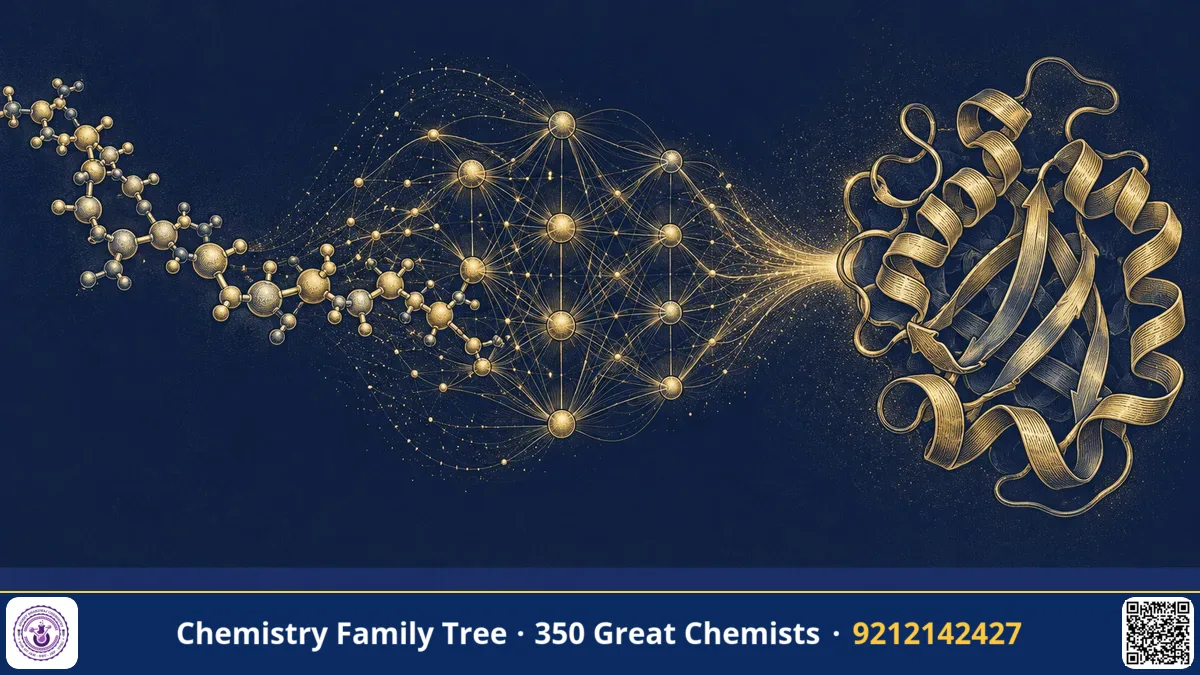
In November 2020, the organisers of a worldwide contest on protein structure prediction announced that a computer program had, for the first time, reached accuracy comparable to experiments. The program was AlphaFold2, built by a team at DeepMind led by Demis Hassabis and John Jumper. Within two years the program had predicted the structures of more than 200 million proteins, almost every known protein, and the results were made free to the world in a public database. In 2024 Hassabis and Jumper shared half of the Nobel Prize in Chemistry "for protein structure prediction". The other half went to David Baker for computational protein design.
This post explains the protein folding problem, how AlphaFold approaches it, and the chemistry background you should know for exams.
The Scientific Problem Before the Discovery
A protein is a chain of amino acids. The chain folds into a unique three-dimensional shape, and the shape defines the function. Hemoglobin carries oxygen, insulin signals sugar levels, and enzymes catalyse reactions only because of their folded shapes. To know how a protein works, or to design a drug that blocks it, you need its structure.
For decades the only way to get the structure was experiment:
- X-ray crystallography (first used for myoglobin by John Kendrew in 1958), which needs crystals that can be hard or impossible to grow.
- NMR spectroscopy, limited mainly to smaller proteins.
- Cryo-electron microscopy, powerful but expensive and needing specialised equipment.
Each structure could take months or years. By about 2020, sequences of hundreds of millions of proteins were known, but only about 170,000 structures were in the Protein Data Bank. In 1972 Christian Anfinsen had suggested in his Nobel lecture that the sequence should determine structure, which led to the "protein folding problem": can we predict the structure from the sequence alone? Since 1994, a biennial contest called CASP (Critical Assessment of protein Structure Prediction) has tested prediction methods on proteins whose structures are solved but not yet public. Progress was slow until AlphaFold.
The Discovery / Experiment
Hassabis, a neuroscientist and AI researcher, co-founded DeepMind in 2010. After building programs that mastered games such as Go (AlphaGo, 2016), he turned his attention to science. His aim, as he has said, was to use AI to solve fundamental scientific problems, and protein folding was an ideal target because there was a large public dataset and a fair competition (CASP) to measure success.
- AlphaFold1 (2018). Entered in CASP13, it used deep learning to predict distances between pairs of amino acids and then built a structure that satisfied them. It won CASP13 but was not yet at experimental accuracy.
- AlphaFold2 (2020). A new design led by John Jumper, with an attention-based neural network, directly predicted the 3D coordinates of all atoms. In CASP14 it reached a median accuracy (GDT score) of around 90 for many targets, comparable to experiments.
- Publication and database (2021). DeepMind published the method in Nature and released the code. With the European Bioinformatics Institute (EMBL-EBI) it launched the AlphaFold Protein Structure Database, expanding in 2022 to more than 200 million predicted structures.
Amino acid sequence → find related sequences (MSA) + templates
→ neural network (Evoformer + structure module)
→ 3D coordinates + confidence score (pLDDT)
The Chemistry Behind It
Co-evolution. If two amino acids are in contact in the folded protein, a mutation in one often needs a compensating mutation in the other to keep the protein stable. By aligning thousands of related sequences from different species (a multiple sequence alignment, MSA), AlphaFold can detect such correlated changes and infer which residues are close in space.
Attention. AlphaFold2's "Evoformer" uses attention, an AI technique in which each element of the input weighs its relation to all others. It processes both the MSA and a map of residue pairs, and exchanges information between them repeatedly. A "structure module" then converts these into 3D positions, building the backbone and side chains while obeying chemical geometry (bond lengths, angles, chirality).
Confidence. The program reports pLDDT (predicted local distance difference test), a per-residue score from 0 to 100. Scores above 90 are very reliable; scores below 50 usually mean disordered regions.
| Method | Strength | Limitation |
|---|---|---|
| X-ray crystallography | Atomic resolution | Needs good crystals |
| NMR | Solution, dynamics | Small proteins |
| Cryo-EM | Large complexes | Costly equipment |
| AlphaFold | Fast, cheap, wide coverage | Predicts mainly static structures; not all states, ligands |
Protein structure basics you need: primary structure (sequence), secondary (alpha-helix, beta-sheet), tertiary (overall 3D fold, stabilised by hydrophobic effect, hydrogen bonds, salt bridges, disulfide bonds) and quaternary (assembly of subunits).
Applications Today
- Drug discovery. Structures of target proteins help design inhibitors. Hassabis founded Isomorphic Labs in 2021 to apply AI to drug discovery.
- Neglected diseases and public health. Researchers have used predicted structures to study proteins of malaria parasites and other pathogens.
- Enzyme and plastic degradation. Understanding enzymes that break down plastics or pollutants.
- Basic biology. Studying large protein complexes, such as the nuclear pore complex.
- Education and India. The database is free; students and researchers in India can use it in biochemistry projects without costly equipment.
Exam Corner
- Anfinsen's experiment on ribonuclease showed that the sequence contains the information for folding.
- Levinthal's paradox: random search of conformations would take impossibly long.
- CASP is the biennial community experiment testing structure prediction accuracy.
- pLDDT is the per-residue confidence score of AlphaFold.
- 2024 Nobel Prize in Chemistry: Baker (half), Hassabis and Jumper (half).
Common Misconceptions
- "AlphaFold replaced experimental structure determination." Experiments are still needed for validation, ligand binding and dynamics.
- "AlphaFold designs new proteins." It predicts structures; design is the area of Baker.
- "The AI discovered how proteins fold." It predicts the final structure but does not simulate the physical folding pathway.
Quick Revision Box
- AlphaFold1: CASP13, 2018. AlphaFold2: CASP14, 2020.
- Core idea: deep learning with attention using co-evolution information.
- Output: 3D coordinates plus pLDDT confidence.
- Database: more than 200 million predicted structures with EMBL-EBI.
- Team: Hassabis (DeepMind leader), Jumper (lead scientist on AlphaFold2).
- Nobel Prize in Chemistry 2024 (half, shared by Hassabis and Jumper).
FAQ
What is the protein folding problem?
It is the challenge of predicting a protein's 3D structure from its amino acid sequence.
Is AlphaFold free to use?
Predicted structures are freely available in the AlphaFold database, and the AlphaFold2 code was released openly.
Why is Hassabis, a computer scientist, a chemistry Nobel laureate?
The prize recognises the solution of a central chemical and biological problem, the relation between sequence and 3D structure, whatever the method.
What is a GDT score?
The Global Distance Test measures the similarity between a predicted and an experimental structure on a scale of 0 to 100.
Published by ABC Chemistry — IIT-JAM | CSIR-NET | GATE Chemistry Coaching. Visit abcchemistry.com
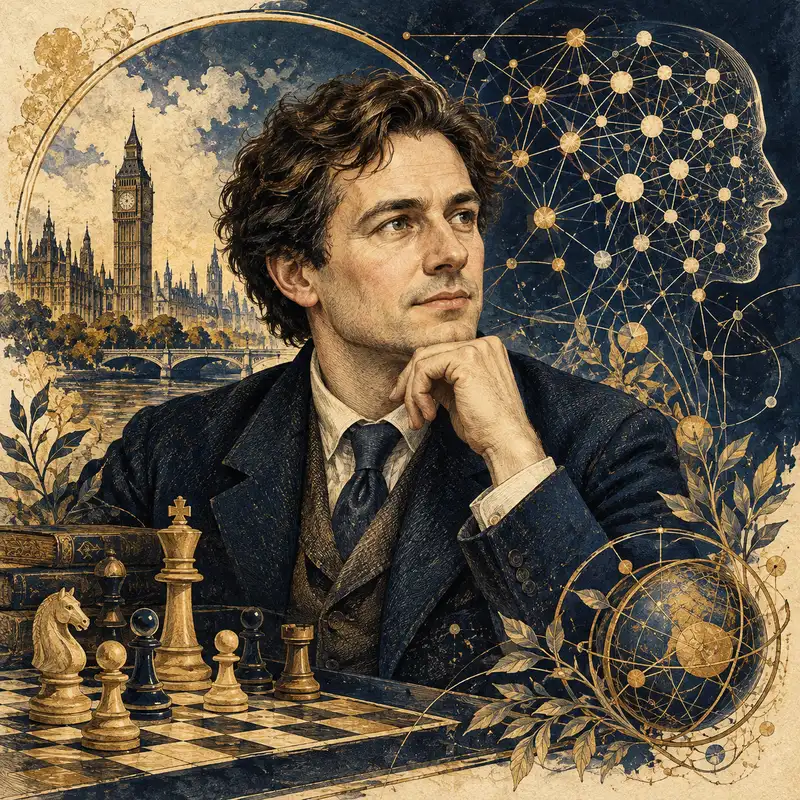
About the chemist
Demis Hassabis
1976- · United Kingdom · Nobel Chemistry 2024
AlphaFold protein structure prediction