Biography · Chemist no. 226 of 350
Demis Hassabis: From Chess Prodigy to Nobel Laureate in Chemistry
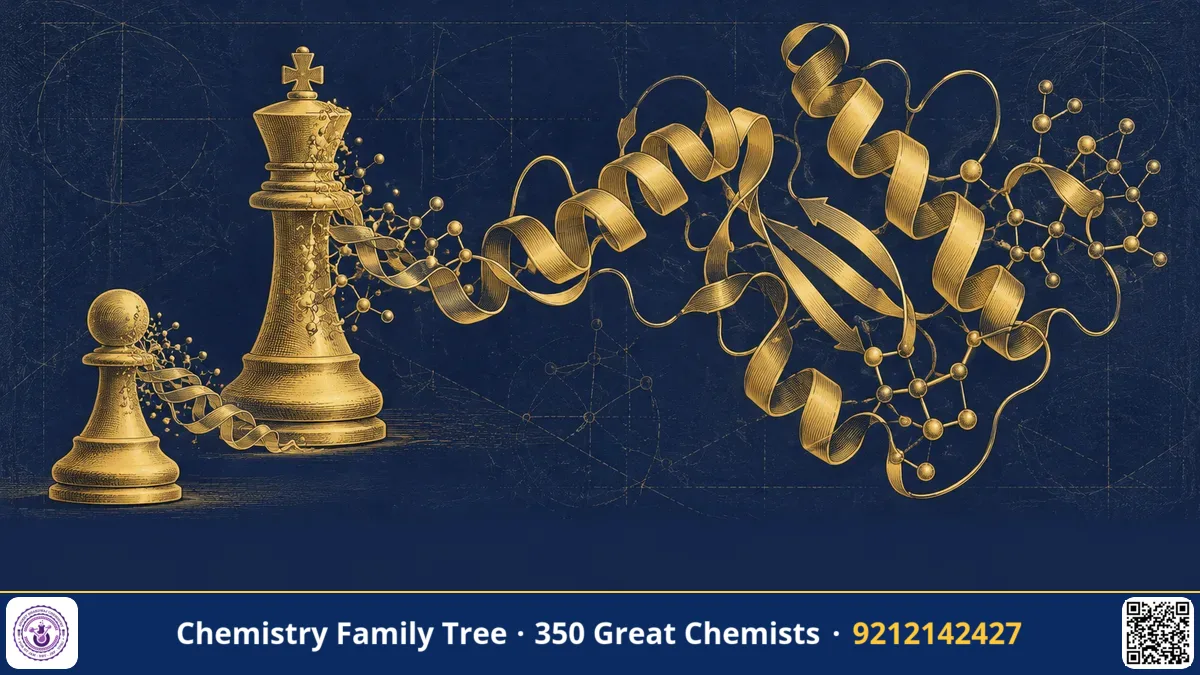
Sir Demis Hassabis, born in 1976 in London, is a British artificial intelligence researcher, neuroscientist and entrepreneur. He is co-founder and chief executive of Google DeepMind, whose AlphaFold program predicts protein structures from amino acid sequences. In 2024 he shared half of the Nobel Prize in Chemistry with John Jumper, while the other half went to David Baker. His legacy in one line: he showed that artificial intelligence can solve one of the great scientific problems, the protein folding problem.
Early Life and Family
Demis Hassabis was born on 27 July 1976 in London. His father is of Greek Cypriot descent and his mother is of Chinese Singaporean descent, and the family lived in North London. He was a gifted child. He began playing chess at the age of four, and became a chess master as a young teenager; by his early teens he was among the top-ranked players of his age in the world. With his prize money from chess he bought his first computer, a ZX Spectrum, and taught himself programming. This combination of games and computers shaped his path.
Education and Mentors
As a teenager Hassabis worked at the games company Bullfrog Productions, where he contributed to the game Theme Park, released in 1994 and a global success. He then studied computer science at the University of Cambridge (Queens' College), graduating in 1997. After graduation he founded his own games company, Elixir Studios, which made games such as Republic and Evil Genius. He later returned to academia and obtained a PhD in cognitive neuroscience at University College London in 2009, studying the role of the hippocampus in memory and imagination. His research showed that patients with damage to the hippocampus have difficulty imagining new experiences, suggesting that memory and imagination share the same brain systems. He then worked as a postdoctoral researcher at the Gatsby Computational Neuroscience Unit at UCL.
Career Timeline
| Year | Event |
|---|---|
| 1976 | Born in London |
| 1994 | Theme Park released, with his contribution as a young programmer at Bullfrog |
| 1997 | Graduates in computer science from Cambridge; founds Elixir Studios (1998) |
| 2009 | PhD in cognitive neuroscience, University College London |
| 2010 | Co-founds DeepMind with Shane Legg and Mustafa Suleyman |
| 2014 | Google acquires DeepMind |
| 2016 | AlphaGo defeats world champion Lee Sedol at Go |
| 2018-2020 | AlphaFold wins CASP13; AlphaFold2 achieves experimental-level accuracy at CASP14 |
| 2021 | AlphaFold2 published; Isomorphic Labs founded |
| 2024 | Nobel Prize in Chemistry (shared); knighted |
Major Scientific Contributions
Deep reinforcement learning. At DeepMind, Hassabis led work on systems that learn to play Atari video games from raw pixels, and on AlphaGo, AlphaZero (which mastered chess, shogi and Go by self-play) and related systems.
AlphaFold. The AlphaFold programme turned protein structure prediction into a largely solved problem for many proteins. Hassabis set the vision and guided the team; John Jumper led the technical development of AlphaFold2. Please read our discovery post for details.
Open scientific resources. With EMBL-EBI, DeepMind made the structures of more than 200 million proteins freely available.
AI for science. The group has produced AI systems for other scientific problems, including weather forecasting, nuclear fusion plasma control, and mathematics, with the idea that AI can be a tool for scientific discovery. Isomorphic Labs focuses on drug discovery.
Neuroscience. Before DeepMind, his research on the hippocampus, memory and imagination was published in leading journals and was named by the journal Science as one of the breakthroughs of the year in 2007.
Awards, Honours and Nobel Prize
Hassabis was awarded half of the 2024 Nobel Prize in Chemistry together with John Jumper "for protein structure prediction". He was knighted in 2024 for services to artificial intelligence. Other honours include the Lasker Award (2023, shared with Jumper), the Breakthrough Prize in Life Sciences (2023, also shared) and election as a Fellow of the Royal Society and the Royal Academy of Engineering.
Personality, Struggles and Lesser-Known Facts
- A child of games. He has said that games shaped his thinking about intelligence, strategy and learning.
- Mind sports. He was a strong competitor in the Mind Sports Olympiad, winning the Pentamind title several times.
- A long-term plan. He has said that he had planned for decades to build AI to help science, and that games were a stepping stone.
- Unusual Nobel path. He is a computer scientist and neuroscientist who won a chemistry Nobel; he has often said that biology is a perfect domain for AI.
- Concern about responsibility. He has publicly said that powerful AI should be developed carefully, with safety and ethics in mind.
Legacy and Influence on Modern Chemistry
AlphaFold changed the daily work of structural biologists and chemists. A researcher who needs the shape of a protein can now often get a good model in minutes, instead of waiting months. It has been used by millions of researchers across more than 190 countries, including a large community in India. The success also encouraged the development of new AI-based methods for molecules, materials and chemical reactions. It showed that when data, algorithms and a clear benchmark come together, a decades-old grand challenge can be solved.
Lessons for Students
- Cross boundaries. Games, neuroscience, AI and chemistry all contributed to his success.
- Choose important problems. He looked for a scientific problem where AI could make a difference.
- Use benchmarks. CASP gave an honest test of progress.
- Build strong teams. AlphaFold was a team effort of many scientists and engineers.
- Keep learning. He went from games to a PhD in neuroscience in order to understand intelligence better.
Quick Facts Box
- Born: 27 July 1976, London, England
- Died: Living
- Nationality: British
- Field: Artificial intelligence, neuroscience, computational biology
- Famous for: Co-founding DeepMind; AlphaGo; AlphaFold
- Nobel: Chemistry 2024 (half, with John Jumper)
FAQ
Is Demis Hassabis a chemist?
No. He is a computer scientist and neuroscientist, but his work solved a core problem in chemistry and biology, so the Nobel Prize in Chemistry recognised it.
What is DeepMind?
DeepMind is an AI research company founded in 2010, acquired by Google in 2014, and now part of Google as Google DeepMind.
Who worked with him on AlphaFold?
John Jumper led the AlphaFold2 development, together with a large team at DeepMind.
Why is his story useful for Indian students?
It shows how computing and data skills can be combined with chemistry and biology, a growing area in research and jobs.
Published by ABC Chemistry — IIT-JAM | CSIR-NET | GATE Chemistry Coaching. Visit abcchemistry.com
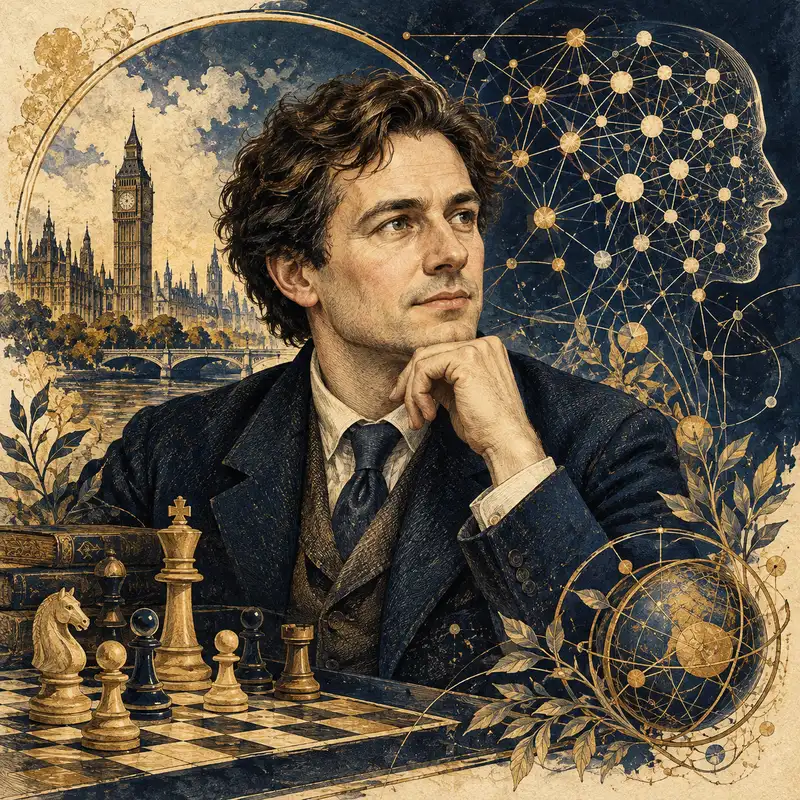
About the chemist
Demis Hassabis
1976- · United Kingdom · Nobel Chemistry 2024
AlphaFold protein structure prediction