Biography · Chemist no. 61 of 350
Sir Derek Barton: The Chemist Who Taught Molecules to Have Shape
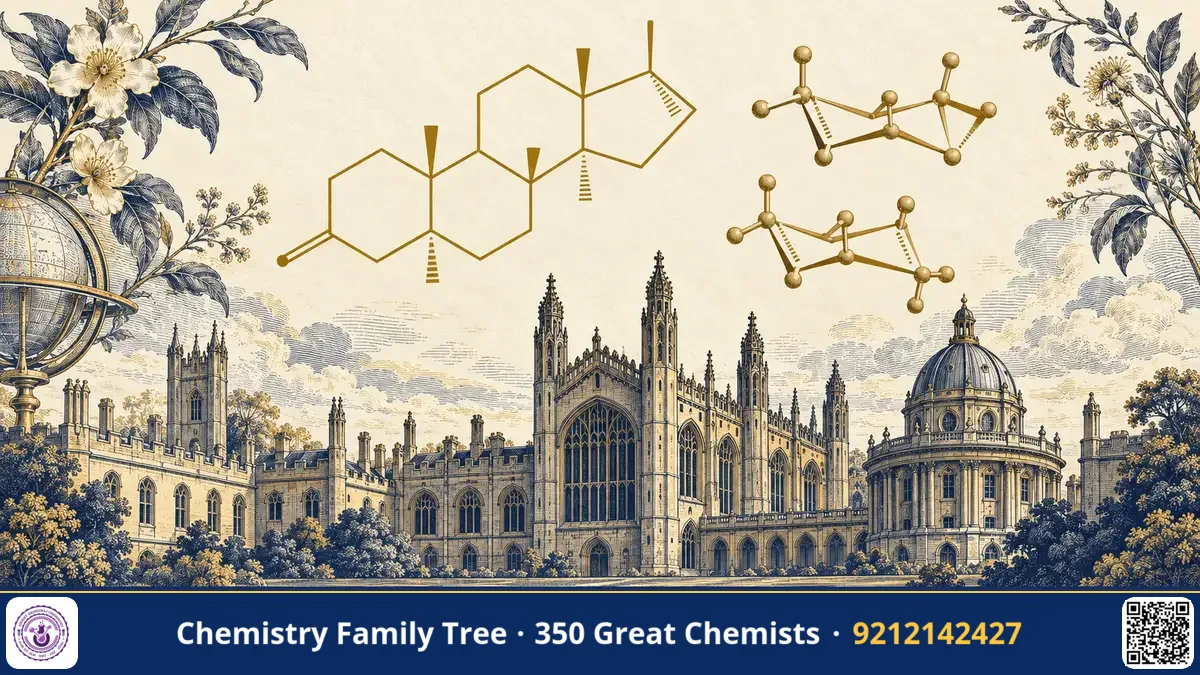
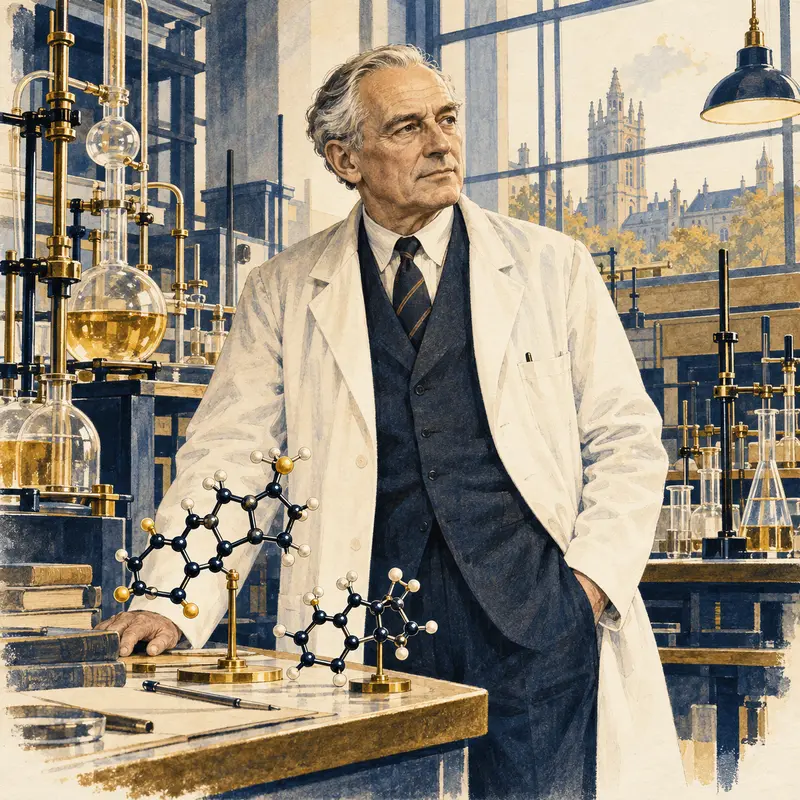
Sir Derek Harold Richard Barton (1918-1998) was a British organic chemist who changed the way chemists think about molecules in three dimensions. His short 1950 paper on steroid conformation founded conformational analysis, and he shared the 1969 Nobel Prize in Chemistry with Odd Hassel. Later in life, he also invented several important radical reactions that carry his name. He worked in Britain, France and the United States, and kept doing research until his death. This biography follows his life and the lessons it holds for young chemists.
Early Life and Family
Barton was born on 8 September 1918 in Gravesend, Kent, England. His father, William Thomas Barton, was a carpenter and timber merchant who ran a family business. Derek grew up in a modest home and showed an early interest in science. He attended Tonbridge School in Kent, where he studied hard, and where his interest in chemistry developed. His father died when Derek was a young man, and this affected the family greatly. He later recalled that he had to work hard and rely on scholarships and his own efforts to continue his studies.
Education and Mentors
Barton went to Imperial College, London, to study chemistry, and obtained his B.Sc. in 1940 (with first-class honours) and Ph.D. in 1942. His doctoral work was under Sir Ian Heilbron, although during the Second World War, he also worked on projects for military intelligence, which included research related to secret inks. After the war he returned to Imperial College as a lecturer and then travelled to Harvard as a visiting lecturer in 1949-50, where he wrote his famous paper on steroid conformation. At Harvard he met chemists like Louis Fieser, who encouraged his steroid studies.
Career Timeline
| Year | Event |
|---|---|
| 1918 | Born in Gravesend, Kent (8 September) |
| 1940 | B.Sc., Imperial College London |
| 1942 | Ph.D., Imperial College London |
| 1949-1950 | Visiting lecturer at Harvard; wrote "The Conformation of the Steroid Nucleus" |
| 1953 | Professor at Birkbeck College, London |
| 1955 | Regius Professor of Chemistry, University of Glasgow |
| 1957 | Professor at Imperial College London |
| 1960 | Barton nitrite photolysis reaction applied to aldosterone synthesis |
| 1969 | Nobel Prize in Chemistry, shared with Odd Hassel |
| 1972 | Knighted |
| 1975 | Barton-McCombie deoxygenation published |
| 1978 | Director of the Institut de Chimie des Substances Naturelles, Gif-sur-Yvette, France |
| 1986 | Joined Texas A&M University, USA |
| 1998 | Died in College Station, Texas (16 March) |
Major Scientific Contributions
1. Conformational analysis
Barton showed how the shape of the cyclohexane chair, with its axial and equatorial bonds, explains reactivity differences in steroids and terpenes. Details are in our companion post on his discovery.
2. Barton reaction
Photolysis of an alkyl nitrite (R-O-N=O) produces an alkoxy radical, which abstracts a hydrogen atom from the δ-carbon through a six-membered transition state. The resulting carbon radical recombines with NO to give a nitroso compound that tautomerises to an oxime. This remote functionalisation was used in a commercial synthesis of the hormone aldosterone.
R-O-N=O --hν--> RO· + NO → 1,5-H shift → ·C(δ) radical → γ-hydroxy oxime
3. Barton-McCombie deoxygenation
With S. W. McCombie in 1975, he developed a radical method to replace an OH group by H. The alcohol is converted to a thiocarbonyl derivative (xanthate), which reacts with tributyltin hydride (Bu3SnH) and a radical initiator such as AIBN:
R-OH → R-O-C(=S)-SMe (xanthate) --Bu3SnH, AIBN--> R-H
4. Barton decarboxylation and other radical chemistry
He developed radical decarboxylation of "Barton esters" (thiohydroxamate esters), and other radical reactions that made free-radical chemistry a reliable tool in synthesis. He also contributed to biosynthesis (phenol oxidative coupling in alkaloid biosynthesis) and the structure of natural products such as triterpenes.
Awards, Honours and Nobel Prize
Barton shared the Nobel Prize in Chemistry 1969 with Odd Hassel "for their contributions to the development of the concept of conformation and its application in chemistry". He was elected a Fellow of the Royal Society (1954), received the Royal Society's Davy Medal and Copley Medal (1995), and was knighted in 1972. He held honorary degrees from many universities and was a foreign member of many academies, including the National Academy of Sciences of the USA and the French Académie des Sciences.
Personality, Struggles and Lesser-Known Facts
- Humble beginnings: The son of a carpenter, he reached the highest level of science through scholarships and hard work.
- A four-page paper: His 1950 article that created conformational analysis was extremely short, but chemists often say it changed the way organic chemistry was taught.
- Wartime intelligence work: During the Second World War, he worked on projects connected with military intelligence, which gave him an unusual early experience of applied chemistry.
- Constant mover: He worked in London, Glasgow, Gif-sur-Yvette and Texas. In the 1970s he decided to move to France, and later accepted an offer from Texas A&M.
- Working to the end: He was still active in research, giving lectures and running a large group, in the last years of his life. Barton was known as an extremely hard worker and a demanding but inspiring research leader.
Legacy and Influence on Modern Chemistry
Every student who draws a chair cyclohexane and labels axial and equatorial positions is using Barton's way of thinking. His reactions are used worldwide: Barton-McCombie deoxygenation is a standard step in carbohydrate and nucleoside chemistry, and Barton decarboxylation is a convenient route to alkyl radicals. His group at Gif-sur-Yvette also studied selective oxidation of hydrocarbons, the so-called "Gif chemistry", trying to imitate the way enzymes oxidise C-H bonds. Many of his students and coworkers became leaders in chemistry in Europe, America and India.
Lessons for Students
- Look at molecules in 3D: Always draw the chair conformation when answering stereochemistry problems.
- Small papers can have big impact: Four pages were enough for a Nobel-worthy idea.
- Stay curious for life: Barton invented new reactions even in his sixties and seventies.
- Do not be limited by your background: The carpenter's son from Kent became Sir Derek Barton, a Nobel laureate.
Quick Facts Box
- Born: 8 September 1918, Gravesend, Kent, England
- Died: 16 March 1998, College Station, Texas, USA
- Nationality: British
- Field: Organic chemistry, stereochemistry, radical chemistry
- Famous for: Conformational analysis, Barton reaction, Barton-McCombie deoxygenation
- Nobel Prize: Chemistry 1969 (shared with Odd Hassel)
FAQ
What is the Barton-McCombie reaction?
It is the radical deoxygenation of alcohols by converting them to thiocarbonyl derivatives and reducing with tributyltin hydride.
Where did Derek Barton work?
He worked at Imperial College, Birkbeck College, the University of Glasgow, the Institut de Chimie des Substances Naturelles in France and finally Texas A&M University.
Why did Barton and Hassel share the Nobel Prize?
Hassel showed the chair form of cyclohexane and the types of bonds, and Barton applied this to steroids and organic reactivity, creating conformational analysis.
When was Barton knighted?
He was knighted in 1972.
Published by ABC Chemistry — IIT-JAM | CSIR-NET | GATE Chemistry Coaching. Visit abcchemistry.com
About the chemist
Derek Barton
1918-1998 · United Kingdom · Nobel Chemistry 1969
Conformational analysis