The discovery, explained · Chemist no. 61 of 350
Conformational Analysis: How Derek Barton Linked 3D Shape to Reactivity
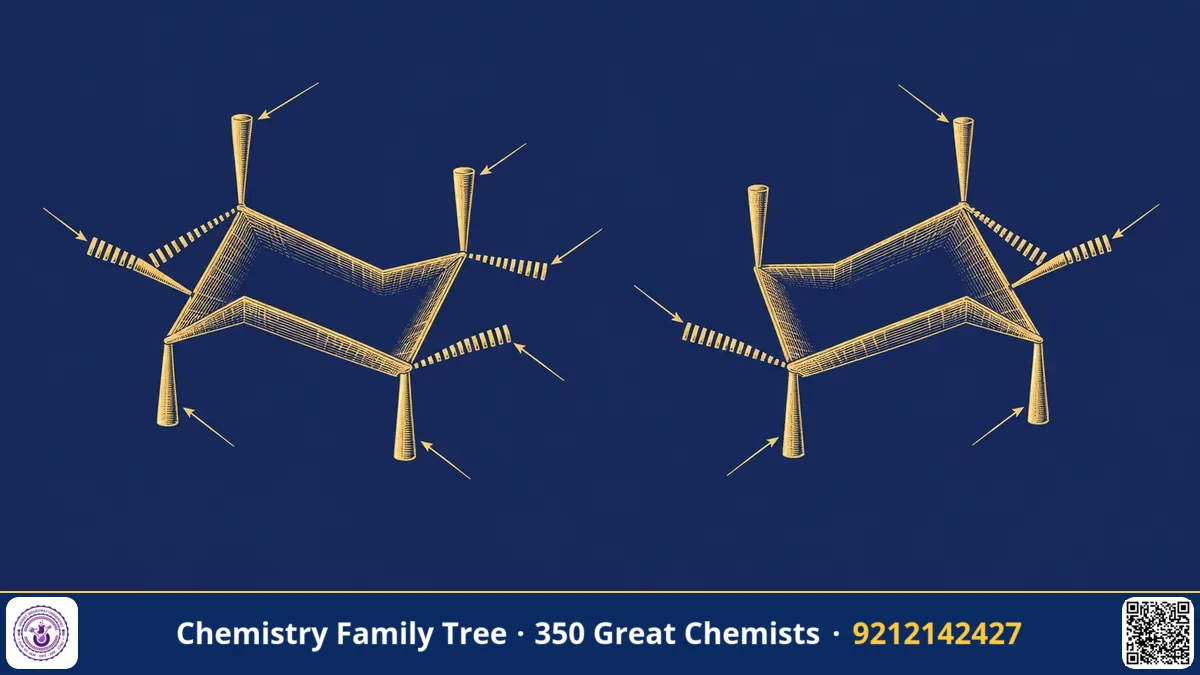
Why does an axial hydroxyl group on a cyclohexane ring oxidise faster than an equatorial one? Why does one stereoisomer of menthyl chloride undergo elimination quickly while its diastereomer is slow? The answer lies in the three-dimensional shape of the molecule, and the person who showed how to use shape to predict reactivity was the British chemist Derek H. R. Barton. In 1950 he published a short paper of only four pages on the conformation of steroids that opened the whole field of conformational analysis. For this he shared the 1969 Nobel Prize in Chemistry with the Norwegian Odd Hassel. Axial and equatorial positions, ring flipping and 1,3-diaxial strain, topics you meet in Class 11 and again in JAM, NET and GATE, grew out of this work.
The Scientific Problem Before the Discovery
Until the 1940s, most organic chemists drew rings as flat polygons, a view that came from Baeyer's strain theory. But Baeyer's theory predicted that cyclohexane should be strained, whereas in reality it is nearly strain-free. Sachse and Mohr had suggested puckered, strain-free chair and boat forms in 1890-1918, but few chemists understood the consequences. In particular, nobody had a consistent way to explain why stereoisomers of the same ring system reacted at different rates and why some products were formed in preference to others.
The Norwegian chemist Odd Hassel had shown by electron diffraction that cyclohexane exists in the chair form and that the bonds fall into two sets. Hassel's work, published in a language and journal that few organic chemists read, had not had much influence on organic chemistry.
The Discovery: Step by Step
- Studying steroids: During a visiting lectureship at Harvard in 1949-50, Barton thought about the shape of steroid molecules, which consist of fused six-membered rings. Many reactions of steroids showed large differences in reaction rate between isomers.
- Using Hassel's chair model: Barton applied the chair conformation of cyclohexane, with its axial and equatorial bonds, to the rigid ring system of steroids.
- Classifying substituents: In a trans-fused steroid, each substituent sits in a fixed position, either axial (a) or equatorial (e), and cannot flip. He then correlated the reactivity of each group with its position.
- Publication: The paper "The Conformation of the Steroid Nucleus" appeared in the journal Experientia in 1950. It gave a simple rule: reactivity depends on the conformation, and the conformation can be predicted from steric strain.
The Chemistry Behind It
Axial and equatorial positions
In the chair form of cyclohexane, each carbon has one axial bond (parallel to the ring axis, alternately up and down) and one equatorial bond (pointing roughly outward along the ring "equator"). A ring flip converts all axial bonds into equatorial bonds and vice versa.
Why equatorial is preferred
An axial substituent is close to the two axial hydrogens on the same side of the ring (carbons 3 and 5 relative to the substituent), causing 1,3-diaxial interactions. These are similar to two gauche-butane interactions. For methylcyclohexane:
ΔG (axial → equatorial) ≈ -7.1 kJ/mol (A-value of CH3 = 1.7 kcal/mol)
K = e^(-ΔG/RT) ≈ 18 at 298 K  →  about 95% equatorial, 5% axial
The A-value is the free energy difference between axial and equatorial conformers. Larger groups have larger A-values (tert-butyl > 4.7 kcal/mol), so tert-butyl is effectively locked equatorial. This is why 4-tert-butylcyclohexyl derivatives are used as conformationally locked models.
Reactivity rules from Barton's analysis
- Oxidation of alcohols with chromic acid: Axial alcohols are oxidised faster than equatorial ones, because oxidation relieves the 1,3-diaxial strain by converting sp3 to sp2 carbon.
- Esterification and saponification: Equatorial hydroxyl groups are esterified faster, and equatorial esters are hydrolysed faster, because they are less hindered.
- E2 elimination: Requires the leaving group and the β-hydrogen to be anti-periplanar, that is, trans-diaxial in a cyclohexane.
Worked example: menthyl and neomenthyl chloride
In menthyl chloride, the isopropyl, methyl and chlorine are all equatorial in the most stable chair. For E2, the ring must flip to the diaxial conformation, which is unfavourable, and in that conformation only one β-hydrogen is anti to Cl, so the product is the less substituted alkene and the reaction is slow. In neomenthyl chloride, chlorine is already axial in the stable chair, with two anti-periplanar hydrogens, so elimination is fast and gives the more substituted (Zaitsev) alkene:
neomenthyl chloride + EtO-  →  3-menthene (major, fast)
menthyl chloride + EtO-     →  2-menthene (only, slow)
Steroids
In 5α-cholestane (trans A/B ring fusion) the ring system is rigid and mostly chair. Substituents at positions such as C-3 are either 3β (equatorial) or 3α (axial) and show different reactivity. Cholesterol's 3β-OH is equatorial.
Applications Today
- Drug design: The shape of a drug molecule determines how it fits in a receptor. Conformational analysis is used to design steroid hormones, contraceptives and anti-inflammatory drugs.
- Carbohydrate chemistry: Glucose in the β-D-pyranose form has all substituents equatorial, which explains its stability and its abundance in nature, in cellulose and starch.
- Stereocontrolled synthesis: Chemists use ring conformations to predict the stereochemical outcome of reductions, alkylations and additions.
- Computational chemistry: Molecular mechanics programs search for low-energy conformers of drug candidates, based on the same principles.
- Materials: Conformation controls liquid crystal and polymer properties.
Exam Corner
- Chair cyclohexane: 12 hydrogens, 6 axial and 6 equatorial. Ring flip interconverts them.
- A-value of CH3 is about 1.7 kcal/mol (7.1 kJ/mol); large groups prefer equatorial.
- E2 elimination in cyclohexanes needs trans-diaxial leaving group and H.
- Axial alcohols are oxidised faster; equatorial alcohols are esterified faster.
- Barton and Hassel shared the 1969 Nobel Prize for the concept of conformation and its application in chemistry.
Common Misconceptions
- "Axial means more stable." The opposite is usually true: equatorial is more stable for substituents larger than hydrogen.
- "Ring flip changes configuration." It changes only conformation. A cis isomer remains cis, and a trans isomer remains trans.
- "Cyclohexane is planar." It is puckered. A planar ring would have 120° angles, which would give angle strain.
Quick Revision Box
- Barton's 1950 paper applied chair conformations to steroids; start of conformational analysis.
- Axial bonds are parallel to the ring axis; equatorial bonds point outward.
- 1,3-Diaxial interactions make axial substituents less stable.
- E2 in cyclohexane needs trans-diaxial arrangement.
- Nobel Prize in Chemistry 1969, shared with Odd Hassel.
FAQ
What is conformational analysis?
It is the study of the different three-dimensional arrangements a molecule can adopt by rotation about single bonds, and how these affect its energy and reactivity.
What is an A-value?
It is the difference in free energy between the axial and equatorial conformers of a monosubstituted cyclohexane. A larger A-value means a stronger preference for equatorial.
What was Hassel's role?
Hassel used electron diffraction and dipole moment studies to show the chair form of cyclohexane and the two types of bonds. Barton applied these ideas to organic reactions.
Why is the trans-diaxial arrangement needed for E2?
E2 requires an anti-periplanar arrangement of H and the leaving group for best orbital overlap, and on a chair ring only two axial positions on adjacent carbons are anti.
Published by ABC Chemistry — IIT-JAM | CSIR-NET | GATE Chemistry Coaching. Visit abcchemistry.com
About the chemist
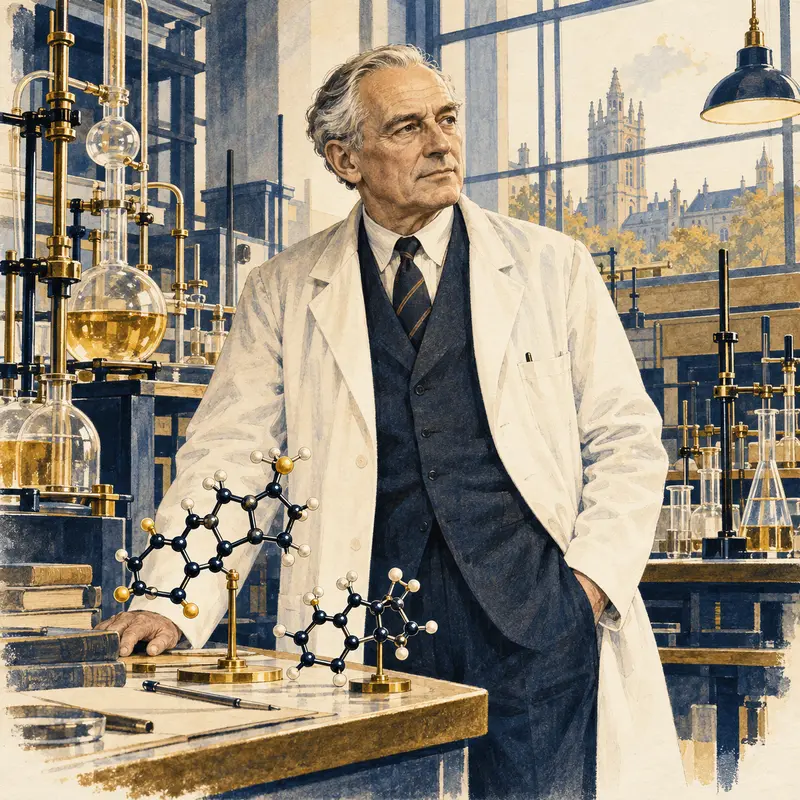
Derek Barton
1918-1998 · United Kingdom · Nobel Chemistry 1969
Conformational analysis