Biography · Chemist no. 299 of 350
Dieter Seebach (born 1937): The Chemist Who Reversed Polarity
Introduction
Dieter Seebach is a German-born chemist who spent much of his career at ETH Zürich in Switzerland. He is best known for developing the concept of Umpolung (polarity reversal) in organic synthesis, the Corey-Seebach reaction using 1,3-dithianes, the chiral ligand family TADDOLs, the method of self-regeneration of stereocentres, and the creation of β-peptides as foldamers. His legacy in one line: he gave synthetic chemists a new way to think about reactivity, and then used that thinking to make chiral molecules and artificial peptides.
Early Life and Family
Seebach was born on 31 October 1937 in Karlsruhe, Germany. He grew up in Germany during and after the Second World War, a period of hardship and reconstruction. Like many gifted students of his generation, he entered university in the late 1950s, when German universities were recovering and rebuilding their research traditions. Beyond these basic facts, little about his family life is widely documented, so this article concentrates on his scientific career.
Education and Mentors
Seebach studied chemistry at the University of Karlsruhe and received his doctorate there in 1964 under Rudolf Criegee, a pioneer of oxidation chemistry and ozonolysis mechanisms (the Criegee intermediate carries his name). Soon afterwards he went to Harvard University to work as a postdoctoral fellow with E. J. Corey, the future Nobel laureate (1990). At Harvard, in the mid-1960s, the collaboration with Corey produced the dithiane chemistry that carries both their names. Seebach has often acknowledged how formative the Harvard years were, because Corey's logic-based approach to synthesis matched his own interest in structural and mechanistic thinking.
Career Timeline
| Year | Event |
|---|---|
| 1937 | Born in Karlsruhe, Germany |
| 1964 | Doctorate, University of Karlsruhe, under Rudolf Criegee |
| 1965 | With E. J. Corey at Harvard, publishes the dithiane method of polarity reversal |
| Late 1960s | Builds an independent research group in Germany on lithiated compounds |
| Early 1970s | Professor at Giessen University in Germany |
| 1977 | Appointed professor of organic chemistry at ETH Zürich |
| 1980s | Develops self-regeneration of stereocentres and chiral building blocks |
| 1990s | Develops TADDOLs and begins work on β-peptides |
| 2003 | Becomes professor emeritus at ETH, remaining active in research |
Major Scientific Contributions
1. Umpolung and the Corey-Seebach reaction
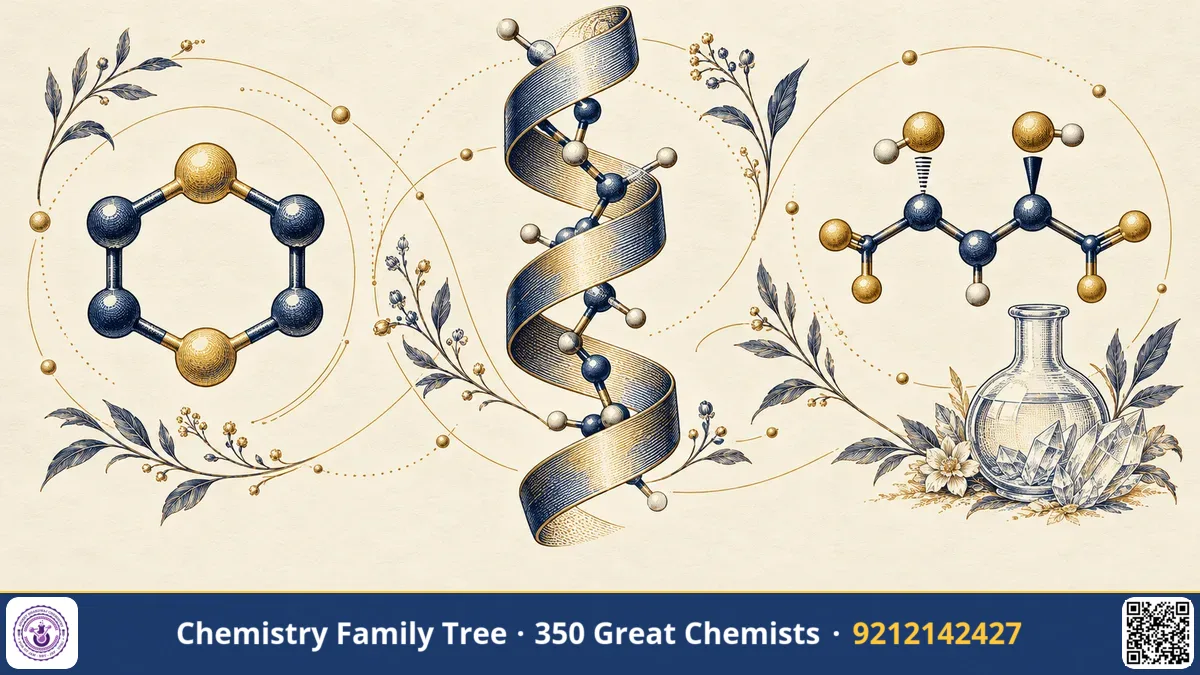
The 1,3-dithiane acts as an acyl anion equivalent, so the carbonyl carbon becomes nucleophilic. Seebach also developed a general language of donor (d) and acceptor (a) sites that helps students plan syntheses. For the full mechanism, see our companion discovery article.
2. Organolithium chemistry
He made detailed studies of the structures and reactivity of lithium enolates and other organolithium compounds in solution and in the solid state, showing that they exist as aggregates (dimers, tetramers) whose structure controls selectivity.
3. Chiral pool and self-regeneration of stereocentres
Seebach showed how natural products such as amino acids, lactic acid, malic acid and 3-hydroxybutanoic acid can be converted into chiral building blocks. His SRS method allows substitution at a stereocentre without loss of chirality, by temporarily forming a new stereocentre in an acetal or imidazolidinone ring.
4. TADDOLs
These diols are made from tartaric acid, acetone (or other ketones) and aryl Grignard reagents. They serve as ligands for titanium and other metals, allowing enantioselective reactions such as the addition of dialkylzinc reagents to aldehydes.
5. β-Peptides and foldamers
Seebach and his co-workers showed that oligomers of β-amino acids fold into stable helices (such as the 14-helix) and sheets in solution, even when short. Unlike natural α-peptides, they resist cleavage by proteases, which makes them interesting for drug design.
Awards, Honours and Nobel Prize
Seebach has not won a Nobel Prize. He has been honoured with numerous prizes from chemical societies in Europe and North America, honorary doctorates, and membership of several academies of science. Among chemists, his name is attached to widely taught concepts, which is a more lasting honour. Many of his former students and postdoctoral researchers hold professorships around the world.
Personality, Struggles and Lesser-Known Facts
- A teacher of concepts. The donor-acceptor notation helped a generation of students think about how to disconnect target molecules.
- From carbonyl chemistry to biology. He moved from classical organic reagents to peptide-like materials in his later career, showing a broad scientific curiosity.
- Close ties to Corey. The Corey-Seebach reaction is a rare example of a named reaction that combines a mentor and a postdoctoral fellow equally.
- A prolific author. He published several hundred scientific papers during his career and regularly gave lectures worldwide.
- Beyond national borders. His career crossed Germany, the United States and Switzerland, a model of international science.
Legacy and Influence on Modern Chemistry
The idea of polarity reversal underpins N-heterocyclic carbene catalysis, the Stetter reaction and many modern strategies in total synthesis. The chiral building blocks and auxiliaries he developed are still used to create enantiopure compounds. β-Peptides inspired a major research field, foldamers, that tries to mimic the functions of proteins using unnatural backbones. In Indian universities and exam syllabi, Umpolung and the dithiane reaction appear almost every year in questions on retrosynthesis and synthon logic.
Lessons for Students
- Question the obvious: a carbonyl carbon is electrophilic, but with the right trick it can be nucleophilic.
- Develop a vocabulary for thinking. The d/a notation made the planning of syntheses systematic.
- Be ready to change fields as your curiosity grows.
- Make use of natural chirality: cheap natural acids and amino acids are excellent starting points.
- Value mentors and international experience.
Quick Facts Box
- Born: 31 October 1937, Karlsruhe, Germany
- Died: Living (as of this writing)
- Nationality: German, working in Switzerland
- Field: Synthetic organic chemistry, stereochemistry, peptide chemistry
- Famous for: Umpolung, Corey-Seebach reaction, TADDOLs, SRS, β-peptides
- Nobel Prize: None
FAQ
Who did Dieter Seebach work with at Harvard?
He worked with E. J. Corey, and together they introduced the use of 1,3-dithianes as acyl anion equivalents in 1965.
What are TADDOLs?
TADDOLs are chiral diols derived from tartaric acid. They are used as ligands and auxiliaries in asymmetric synthesis, particularly with titanium.
What is a β-peptide?
It is a polymer of β-amino acids, which have an extra carbon in the backbone. It can fold into stable helices and resists enzymatic degradation.
Why is Seebach important for exams?
Umpolung, synthons and the Corey-Seebach reaction are central topics in advanced organic chemistry questions on retrosynthesis in IIT-JAM, CSIR-NET and GATE.
Published by ABC Chemistry — IIT-JAM | CSIR-NET | GATE Chemistry Coaching. Visit abcchemistry.com
About the chemist
Dieter Seebach
1937- · Switzerland
Umpolung; Seebach dithiane chemistry