The discovery, explained · Chemist no. 299 of 350
Umpolung: How Dieter Seebach Taught Carbonyl Carbon to Be Nucleophilic
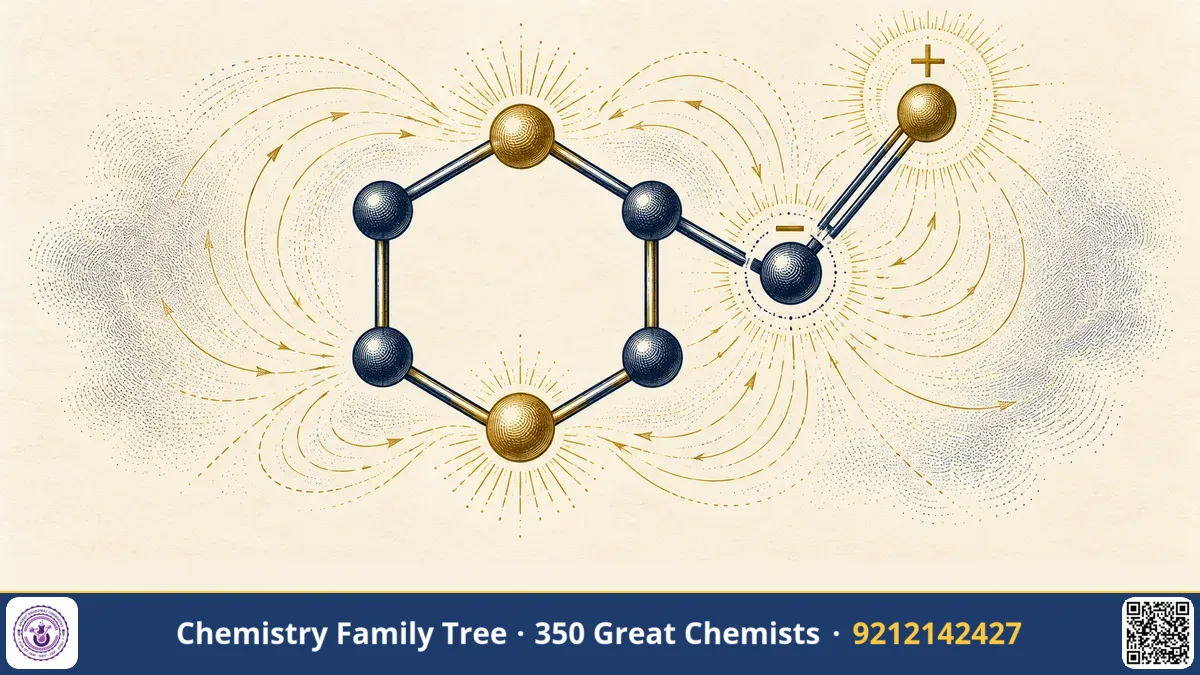
Every first-year organic chemistry student learns that the carbon of a carbonyl group is electrophilic. It carries a partial positive charge, and nucleophiles attack it. In the mid-1960s, Dieter Seebach, working in Cambridge, Massachusetts, with E. J. Corey and later in his own labs, introduced a way of making that same carbon behave as a nucleophile. He called the concept Umpolung, a German word meaning "polarity reversal". The Corey-Seebach reaction, which uses 1,3-dithianes as masked acyl anions, is the best-known example. It opened up new routes to ketones, α-hydroxy ketones, 1,2-diketones and many other compounds that are hard to make by normal polar logic.
The Scientific Problem Before the Discovery
Organic synthesis in the 1960s was dominated by one idea: build molecules by combining a nucleophile (electron-rich) with an electrophile (electron-poor). Seen this way, atoms in a molecule are naturally "donor" (d) or "acceptor" (a) sites. In a carbonyl compound, the carbonyl carbon is an acceptor (a¹), while the α-carbon of its enolate is a donor (d²). Alternate positions follow a pattern: odd-numbered carbons are acceptors, even-numbered ones donors, when counted from the heteroatom.
This pattern means that certain target molecules are easy to make by polar disconnection: 1,3-dioxygenated (a¹-d²) and 1,5-dioxygenated compounds, for example by aldol and Michael reactions. But 1,2- and 1,4-dioxygenated compounds, such as α-hydroxy ketones and 1,4-diketones, require a "wrong" polarity. To get them, you would need an acyl anion, R-C(=O)⁻, which is not stable and cannot be simply prepared. The problem was therefore: how to make an acyl anion equivalent?
The Discovery: Step-by-Step
The solution, published by Corey and Seebach in 1965, uses a sulfur-based trick. The four steps are:
- Dithioacetal formation. An aldehyde reacts with 1,3-propanedithiol (HS-CH₂CH₂CH₂-SH) and a Lewis acid (BF₃·Et₂O) to give a cyclic 2-substituted 1,3-dithiane.
- Deprotonation. The C-2 proton of the dithiane is acidic (pKa about 31), because sulfur stabilises the adjacent carbanion through polarisability and d-orbital-like (σ*) delocalisation. Treatment with n-butyllithium in THF at about -20 °C produces 2-lithio-1,3-dithiane. This is the acyl anion equivalent.
- Alkylation. The lithiated dithiane reacts with electrophiles: alkyl halides, epoxides, aldehydes, ketones, or carbonyl compounds. A new C-C bond forms at C-2.
- Unmasking. The dithiane is hydrolysed to a carbonyl group with Hg(II) salts (HgCl₂/CaCO₃ in aqueous acetonitrile), or with milder oxidative reagents such as NCS/AgNO₃ or I₂, to reveal the ketone.
R-CHO + HS(CH₂)₃SH → 2-R-1,3-dithiane
2-R-dithiane + n-BuLi → 2-R-2-lithio-1,3-dithiane
2-R-2-Li-dithiane + R'-X → 2-R,2-R'-dithiane
2-R,2-R'-dithiane + HgCl₂/H₂O → R-CO-R' (ketone)
In this sequence, the original aldehyde carbon, which was electrophilic, behaved as a nucleophile at step 3 and ended as a ketone. The polarity was reversed and then restored.
Using an epoxide or an aldehyde as the electrophile gives α-hydroxy ketones, and using an alkyl dihalide allows ring formation.
The Chemistry Behind It
Why sulfur? Sulfur is large and polarisable, so it stabilises the negative charge on the adjacent carbon far better than oxygen does. The analogous acetal (1,3-dioxolane) is not acidic enough to be deprotonated by butyllithium. In addition, sulfur-containing groups are easily removed by soft Lewis acids such as Hg²⁺, which binds strongly to sulfur.
Why use a cyclic dithiane? The six-membered ring prevents fragmentation of the carbanion, which would be a problem for open-chain dithioacetals (loss of thiolate to give carbene-like products). The ring also makes preparation easy.
d and a labels. Seebach introduced the notation of donor (d) and acceptor (a) sites, and the idea of "synthons". An acyl anion is a d¹ synthon (donor at position 1), the opposite of the usual a¹ carbonyl carbon. Dithiane chemistry provides the real reagent for this imaginary synthon.
| Synthon | Natural polarity | Reagent for reversed polarity |
|---|---|---|
| Acyl, R-C⁻=O (d¹) | Electrophilic (a¹) | Lithiated 1,3-dithiane |
| Cyanohydrin anion | Electrophilic carbonyl | Protected cyanohydrin (O-silyl, O-ethoxyethyl) |
| Benzoin / Stetter | Electrophilic aldehyde | Cyanide or thiazolium (Breslow intermediate) |
| Nitroalkane anion | Electrophilic carbon bearing NO₂ | Nitronate (Henry reaction) |
Other Seebach contributions
- TADDOLs: Chiral diols derived from tartaric acid, used as ligands and auxiliaries, for example with titanium in enantioselective additions.
- Self-regeneration of stereocentres (SRS): Using a temporary stereocentre to hold chirality while a new group is introduced at the original stereocentre, for amino acids and hydroxy acids.
- β-Peptides: Oligomers of β-amino acids that fold into stable helices and sheets, and resist enzymatic degradation. This is an important area of foldamer chemistry.
Applications Today
- Natural product synthesis: Dithiane coupling is a standard tool for linking two complex fragments (Smith's anion relay chemistry for spongistatin and other targets).
- Pharmaceutical synthesis: Preparing α-hydroxy ketones, 1,2-diketones and heterocycles.
- Catalysis: N-heterocyclic carbene (NHC) catalysis, based on the same Umpolung logic, is used for benzoin, Stetter and related reactions, and in asymmetric catalysis.
- Biochemistry: Thiamine (vitamin B1) diphosphate acts as a natural Umpolung catalyst in pyruvate decarboxylase and transketolase.
- Drug design: β-Peptides and TADDOL-based catalysts are used in research on enzyme-stable peptide mimics and enantioselective synthesis.
Exam Corner
- Umpolung means reversal of the normal polarity of a functional group; dithiane makes the carbonyl carbon nucleophilic.
- Corey-Seebach: aldehyde → 1,3-dithiane → n-BuLi → R'X → hydrolysis (HgCl₂) → ketone.
- The C-2 proton of 1,3-dithiane has pKa about 31; sulfur stabilises the carbanion.
- The Stetter reaction and the benzoin condensation also use Umpolung (via cyanide or thiazolium/NHC catalysts).
- TADDOLs are tartaric acid-derived chiral diols (α,α,α',α'-tetraaryl-1,3-dioxolane-4,5-dimethanols).
Common Misconceptions
- "Acyl anions are stable reagents." They are not. Dithiane anions are equivalents, not true acyl anions.
- "Any thioacetal works equally well." Cyclic dithianes are more reliable than open-chain thioacetals, which can fragment.
- "Umpolung only refers to dithianes." It is a general concept, including cyanide, NHC and many other reversals of polarity.
Quick Revision Box
- Umpolung = polarity reversal (German, "pole reversal").
- Corey-Seebach reaction, 1965: 1,3-dithiane as an acyl anion equivalent.
- Sequence: dithiane formation, BuLi, electrophile, Hg(II) hydrolysis.
- Electrophiles: alkyl halides, epoxides, aldehydes, ketones.
- Natural Umpolung: thiamine diphosphate; synthetic: cyanide, NHC.
- Seebach also introduced TADDOLs, SRS and β-peptides.
FAQ
What does Umpolung mean?
It is a German term meaning "polarity inversion". In synthesis it refers to reversing the usual electrophilic or nucleophilic character of an atom, for example making the carbonyl carbon nucleophilic.
Why is the dithiane C-2 proton acidic?
The two sulfur atoms stabilise the adjacent carbanion through polarisability and negative hyperconjugation, which lowers the pKa to roughly 31.
How is the dithiane removed at the end?
It is hydrolysed using soft Lewis acids such as Hg(II) salts, or oxidatively using NBS, NCS/AgNO₃ or iodine-based reagents, giving back the carbonyl compound.
What is the biological example of Umpolung?
Thiamine pyrophosphate (vitamin B1 cofactor) forms a nucleophilic carbanion at its thiazolium C-2, which adds to carbonyls and enables decarboxylation and transketolase reactions.
Published by ABC Chemistry — IIT-JAM | CSIR-NET | GATE Chemistry Coaching. Visit abcchemistry.com
About the chemist
Dieter Seebach
1937- · Switzerland
Umpolung; Seebach dithiane chemistry