Biography · Chemist no. 3 of 350
Dmitri Mendeleev: The Life and Legacy of the Creator of the Periodic Table
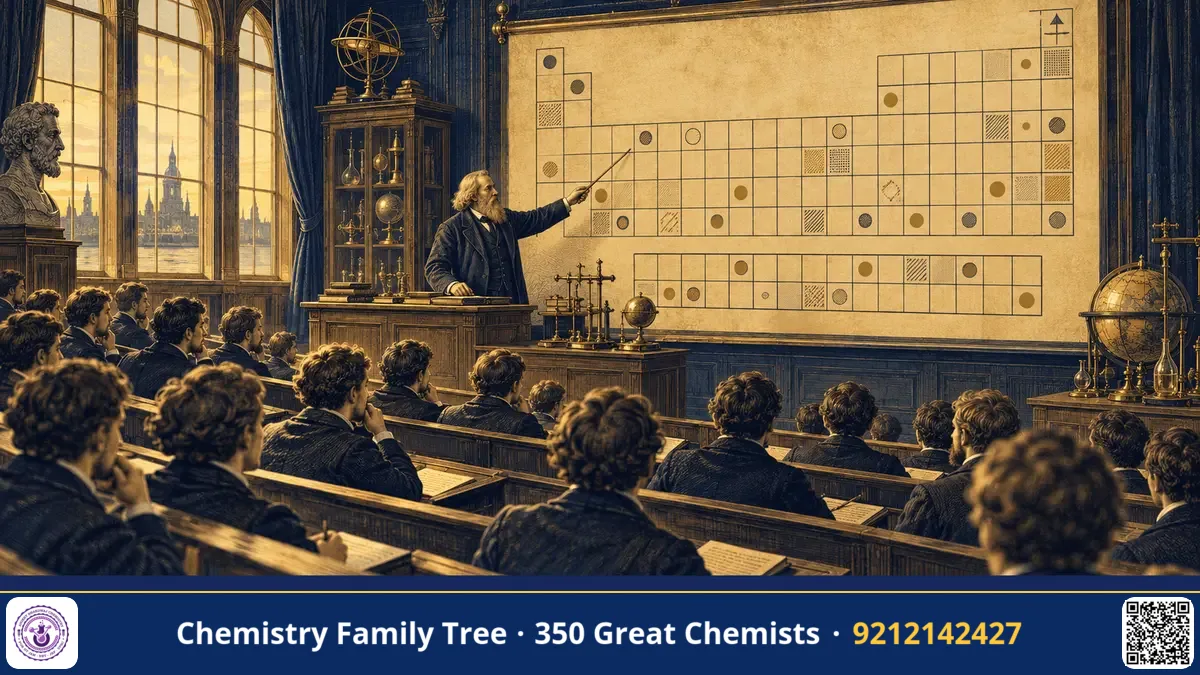
Dmitri Ivanovich Mendeleev (1834-1907) was a Russian chemist and polymath who arranged the elements into a table that revealed their repeating pattern and predicted elements yet to be found. He was also a professor, an author of a famous textbook, a researcher of solutions and gases, an adviser on the oil industry and the head of Russia's weights and measures office. His legacy in one line: the periodic table that hangs in every chemistry classroom in the world.
Early Life and Family
Mendeleev was born on 8 February 1834 (27 January in the old Russian calendar) in Tobolsk, Siberia. He was the youngest of a very large family; sources differ on the exact number of children. His father, Ivan Pavlovich Mendeleev, was the director of the local gymnasium (high school) but became blind and lost his job, and he died while Dmitri was still young. His mother, Maria Dmitrievna Kornilieva, then took charge of the family. She ran a family glass factory, which gave young Dmitri early exposure to practical chemistry and materials. When the factory was destroyed by fire, she was determined that her youngest and most gifted son should receive a proper education, and she travelled with him across Russia, first to Moscow and then to St Petersburg. She died soon afterwards. Mendeleev always remembered her sacrifice with gratitude.
Education and Mentors
Because he came from Siberia, he was refused admission to Moscow University, and he entered the Main Pedagogical Institute in St Petersburg, where his father had once studied. He took a degree in 1855 and was awarded a gold medal. Suffering from ill health, he went to the milder climate of Crimea to work as a teacher for a time. He returned to St Petersburg, and in 1859 was sent abroad to study at Heidelberg, where he worked on capillarity and the properties of liquids, and where he met other leading chemists. In 1860, he attended the Karlsruhe Congress, where Stanislao Cannizzaro's talk on atomic weights made a deep impression on him. Among his teachers and influences in St Petersburg were the chemists Aleksandr Voskresensky and Nikolay Zinin.
Career Timeline
| Year | Event |
|---|---|
| 1834 | Born in Tobolsk, Siberia |
| 1855 | Graduates from the Main Pedagogical Institute, St Petersburg |
| 1859-1861 | Studies in Heidelberg |
| 1860 | Attends the Karlsruhe Congress |
| 1865 | Completes his doctoral thesis on the combination of alcohol with water |
| 1867 | Becomes professor of general chemistry at St Petersburg University |
| 1868-1871 | Writes Principles of Chemistry |
| 1869 | Presents the first periodic table |
| 1871 | Publishes a refined table with predictions for undiscovered elements |
| 1875-1886 | Gallium, scandium and germanium discovered, matching his predictions |
| 1887 | Ascends in a balloon alone to observe a solar eclipse |
| 1890 | Leaves the university after a dispute over a student petition |
| 1893 | Becomes director of the Bureau of Weights and Measures |
| 1907 | Dies in St Petersburg on 2 February |
Major Scientific Contributions
The periodic law and periodic table. By arranging elements by atomic weight and similarity, he showed that properties repeat. He left gaps and predicted the properties of gallium, scandium and germanium. This is discussed in detail in our discovery post on the periodic table.
Principles of Chemistry. His textbook, written in the late 1860s, was widely used and translated into several languages. It organised chemistry around the periodic law and became a model for modern textbooks.
Solutions and gases. He studied the density of aqueous solutions and the expansion of liquids, and worked on gas behaviour at different pressures. He also described the critical temperature of liquids, which he called the "absolute boiling point", in 1860.
Petroleum and industry. He studied the origin and refining of petroleum, visited oil fields in Baku and in the United States, and advised on how Russia should develop its oil industry. He argued that oil was more valuable as a chemical raw material than as a simple fuel.
Weights and measures. As the head of the Bureau of Weights and Measures he oversaw the preparation of new standard prototypes of the pound and the arshin.
Awards, Honours and Nobel Prize
- Davy Medal of the Royal Society, 1882 (shared with Lothar Meyer).
- Copley Medal of the Royal Society, 1905.
- Foreign membership in many academies, including the Royal Society of London (1892).
- Nobel Prize: He was nominated for the Nobel Prize in Chemistry. In 1906, the Nobel committee for chemistry recommended him, but the Royal Swedish Academy of Sciences did not accept it, and the prize went to Henri Moissan, who isolated fluorine. Mendeleev died the following year without receiving the prize.
- Element 101, mendelevium (Md), discovered in 1955, is named after him.
Personality, Struggles and Lesser-Known Facts
- The game of cards. He is said to have written the properties of the elements on cards and arranged them again and again, like a patience game, until the pattern became clear.
- The dream story. A popular story says that he saw the complete table in a dream after working for days without sleep. The story is often repeated, but it cannot be fully verified, and it is better to remember that the table came from years of hard work on atomic weights and properties.
- Not a vodka inventor. A widely told story says that his doctoral thesis fixed 40% as the standard strength of vodka. In fact, his thesis was on the combination of alcohol and water, and the 40% standard has a separate history, so this story is a myth.
- A solo balloon flight. In 1887, when a solar eclipse was to be seen in Russia, cloudy weather made observation difficult on the ground. He took a balloon alone to observe the eclipse above the clouds, which showed his courage and his love for science.
- A hobby with suitcases. He is often reported to have enjoyed making suitcases and other crafts by hand, and to have been known for his long hair and beard, which he trimmed only rarely.
- Personal difficulties. His second marriage, in 1882 to Anna Popova, took place before the church's required waiting period after his divorce, and it caused public controversy.
Legacy and Influence on Modern Chemistry
Mendeleev's table made chemistry predictive. After Moseley's work in 1913 showed that atomic number, not weight, is the true basis, the table became even more solid. Ramsay's noble gases fit in as a new group. The theory of electron configuration later explained why periodicity occurs. Today, chemists use the same logic to look for patterns in properties of the heaviest elements, and the table now has 118 elements in 18 groups and 7 periods. For students in India, the periodic table is a map that must be understood, not memorised.
Lessons for Students
- Look for patterns. Order often hides inside lists of data.
- Have the courage to leave gaps. Admitting what we do not know can lead to new discoveries.
- Trust evidence over habit. He corrected atomic weights that did not fit the pattern.
- Study widely. His work in physics, industry and teaching made him a better chemist.
- Persevere. A boy from Siberia, refused admission by Moscow University, changed science.
Quick Facts Box
- Born: 8 February 1834 (new style), Tobolsk, Siberia, Russian Empire
- Died: 2 February 1907, St Petersburg, Russia
- Nationality: Russian
- Field: Chemistry (general and physical), metrology
- Famous for: Periodic law and periodic table; predicting gallium, scandium, germanium
- Nobel Prize: Not awarded (narrowly missed in 1906)
FAQ
Where was Dmitri Mendeleev born?
He was born in Tobolsk, in Siberia, in the Russian Empire, in 1834.
Did Mendeleev win a Nobel Prize?
No. He was recommended by the Nobel committee in 1906, but the Academy did not approve it, and he died in 1907.
Which element is named after Mendeleev?
Mendelevium (symbol Md, atomic number 101), a radioactive actinoid first made in 1955.
Why is his periodic table special?
It left gaps for elements not yet discovered and correctly predicted their properties, which gave the periodic law great credibility.
Published by ABC Chemistry — IIT-JAM | CSIR-NET | GATE Chemistry Coaching. Visit abcchemistry.com
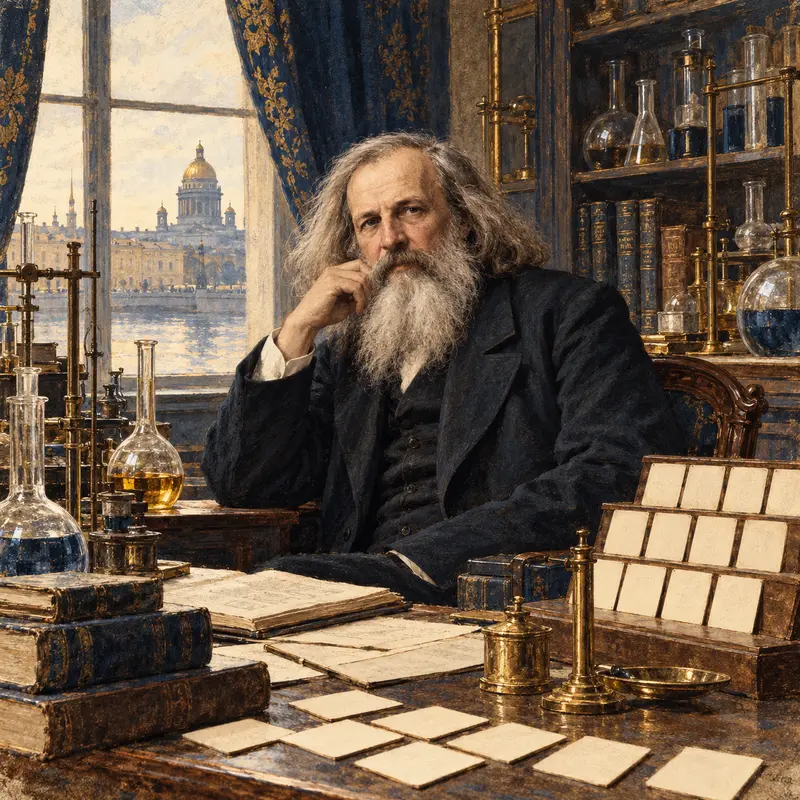
About the chemist
Dmitri Mendeleev
1834-1907 · Russia
Periodic table of the elements