The discovery, explained · Chemist no. 3 of 350
Mendeleev's Periodic Table: The Law That Predicted Elements Before They Were Found
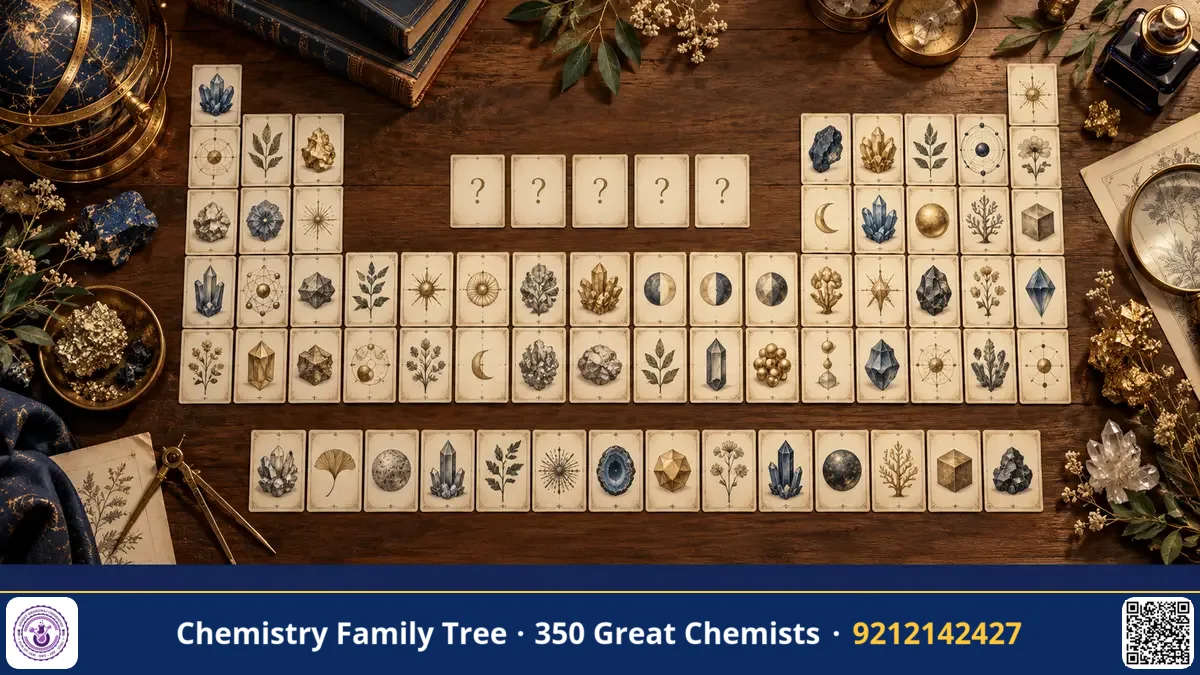
Open any chemistry textbook and the first big chart you will see is the periodic table. It organises more than a hundred elements so well that you can predict the formula of an oxide, the type of bond, or the acidity of a hydroxide just by looking at where an element sits. In 1869, the Russian chemist Dmitri Mendeleev proposed a table of this kind and, more importantly, had the courage to leave gaps for elements that had not yet been discovered. When gallium, scandium and germanium were discovered later and matched his predictions, the periodic law became one of the most trusted ideas of science.
The Scientific Problem Before the Discovery
By the 1860s about 60 elements were known, but they looked like a random list. Chemists were searching for order, and a few had found partial patterns:
- Döbereiner's triads (1829): groups of three similar elements such as Ca, Sr, Ba, where the atomic weight of the middle one is close to the average of the other two.
- Newlands' law of octaves (1865): when elements were arranged by atomic weight, every eighth element resembled the first, like notes in music. It failed for heavier elements and was not taken seriously.
- Lothar Meyer in Germany noticed periodic changes in atomic volume and developed a similar table around the same time.
A further problem was that atomic weights themselves were uncertain. After the Karlsruhe Congress in 1860, where Cannizzaro explained how to use Avogadro's hypothesis to fix atomic weights, the data became more reliable, and this opened the door to Mendeleev's work.
The Discovery: Step by Step
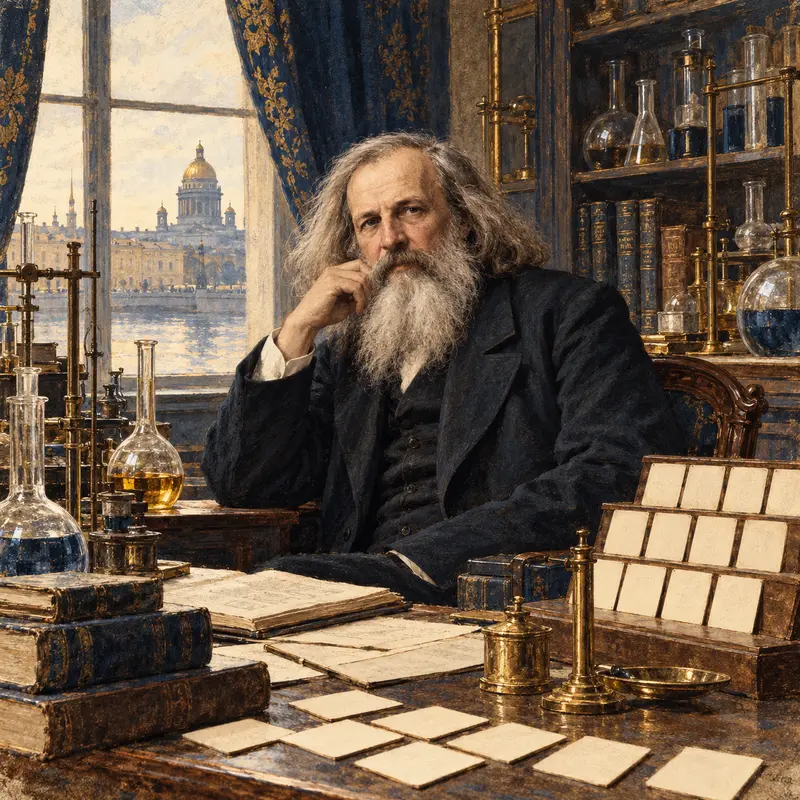
- Writing a textbook. While writing Principles of Chemistry for his students at St Petersburg, Mendeleev needed a logical way to arrange the chapters on the elements.
- Making cards. He wrote the name, atomic weight and main properties of each known element on a separate card and moved them around, like a game of patience.
- Arranging by atomic weight and valency. When elements were placed in order of increasing atomic weight, similar properties repeated at intervals. Elements with similar behaviour were put in the same column (group).
- Leaving gaps. Where no known element fitted a pattern, he left an empty space rather than force a bad match, and he said an undiscovered element would be found.
- Correcting data. Where an atomic weight did not fit the pattern, he suggested that the measured value was wrong. For example, he argued for a revised atomic weight of beryllium (9 instead of the earlier 13.5) to fit it in group II.
- Publication (1869). His first table was presented to the Russian Chemical Society in March 1869 (February by the old Russian calendar). A more developed version came in 1871.
The Chemistry Behind It
Mendeleev's periodic law
"The properties of the elements are a periodic function of their atomic weights." The modern periodic law, which came after Moseley's 1913 work on X-ray spectra, says: the properties of elements are a periodic function of their atomic numbers.
The famous predictions
Mendeleev used the prefix "eka" (Sanskrit for "one") to name his predicted elements: eka-aluminium, eka-boron and eka-silicon. This shows his respect for ancient Sanskrit grammarians such as Panini. The table below compares his forecasts with the real elements.
| Predicted element | Actual element and year | Predicted atomic weight | Actual atomic weight |
|---|---|---|---|
| Eka-aluminium | Gallium (1875, Lecoq de Boisbaudran) | about 68 | about 69.7 |
| Eka-boron | Scandium (1879, Nilson) | about 44 | about 45 |
| Eka-silicon | Germanium (1886, Winkler) | about 72 | about 72.6 |
For eka-silicon, Mendeleev also predicted that it would form an oxide of formula EsO₂ and a chloride EsCl₄, and that its density would be near 5.5 g/cm³. Germanium forms GeO₂ and GeCl₄, with density about 5.3 g/cm³, a close match.
Ge + 2Cl₂ → GeCl₄
Ge + O₂ → GeO₂
Anomalies
Mendeleev placed tellurium (atomic weight 127.6) before iodine (126.9) to keep iodine in the halogen group with chlorine and bromine, trusting chemical properties more than weight. Such pairs (Te-I, Ar-K, Co-Ni) were explained only when atomic number replaced atomic weight as the basis of classification.
Mendeleev's table versus the modern table
| Feature | Mendeleev's table | Modern table |
|---|---|---|
| Basis | Atomic weight | Atomic number |
| Groups | 8 groups (I to VIII) with subgroups | 18 groups |
| Noble gases | Not present originally (found after 1894) | Group 18 |
| Isotopes | Not known | Explained |
| Lanthanoids and actinoids | Not placed properly | Separate f-block |
Applications Today
- Predicting properties. Trends in atomic radius, ionisation enthalpy, electronegativity and oxidation states are used all over inorganic chemistry.
- Semiconductors. Germanium and gallium, whose existence was predicted by Mendeleev, are used in electronics. Gallium arsenide is used in LEDs and solar cells, and germanium in fibre optics and infrared devices.
- Discovery of new elements. The table guides scientists making superheavy elements in laboratories. Element 101 is named mendelevium in his honour.
- Education in India. The periodic table is a core topic from Class 9 to JAM, and questions on periodic trends appear in every competitive examination.
- Materials design. Alloy and catalyst development uses group trends to pick elements with similar behaviour.
Exam Corner
- Mendeleev's table was based on atomic weight; the modern table is based on atomic number (Moseley).
- Eka-aluminium = gallium, eka-boron = scandium, eka-silicon = germanium. Remember the order of discovery: Ga (1875), Sc (1879), Ge (1886).
- Gallium has a very low melting point (about 30 °C), so it melts in the hand; Mendeleev's table did not predict this property in detail.
- Noble gases were not in Mendeleev's original table and were added as a new group (group zero) without disturbing the existing order, which supported the periodic law.
- Along a period, atomic radius generally decreases and ionisation enthalpy generally increases; down a group, atomic radius increases and ionisation enthalpy decreases.
Common Misconceptions
- "Mendeleev was the first to arrange elements." Others, including Newlands and Meyer, had earlier or parallel ideas. His strength was in predicting new elements and correcting atomic weights.
- "The modern table is completely different." It keeps Mendeleev's idea of periodicity. Only the basis (atomic number) changed.
- "All his predictions were right." Some of his predictions failed. Still, the three main ones were correct to a remarkable degree.
Quick Revision Box
- Mendeleev's periodic law (1869): properties are a periodic function of atomic weights.
- Modern periodic law: properties are a periodic function of atomic numbers.
- He left gaps and predicted eka-aluminium (Ga), eka-boron (Sc), eka-silicon (Ge).
- Te was placed before I, going against the order of atomic weight.
- Noble gases were added later as group 18 (group zero).
- Element 101 is mendelevium (Md).
FAQ
What is the periodic law according to Mendeleev?
The physical and chemical properties of the elements repeat at regular intervals when they are arranged in order of increasing atomic weight.
Why is Mendeleev's table considered better than earlier attempts?
He left gaps for undiscovered elements, predicted their properties and corrected doubtful atomic weights, and later discoveries proved him right.
What is the meaning of the prefix eka?
It comes from Sanskrit and means "one". Eka-silicon means "one place below silicon" in the table.
What are the limitations of Mendeleev's table?
It placed some elements out of atomic-weight order, could not explain isotopes or the position of hydrogen, and did not have proper places for lanthanoids and actinoids.
Published by ABC Chemistry — IIT-JAM | CSIR-NET | GATE Chemistry Coaching. Visit abcchemistry.com
About the chemist
Dmitri Mendeleev
1834-1907 · Russia
Periodic table of the elements