Biography · Chemist no. 90 of 350
Donald J. Cram (1919-2001): From Vermont Scholarship Student to Nobel Laureate
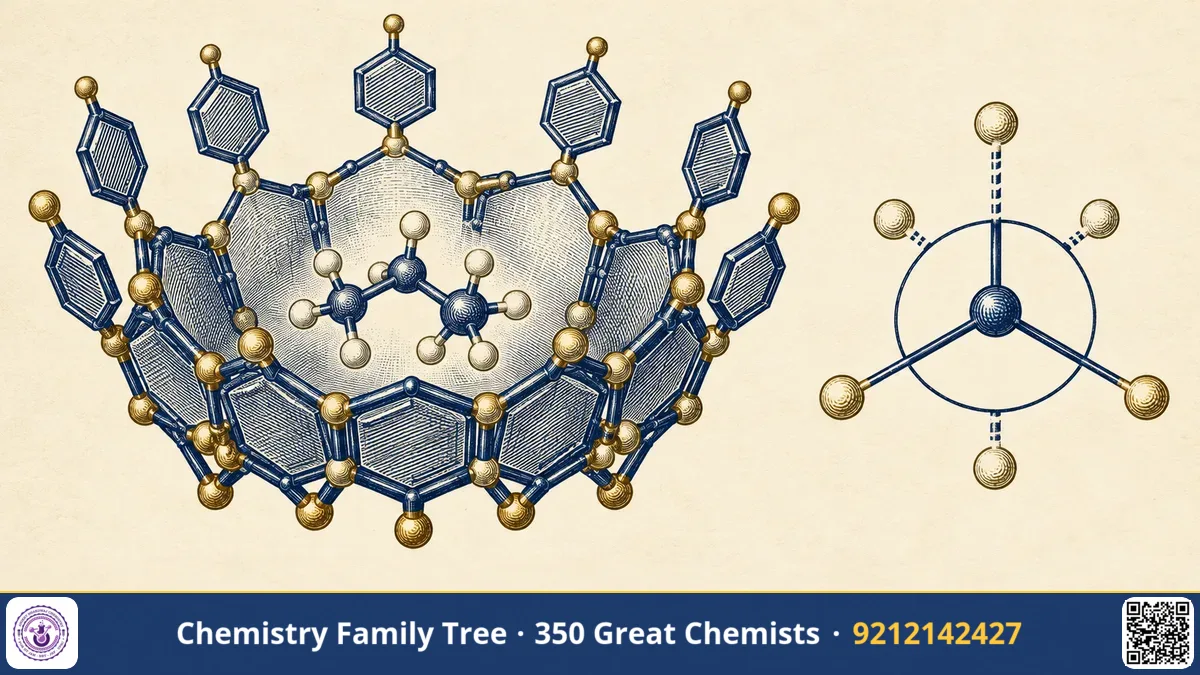
Donald James Cram was an American organic chemist who spent his whole academic career at the University of California, Los Angeles (UCLA). He is remembered for two major achievements: Cram's rule for predicting stereochemistry in carbonyl addition reactions, and the design of artificial host molecules, including spherands, cavitands and carcerands, that bind guest molecules with great selectivity. His legacy in one line: he showed that chemists can design molecular containers and predict the shape of reaction products with simple, powerful models. He shared the 1987 Nobel Prize in Chemistry with Jean-Marie Lehn and Charles Pedersen.
Early Life & Family
Cram was born on 22 April 1919 in Chester, Vermont, in the north-eastern United States. His youth was shaped by the Great Depression. He was an excellent student, and a scholarship made his college education possible. For students in India, who often compete hard for places and scholarships, his story will feel familiar: talent supported by effort and by a scholarship opened the door.
Education & Mentors
Cram received a scholarship to Rollins College in Winter Park, Florida, where he studied chemistry and graduated in 1941. He then completed a master's degree at the University of Nebraska in 1942. During the Second World War he worked for the pharmaceutical company Merck, where he took part in research on the production of penicillin, one of the most important wartime medical projects. After the war he went to Harvard University for doctoral study under Louis F. Fieser, a famous organic chemist known for work on quinones, natural products and for his textbooks. Cram obtained his PhD in 1947. In the same year he joined the chemistry department at UCLA, where he worked for more than fifty years and where he was a colleague of Saul Winstein, a leader in physical organic chemistry.
Career Timeline
| Year | Event |
|---|---|
| 1919 | Born in Chester, Vermont (22 April) |
| 1941 | Bachelor's degree, Rollins College, Florida |
| 1942 | Master's degree, University of Nebraska; works at Merck on penicillin during the war |
| 1947 | PhD at Harvard under Louis Fieser; joins UCLA |
| 1949 | Proposes the phenonium ion (bridged ion) in neighbouring-group reactions |
| 1952 | Publishes the rule for asymmetric induction (Cram's rule), with F. A. Abd Elhafez |
| 1959 | Publishes a textbook of organic chemistry with George S. Hammond |
| 1960s | Studies carbanions and cyclophanes |
| 1970s | Chiral crown ethers; spherands (1979) |
| 1985 | Carcerands |
| 1987 | Nobel Prize in Chemistry |
| 2001 | Dies in Palm Desert, California (17 June) |
Major Scientific Contributions
- Cram's rule: predicting the major diastereomer from addition of nucleophiles to carbonyl compounds with an adjacent stereocentre. It was refined as the Felkin-Anh model.
- Phenonium ion: evidence for a bridged phenyl-bearing cation that explained retention of configuration in certain substitution reactions.
- Carbanion chemistry: studies of the stereochemistry of reactions of carbanions, important for understanding proton transfer and racemisation.
- Chiral crown ethers: hosts that distinguish between enantiomers of ammonium salts, a model of enzyme-like recognition.
- Spherands, cavitands and carcerands: hosts with preorganised cavities of different shapes, culminating in the permanent entrapment of guests.
The stereochemical model and the host-guest systems are explained in more detail in the companion discovery blog on Cram's rule and host-guest chemistry.
Awards, Honours & Nobel Prize
The Nobel Prize in Chemistry 1987 was awarded jointly to Donald J. Cram, Jean-Marie Lehn and Charles J. Pedersen "for their development and use of molecules with structure-specific interactions of high selectivity". Cram also received the Arthur C. Cope Award of the American Chemical Society (1974) and was a member of the US National Academy of Sciences. He wrote an autobiographical book, From Design to Discovery, in which he explained how he thought about science and research.
Personality, Struggles & Lesser-Known Facts
- He studied on a scholarship. Support for talented students changes lives.
- During the Second World War he contributed to penicillin work at Merck, an example of chemistry directly saving lives.
- He spent more than five decades at one university, UCLA, which is unusual in modern science. Long-term focus in one place allowed him to follow ideas for years.
- He named his closed-shell hosts "carcerands" from the Latin word for prison, because the guests are imprisoned inside.
- He believed in designing molecules on paper and with models before starting to synthesise them.
- His textbook with Hammond helped to train a generation of American students in organic chemistry.
Legacy & Influence on Modern Chemistry
Cram's rule is the starting point for all discussions of stereoselective addition to carbonyl groups. Students learn it before Felkin-Anh, chelation control and later catalytic asymmetric synthesis. His host-guest designs showed that molecular recognition could be engineered. Today, the same concepts guide the design of molecular sensors, capsules for drug delivery, chiral separation columns and enzyme mimics. Together with Lehn's cryptands and Pedersen's crown ethers, Cram's hosts form the foundation of supramolecular chemistry, which in turn led to molecular machines and self-assembled materials.
Lessons for Students
- Accept opportunities and work for them. Scholarships and mentors matter, but effort matters most.
- Look for patterns. Cram's rule came from careful observation of many reactions.
- Design before you make. Thinking about shape saves time in the laboratory.
- Use models, both physical and mental, to understand three-dimensional chemistry.
Quick Facts Box
- Born: 22 April 1919, Chester, Vermont, USA
- Died: 17 June 2001, Palm Desert, California, USA
- Nationality: American
- Field: Organic chemistry, stereochemistry, host-guest chemistry
- Famous for: Cram's rule; spherands, cavitands and carcerands
- Nobel Prize: Chemistry, 1987 (with J.-M. Lehn and C. J. Pedersen)
FAQ
Where did Cram work for most of his life?
At the University of California, Los Angeles (UCLA), from 1947 until the end of his career.
Who was Cram's PhD supervisor?
Louis F. Fieser at Harvard University.
Is Cram's rule still used?
Yes, as a first approximation and as a teaching tool, along with the Felkin-Anh and chelation models, which refine it.
What is the difference between a cavitand and a carcerand?
A cavitand is an open bowl-shaped host. A carcerand is a closed host, made by joining two cavitands, that completely traps a guest.
Published by ABC Chemistry — IIT-JAM | CSIR-NET | GATE Chemistry Coaching. Visit abcchemistry.com
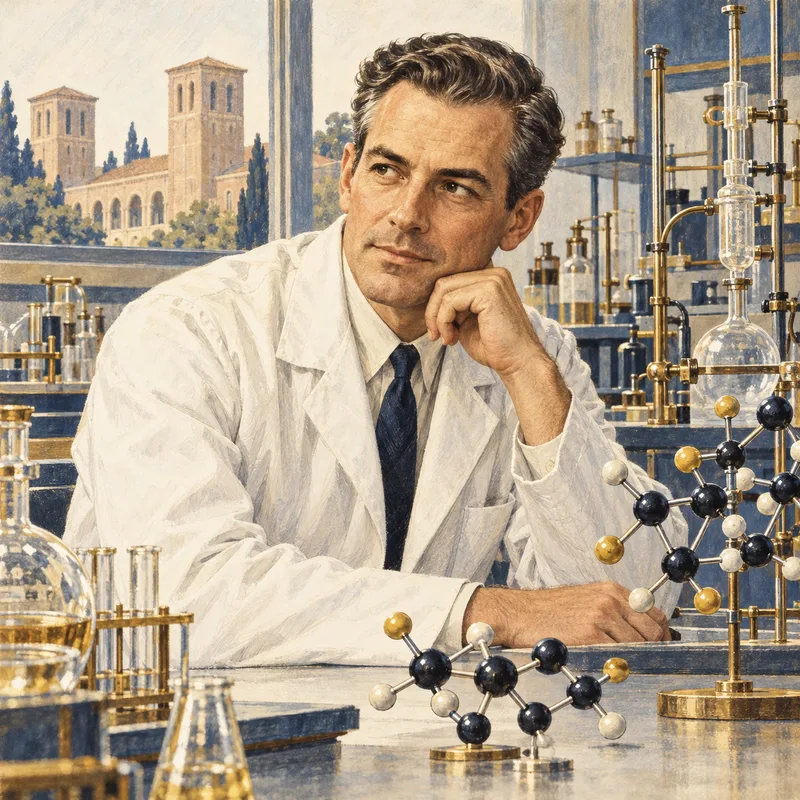
About the chemist
Donald Cram
1919-2001 · United States · Nobel Chemistry 1987
Host-guest chemistry, crown-type receptors