The discovery, explained · Chemist no. 90 of 350
Cram's Rule and Host-Guest Chemistry: Donald Cram's Two Great Contributions
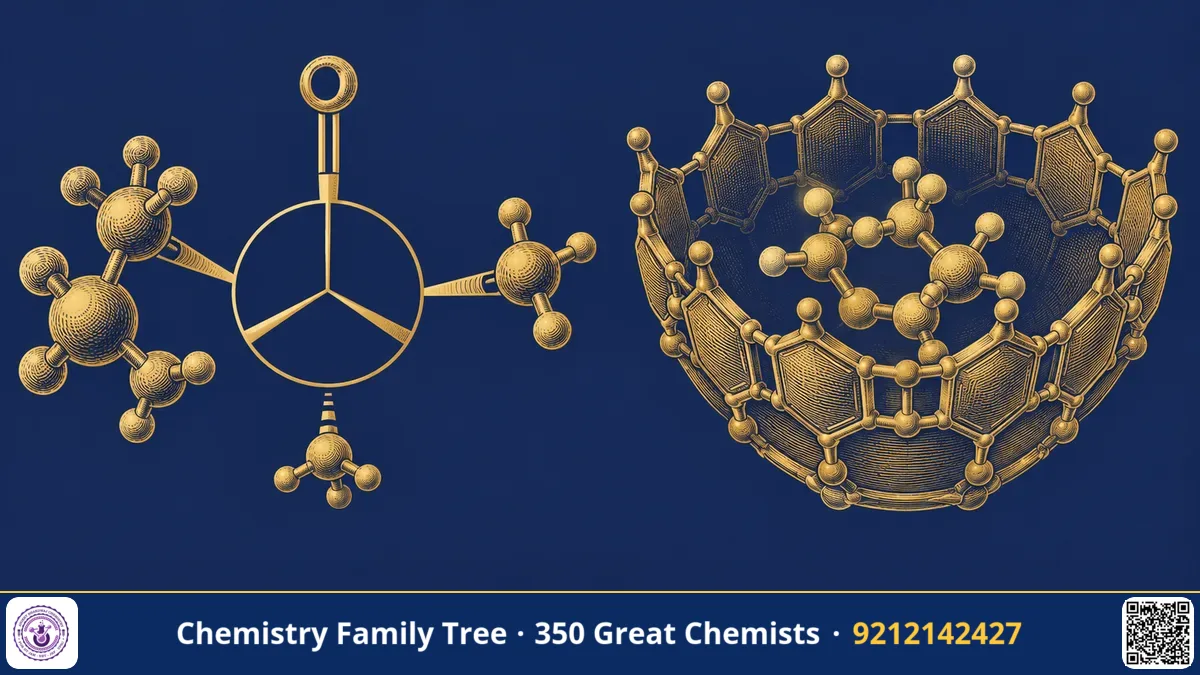
Donald J. Cram of the University of California, Los Angeles (UCLA), is known to every student of organic chemistry for two reasons. First, Cram's rule (1952) predicts which stereoisomer is formed when a nucleophile adds to a carbonyl group next to a stereocentre. Second, he designed whole families of synthetic molecules, spherands, cavitands and carcerands, that act as hosts for smaller guest molecules, mimicking enzymes. For this work he shared the 1987 Nobel Prize in Chemistry with Jean-Marie Lehn and Charles Pedersen. This blog explains both contributions with the details useful for IIT-JAM, CSIR-NET, GATE and B.Sc. organic chemistry.
The Scientific Problem Before the Discovery
By the late 1940s chemists knew that molecules can be chiral and that reactions at a new stereocentre can give two diastereomers, but they could not predict which would be the major product. Consider a ketone or aldehyde R-CO-C*(S)(M)(L), where C* is an existing stereocentre. When a Grignard reagent attacks the carbonyl carbon, a second stereocentre forms. The two possible products (diastereomers) are not formed in equal amounts, but the reason was unknown. Chemists needed a model to predict this "asymmetric induction".
A second problem emerged later. Enzymes recognise and bind their substrates with great selectivity. Pedersen's crown ethers (1967) showed that simple synthetic hosts can bind metal ions, but how could chemists design hosts for organic molecules, with controlled shape and chirality?
The Discovery / Experiment — Step by Step
Part 1: Cram's rule (open-chain model, 1952)
Cram studied the addition of Grignard reagents to ketones such as 2-phenylpropanal derivatives, which have a stereocentre next to the carbonyl. He found a consistent pattern. The model says:
- Label the three substituents on the adjacent stereocentre as L (large), M (medium) and S (small).
- Place the molecule in the conformation in which the carbonyl group is flanked by the two smaller groups, S and M, while the large group L is anti (pointing away) to the carbonyl, to reduce steric strain.
- The nucleophile attacks the carbonyl carbon from the less hindered side, the side of the small group S.
R'-CO-C*(L)(M)(S) + Nu⁻ → R'-C(OH)(Nu)-C*(L)(M)(S)
Major diastereomer: Nu enters from the side of S
An example is the reaction of 2-phenylpropanal, CH3CH(Ph)CHO, with methylmagnesium bromide: the major product is the diastereomer predicted by this model, and the minor product is the other one. Later work by Felkin and Anh refined the rule; in the Felkin-Anh model the large group is perpendicular to the carbonyl plane, and the nucleophile approaches along the Bürgi-Dunitz angle of about 107°. For exams, remember that the Felkin-Anh model is more accurate for most cases, while Cram's rule remains the historical starting point.
Cram's chelation model
If the stereocentre carries an OR or NR2 group and the reagent contains a metal such as Mg2+ or Zn2+, the metal can bind both the carbonyl oxygen and the heteroatom, forming a rigid five-membered chelate ring. The nucleophile then attacks from the less hindered face of this ring, and the opposite diastereomer may be favoured compared with the open-chain model.
Part 2: Host-guest chemistry (1970s-1980s)
After Pedersen's discovery of crown ethers, Cram built chiral crown ethers using the 1,1'-binaphthyl unit. These could distinguish between the two enantiomers of an ammonium salt (such as the salt of an amino acid ester, RNH3+): one enantiomer binds better than the other, so they can be separated. This was a synthetic model of an enzyme's chiral recognition. Cram then proposed the key concept of preorganisation: a host that already has the correct shape before binding needs less reorganisation, and so binds more strongly. He tested this idea with three classes of hosts:
| Host type | Shape | Feature |
|---|---|---|
| Spherands (1979) | Rigid, spherical cavity lined with oxygen atoms | Fully preorganised; bind Li+ and Na+ extremely strongly and selectively |
| Cavitands | Bowl or vase-shaped, with a permanent cavity | Based on resorcinol-derived macrocycles; bind neutral molecules or ions |
| Carcerands (1985) | Closed-shell, two cavitands joined at the rims | Trap guest molecules permanently inside, as in a prison (Latin carcer) |
In carcerands, solvent molecules or other guests present during the synthesis become locked inside the cavity. Their trapped molecules can then be studied in an unusual state of isolation. This became a place for studying short-lived reactive species such as cyclobutadiene, which Cram later stabilised inside a hemicarcerand (a host with a door that is partially open).
The Chemistry Behind It
The central principle of both discoveries is the same: shape and non-bonded interactions control reactivity. In Cram's rule, steric hindrance and torsional strain in the transition state decide which face of the carbonyl is attacked. In host-guest chemistry, the forces are ion-dipole interactions, hydrogen bonds, pi-stacking and the hydrophobic effect. The strength of binding is described by the association constant:
Host + Guest ⇌ Host·Guest K = [H·G] / ([H][G]) ΔG° = −RT ln K
A very large K is given by preorganised hosts, because the entropy cost of organising the host is paid during its synthesis, not during the binding.
Applications Today
- Pharmaceutical synthesis: predicting stereochemistry with Felkin-Anh and chelation models is used every day in planning the synthesis of single-enantiomer drugs.
- Chiral separation: chiral crown ether columns separate enantiomers of amino acids and amines in HPLC.
- Sensors and extraction: calixarenes and cavitands are used in ion sensors and for extraction of metal ions.
- Drug delivery and catalysis: molecular capsules and cages protect or activate guests, as enzymes do.
- Environmental chemistry: cavity-based hosts are studied for capture of pollutants.
Exam Corner — 5 Likely Points
- Cram's rule: the nucleophile attacks the carbonyl from the side of the smallest substituent on the adjacent stereocentre, in the conformation with L anti to the carbonyl.
- Chelation control needs a heteroatom at the α-position and a metal that can chelate (Mg2+, Zn2+).
- Felkin-Anh model: L perpendicular to C=O, nucleophile attack at about 107° (Bürgi-Dunitz).
- Spherand (rigid, preorganised) is a stronger binder than a crown ether.
- Carcerands permanently enclose guests; hemicarcerands allow guests to enter and leave.
Common Misconceptions
- "Cram's rule predicts the enantiomer formed." It predicts the major diastereomer when a stereocentre is already present.
- "A rigid host is always a bad host." Rigid, preorganised hosts bind the best, if the guest fits.
- "Cram's rule always works." It fails with chelating groups and with some bulky nucleophiles.
Quick Revision Box
- Cram's rule (1952): asymmetric induction in addition to α-chiral carbonyls.
- Substituents ranked L, M, S; attack from the S side.
- Chelation-controlled addition can give the opposite diastereomer.
- Cram's host classes: spherands, cavitands, carcerands.
- Preorganisation increases host-guest binding strength.
- Nobel Prize in Chemistry 1987: Cram, Lehn, Pedersen.
FAQ
What does asymmetric induction mean?
It means the preferential formation of one stereoisomer because of a chiral feature already present in the molecule or reagent.
How is the Felkin-Anh model different from Cram's rule?
Felkin-Anh places the largest group perpendicular to the carbonyl and considers the angle of nucleophile attack, giving a better description of the transition state.
What is a carcerand?
It is a closed molecular container formed from two bowl-shaped halves, which traps guest molecules inside.
Why was Cram's Nobel Prize shared?
Crown ethers (Pedersen), cryptands and supramolecular concepts (Lehn) and designed host molecules (Cram) together created the field of host-guest chemistry.
Published by ABC Chemistry — IIT-JAM | CSIR-NET | GATE Chemistry Coaching. Visit abcchemistry.com
About the chemist
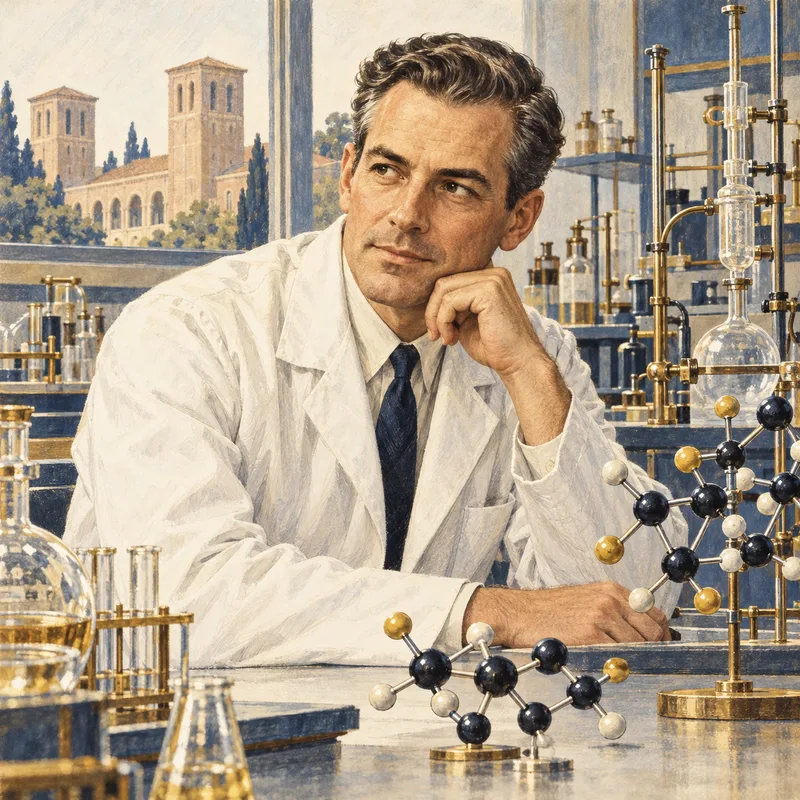
Donald Cram
1919-2001 · United States · Nobel Chemistry 1987
Host-guest chemistry, crown-type receptors