Biography · Chemist no. 66 of 350
Dorothy Crowfoot Hodgkin: Life, Struggles and Legacy of a Crystallography Pioneer
Dorothy Crowfoot Hodgkin (1910-1994) was a British chemist who showed the world what complex molecules look like in three dimensions. By solving the structures of penicillin, vitamin B12 and insulin using X-ray crystallography, she changed medicine and chemistry. She received the Nobel Prize in Chemistry in 1964 and remains the only British woman to have won a science Nobel Prize. Her legacy in one line: she turned crystallography into the main tool for seeing the molecules of life.
Early Life and Family
Dorothy Mary Crowfoot was born on 12 May 1910 in Cairo, Egypt, where her father John Winter Crowfoot worked in the education service. Her mother, Grace Mary (known as Molly) Hood, was a skilled botanical artist and had a keen interest in ancient textiles. Her parents were deeply involved in archaeology, and the family later lived in Sudan and spent long periods abroad. The children were sometimes sent back to England for school while their parents worked overseas.
As a child, Dorothy was curious about crystals. She enjoyed growing them at home and tested minerals with simple chemical reagents. A book by W. H. Bragg on the nature of things also fascinated her, and by her teens she knew she wanted to study chemistry.
Education and Mentors
She attended the Sir John Leman School in Beccles, Suffolk, and entered Somerville College, Oxford, in 1928 to study chemistry. Her fourth-year research in Oxford on crystal structure introduced her to X-ray analysis. In 1932 she moved to Cambridge to work with John Desmond Bernal, a brilliant and inspiring crystallographer who believed that X-rays could unlock the structure of biological molecules. Bernal shaped her vision. In 1934 she returned to Oxford as a fellow of Somerville, where she remained for decades.
Career Timeline
| Year | Event |
|---|---|
| 1910 | Born in Cairo, Egypt |
| 1928 | Enters Somerville College, Oxford |
| 1932 | Starts research with J. D. Bernal at Cambridge |
| 1934 | Returns to Oxford; first insulin crystal photographs |
| 1937 | Marries Thomas Hodgkin |
| 1947 | Elected Fellow of the Royal Society |
| 1949 | Penicillin structure published |
| 1956 | Vitamin B12 structure published |
| 1964 | Nobel Prize in Chemistry |
| 1965 | Appointed to the Order of Merit |
| 1969 | Insulin structure reported |
| 1994 | Dies at Ilmington, Warwickshire |
Major Scientific Contributions
Hodgkin's work followed a clear line: use crystallography on bigger and more important molecules. Early studies covered sterols such as cholesteryl iodide. Then came penicillin, where the β-lactam ring was confirmed. In 1956 she solved vitamin B12, with its cobalt-containing corrin ring, and in 1969 insulin. The key idea was Bragg's law, nλ = 2d sinθ, combined with Fourier synthesis and heavy-atom methods to overcome the phase problem. She was also one of the first to make heavy use of electronic computers in chemistry. You can read more of the technical details in our discovery post on her X-ray work.
Awards, Honours and Nobel Prize
- Nobel Prize in Chemistry, 1964, for determining the structures of important biochemical substances by X-ray techniques.
- Fellow of the Royal Society (1947) and Royal Society's Copley Medal (1976).
- Order of Merit (1965), the second woman after Florence Nightingale to receive it.
- Lenin Peace Prize (1987), reflecting her work for international peace.
- Chancellor of the University of Bristol (1970-1988).
Personality, Struggles and Lesser-Known Facts
- Illness: From her mid-twenties she developed rheumatoid arthritis, which gradually deformed her hands and later forced her to use a wheelchair. She continued working with great precision.
- Family and science: She married the historian Thomas Hodgkin in 1937 and raised three children while running a research group.
- Teacher of a future politician: Margaret Thatcher studied chemistry at Somerville under Hodgkin.
- Peace activism: She was president of the Pugwash movement from 1976 to 1988 and campaigned for scientific cooperation across the Cold War divide.
- Support for students: She was known for warmth and encouragement and trained many students from different countries, including India.
- Patience: She waited about 35 years between the first insulin photographs and the final structure.
Legacy and Influence on Modern Chemistry
Every protein structure in the Protein Data Bank carries a little of Hodgkin's legacy. Her work proved that large molecules could be solved by X-rays, encouraging Perutz, Kendrew, Klug and many others. Today's drug design depends on knowing how a molecule fits into an enzyme's active site, which is exactly the type of knowledge she pioneered. Her students and collaborators spread across the world, and the techniques she developed continue in synchrotron beamlines and modern computing.
Hodgkin's working style is worth remembering. She enjoyed discussing structures with her students and treated each new diffraction photograph with excitement. Colleagues recalled that she kept her laboratory friendly and open, and that she often shared credit generously. She also travelled widely, including visits to India and China, to meet scientists and to promote scientific cooperation. In India she took a special interest in the work of local crystallographers, and her example encouraged many young researchers to enter structural chemistry.
Lessons for Students
- Patience wins: hard problems may take decades, and each small advance counts.
- Learn mathematics along with chemistry; structure solving is applied Fourier analysis.
- Do not let physical limits define your work. Hodgkin made a world-class career despite severe arthritis.
- Collaborate and mentor others.
Quick Facts Box
- Born: 12 May 1910, Cairo, Egypt
- Died: 29 July 1994, Ilmington, England
- Nationality: British
- Field: X-ray crystallography, biochemistry
- Famous for: Structures of penicillin, vitamin B12 and insulin
- Nobel: Chemistry, 1964
FAQ
Did Dorothy Hodgkin win the Nobel Prize alone?
Yes. The 1964 Nobel Prize in Chemistry was awarded to her alone.
Who was her scientific mentor?
J. D. Bernal at Cambridge was her main mentor in crystallography.
Which structures did she solve?
She worked on sterols, penicillin, vitamin B12 and insulin, among others.
Why is she important for Indian students?
Her methods underpin X-ray diffraction topics in physical and inorganic chemistry syllabi, and she showed how rigour and persistence lead to success in science.
Published by ABC Chemistry — IIT-JAM | CSIR-NET | GATE Chemistry Coaching. Visit abcchemistry.com
About the chemist
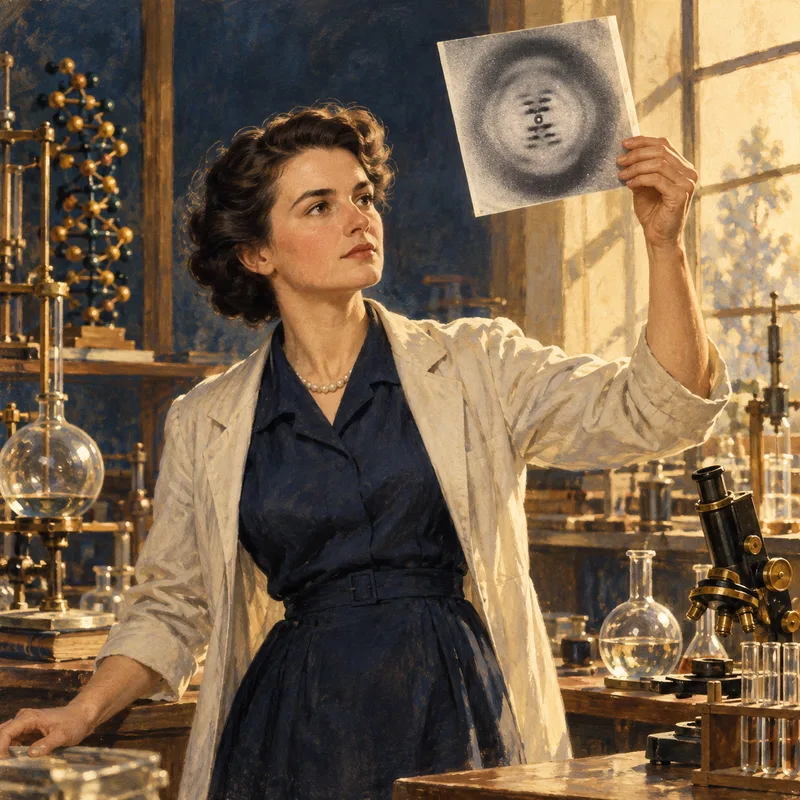
Dorothy Crowfoot Hodgkin
1910-1994 · United Kingdom · Nobel Chemistry 1964
X-ray crystallography of penicillin, B12, insulin