Biography · Chemist no. 154 of 350
Dudley Herschbach: Complete Life and Legacy of a Reaction Dynamics Pioneer
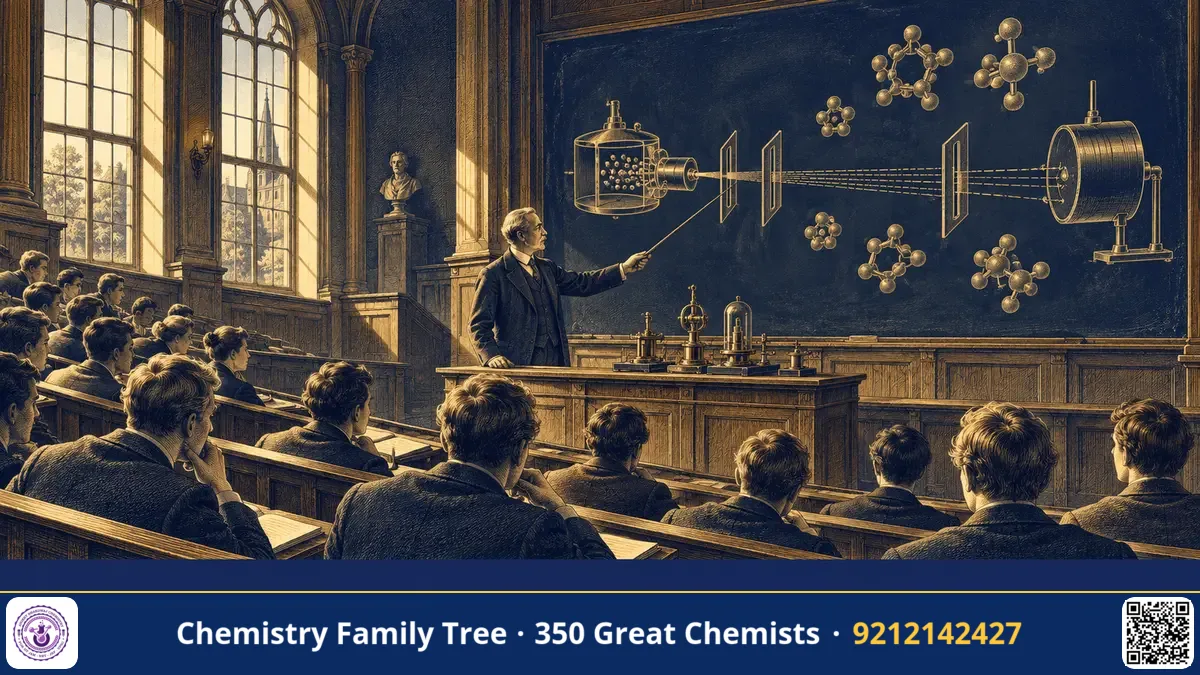
Dudley Herschbach, born in 1932, is an American physical chemist who spent most of his career at Harvard University. With Yuan T. Lee and John Polanyi, he won the 1986 Nobel Prize in Chemistry for contributions to the dynamics of chemical elementary processes. He is remembered not only for crossed molecular beams but also for a lifelong passion for teaching, including introductory chemistry for first-year students. His legacy: he helped turn chemical reactions from averaged laboratory observations into events studied one collision at a time.
Early Life and Family
Dudley Robert Herschbach was born on 18 June 1932 in San Jose, California. He grew up in a farming-oriented area of California. As a schoolboy he was active in sports, and a high-school teacher and coach is often mentioned in accounts of his early life as an important influence. He has spoken of the encouragement he received from teachers who recognised his ability. This background, a small-town upbringing with strong support from school teachers, shaped his belief that good teaching can change lives.
Education and Mentors
Herschbach attended Stanford University, where he earned a bachelor's degree in mathematics in 1954 and a master's degree in chemistry in 1955. He then moved to Harvard University for doctoral work, where he studied under E. Bright Wilson, a well-known physical chemist and spectroscopist. His PhD, completed in 1958, was in chemical physics. Wilson's group taught him the value of rigorous theory combined with experiments in molecular spectroscopy. After the PhD he spent a short period as a junior fellow at Harvard before moving to the University of California, Berkeley.
Career Timeline
| Year | Event |
|---|---|
| 1932 | Born in San Jose, California |
| 1954 | Bachelor's degree in mathematics, Stanford University |
| 1955 | Master's degree in chemistry, Stanford University |
| 1958 | PhD, Harvard University, under E. Bright Wilson |
| 1959–1963 | Faculty member at the University of California, Berkeley |
| 1963 | Returned to Harvard as professor of chemistry |
| 1960s | Developed crossed molecular beam experiments with alkali atoms |
| 1986 | Shared the Nobel Prize in Chemistry with Yuan T. Lee and John Polanyi |
Major Scientific Contributions
Herschbach's most famous work was on crossed molecular beams. In his Harvard laboratory, beams of alkali metal atoms and halogen-containing molecules were made to cross in high vacuum. The scattering angles and speeds of the products were recorded. For reactions such as K + CH₃I → KI + CH₃, the data revealed whether the product moved forward or backward and how the energy was divided. This was direct evidence for ideas such as the harpoon mechanism, and the findings fed into the construction of potential energy surfaces.
Other contributions include:
- Theory of reactive scattering: He worked on how angular momentum is conserved and distributed in reactive collisions.
- Dimensional scaling: He developed approximate methods for quantum systems by treating the number of spatial dimensions as a variable and considering a limit of large dimension, which simplifies some problems of atomic and molecular structure.
- Training of students: Many of his students and postdoctoral fellows became leaders in chemical physics, the best known being Yuan T. Lee.
Awards, Honours and Nobel Prize
The 1986 Nobel Prize in Chemistry was awarded jointly to Dudley R. Herschbach, Yuan T. Lee and John C. Polanyi "for their contributions concerning the dynamics of chemical elementary processes." It was a Chemistry prize. Herschbach also received the US National Medal of Science and is a member of the US National Academy of Sciences, among other honours. He was widely respected for his lectures and for supporting science education.
Personality, Struggles and Lesser-Known Facts
- A mathematician by first degree: His undergraduate degree was in mathematics, and this shows in the theoretical side of his work.
- Passion for teaching freshmen: Even after the Nobel Prize he continued to teach introductory chemistry and spoke often about the importance of science education.
- Sharing credit: He consistently emphasised the role of his students and collaborators, especially Yuan T. Lee, in the success of the research programme.
- Cross-border science: The 1986 prize was shared by an American, a Taiwanese-born American and a Canadian, a reminder that chemistry is a global effort.
- Big machines, simple question: The apparatus occupied entire rooms, but the question behind it was simple: what happens in one collision?
Legacy and Influence on Modern Chemistry
The field of chemical dynamics grew from these experiments. Today, advanced techniques such as velocity-map imaging, femtosecond laser spectroscopy and ultracold collision experiments continue the same goal of describing a reaction at the molecular level. Theoretical chemists test their computed potential energy surfaces against beam data. In education, the idea that rate constants are averages over molecular events is a standard part of physical chemistry courses. In India, this physical picture appears in kinetics sections of B.Sc., M.Sc. and competitive exams, where collision theory and transition-state theory are compared with real molecular behaviour.
Lessons for Students
- Ask a narrower question. Instead of "how fast is the reaction?", ask "what happens in one collision?"
- Value teachers. Herschbach credits teachers for his own path; becoming a good teacher is a scientific achievement too.
- Combine mathematics and chemistry. His first degree in mathematics became a strength.
- Share credit. Large experiments succeed through teams.
Quick Facts Box
- Born: 18 June 1932, San Jose, California, USA
- Died: Not covered here
- Nationality: American
- Field: Physical chemistry, chemical dynamics
- Famous for: Crossed molecular beam studies of reaction dynamics
- Nobel: 1986, Chemistry (shared with Yuan T. Lee and John Polanyi)
FAQ
Where did Herschbach work for most of his career?
At Harvard University, where he was a professor from 1963, after a few years at Berkeley.
Who was his doctoral supervisor?
E. Bright Wilson at Harvard University.
What is the harpoon mechanism?
It is an electron-transfer picture in which an alkali atom gives up an electron to a halogen-containing molecule at a relatively long distance, pulling the partners together like a harpoon.
How is this relevant to exams?
It gives the physical meaning behind collision theory, steric factor and activation energy. Questions on the Nobel Prize years and names can also appear in general-awareness sections.
Published by ABC Chemistry — IIT-JAM | CSIR-NET | GATE Chemistry Coaching. Visit abcchemistry.com
About the chemist
Dudley Herschbach
1932- · United States · Nobel Chemistry 1986
Crossed molecular beam dynamics