The discovery, explained · Chemist no. 154 of 350
Dudley Herschbach and Crossed Molecular Beams: Watching Reactions Collision by Collision
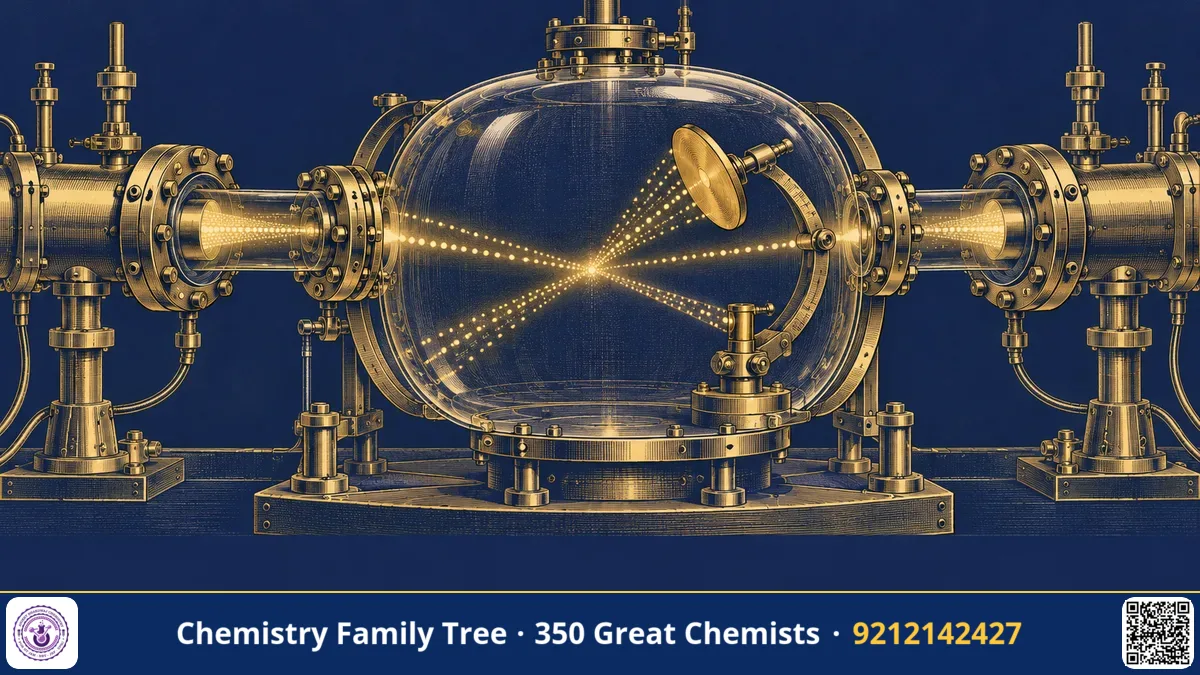
When you write CH₃I + K → CH₃ + KI on paper, it looks like a single clean step. In a flask, however, billions of molecules collide at random speeds, angles and energies, and what you measure is only an average. Dudley Herschbach and his students at Harvard asked a bolder question: can we study one type of collision at a time, and see where the products go? Using crossed molecular beams they showed that the answer is yes. For this contribution to the dynamics of elementary chemical reactions, Herschbach shared the 1986 Nobel Prize in Chemistry with Yuan T. Lee and John Polanyi. Their work gave chemists a microscope for the act of bond breaking and bond making.
The Scientific Problem Before the Discovery
By the 1950s chemical kinetics was well developed. Students learned the Arrhenius equation, k = A e−Ea/RT, and collision theory and transition-state theory to explain rate constants. But these theories dealt with averages over a Boltzmann distribution of energies. They could not say:
- Does the product fly forward along the direction of the reactant, or bounce backward?
- How is the reaction energy shared between translation, vibration and rotation of the product?
- Does the molecule need to hit with a certain orientation?
A bulk experiment mixes all possibilities. To answer these questions one needs reactants with well-defined velocities, colliding under conditions where each molecule collides only once, and detectors that measure where the products go.
The Discovery and the Experiments
Herschbach started his independent career at Berkeley (1959–1963) and moved to Harvard in 1963. With his group he built apparatus in which two beams of particles travel in a high vacuum and cross each other at a right angle. In the vacuum, the pressure is so low that molecules in a beam do not collide with each other or with air; they meet only at the crossing point.
The basic setup can be described in stages:
- Beam sources. One beam is made of an alkali metal atom such as potassium, produced by heating in an oven with a small slit. The other beam is a molecular gas such as CH₃I.
- Velocity selection. Rotating slotted disks allow only particles of a narrow speed range to pass.
- Collision zone. The two beams cross in a chamber at very low pressure, so reactions occur in single collisions.
- Detection. A detector, which can be moved around the crossing point, counts the product molecules at different angles. In the early alkali-atom experiments a hot wire detector was used, which ionises alkali atoms and their halides efficiently.
- Analysis. The angular distribution of the product is plotted and interpreted in the centre-of-mass frame.
The classic reaction was:
K + CH₃I → KI + CH₃
Herschbach and co-workers found that the KI product was strongly scattered in the forward or backward direction relative to the K beam, depending on the system, rather than in all directions equally. For K + CH₃I the KI emerged mainly in the forward direction. This was said to be consistent with a "stripping"-type picture, in which the K atom picks up the iodine as it passes and keeps going, while the methyl group is left behind. For other systems, a rebound pattern appeared, in which the products travel backward. Such patterns gave direct information about the shape of the potential energy surface and the lifetime of the collision complex.
The Chemistry Behind It
Several ideas from your syllabus connect here.
| Concept | Link to molecular beams |
|---|---|
| Collision theory | Rate depends on collision frequency, energy and orientation (steric factor) |
| Potential energy surface | Energy of the system as a function of nuclear positions; trajectories follow it |
| Activation energy | Threshold energy that collisions must have to react |
| Centre-of-mass frame | Used to describe angular distribution independent of overall motion |
| Energy partitioning | Reaction energy goes into product translation, vibration, rotation |
Alkali atoms such as K have a low ionisation energy, and halogen-containing molecules have a high electron affinity. In such reactions an electron can jump from the metal atom to the molecule at a fairly large separation, creating K⁺ and a negative ion that then attract each other. This is called the harpoon mechanism, because the electron acts like a harpoon that reels in the reaction partner. It explains why some reactions have unusually large reaction cross-sections.
Herschbach also made major contributions to theory, including the study of angular momentum in reactive collisions and, later, methods that treat a many-dimensional quantum problem by considering the limit of large dimensionality. These help in understanding the structure of atoms and molecules.
Applications Today
- Atmospheric chemistry: State-resolved collision data help model reactions of ozone, radicals and nitrogen oxides in the atmosphere.
- Combustion: Elementary reaction rates and product distributions feed into models of flames and engines.
- Laser chemistry: Understanding energy distribution in products supports the design of chemical lasers and selective bond breaking.
- Computational chemistry: Beam data are used to test calculated potential energy surfaces.
- Astrochemistry: Collision studies at low energy help explain how molecules form in interstellar clouds.
- Teaching in India: Chemical dynamics is part of advanced physical chemistry courses at M.Sc. level, and molecular-beam ideas appear in JAM and NET kinetics questions.
Exam Corner
- The 1986 Nobel Prize in Chemistry was shared by Dudley Herschbach, Yuan T. Lee and John Polanyi for the dynamics of chemical elementary processes.
- In a crossed-beam experiment, a high vacuum ensures single collisions and no secondary reactions.
- Typical reaction studied: K + CH₃I → KI + CH₃.
- Harpoon mechanism: long-range electron transfer from an alkali atom to a halogen-containing molecule.
- Angular distribution of products indicates direct (stripping or rebound) or complex-forming (long-lived) reactions.
Common Misconceptions
- "A beam experiment measures a rate constant." It gives much more detailed information, such as the cross-section and the angular and energy distributions, from which rate constants can be derived.
- "Molecules react every time they collide." Only collisions with enough energy and suitable orientation lead to reaction.
- "The Nobel was only for experiments." The prize recognised both experiment and the insight from them about reaction dynamics.
Quick Revision Box
- Crossed beams: two collimated beams cross in high vacuum, single collisions.
- Detector measures product intensity versus angle.
- K + CH₃I → KI + CH₃ is a classic system.
- Harpoon mechanism explains large cross-sections for alkali–halogen reactions.
- Nobel Prize in Chemistry, 1986: Herschbach, Lee, Polanyi.
- Links to collision theory, activation energy and potential energy surfaces.
FAQ
Why must the experiment be done in a vacuum?
In a vacuum, beam molecules do not collide with air or with each other before the crossing point, so each product comes from a single, known type of collision.
Did Herschbach work alone?
No. His students and colleagues at Harvard, including Yuan T. Lee, who was a postdoctoral researcher there, played a major role. Lee later developed his own more versatile machine.
Is this Physics or Chemistry?
The prize was in Chemistry, although the methods use ideas from physics.
What is the main message for students?
Chemical reactions are collisions between individual molecules, and detailed measurements of those collisions can reveal how bonds break and form.
Published by ABC Chemistry — IIT-JAM | CSIR-NET | GATE Chemistry Coaching. Visit abcchemistry.com
About the chemist
Dudley Herschbach
1932- · United States · Nobel Chemistry 1986
Crossed molecular beam dynamics