Biography · Chemist no. 101 of 350
Eduard Buchner: Complete Life and Legacy
Introduction
Eduard Buchner (1860–1917) was a German chemist who proved that the chemical changes of fermentation can take place without a living cell. His finding that a juice pressed from yeast could turn sugar into alcohol and carbon dioxide gave the world the first clear demonstration of cell-free enzyme action. He received the Nobel Prize in Chemistry in 1907. He also left a mark in organic chemistry through the ring expansion reaction that bears his name. His life ended in the First World War, far too early for a scientist of his talent. His legacy is simple: he turned biology's mysteries into chemistry that can be studied in a flask.
Early Life and Family
Eduard Buchner was born on 20 May 1860 in Munich, Bavaria. His father, Ernst Buchner, was a professor of forensic medicine and an editor of a medical journal. The household was educated and scientific. His elder brother Hans Buchner became a well-known bacteriologist and hygienist, and later collaborated with Eduard in the work that led to the Nobel Prize. Growing up in a family of doctors and academics, Eduard was exposed to scientific discussion from childhood.
Money became a problem when his father died while Eduard was still young, and the family's finances were strained. Because of this, Buchner had to interrupt his studies and take up paid work for some time before returning to university. This early struggle is worth remembering: the future Nobel laureate did not follow a smooth, uninterrupted path.
Education and Mentors
Buchner trained in chemistry in Munich, where he came under the influence of two outstanding teachers. Adolf von Baeyer, the great organic chemist who synthesised indigo, led the chemistry department and later won the Nobel Prize in 1905. Theodor Curtius, the discoverer of diazoacetic ester and of the Curtius rearrangement, supervised his early research. Buchner followed Curtius to Erlangen for some time and then returned to Munich, where he received his doctorate in 1888 and became a lecturer.
Curtius' work on diazoacetic ester was important for Buchner. In the 1880s, Buchner studied the reactions of ethyl diazoacetate with unsaturated compounds such as benzene, and found that carbene transfer could expand a six-membered ring into a seven-membered ring. This gave the Buchner ring expansion, still taught in advanced organic chemistry.
Career Timeline
| Year | Event |
|---|---|
| 1860 | Born in Munich on 20 May. |
| 1888 | Doctorate in chemistry at Munich. |
| 1890s | Works at Munich and gains a position as assistant and lecturer; studies diazoacetic ester chemistry. |
| 1896–97 | With his brother Hans and Martin Hahn, prepares yeast press juice and discovers cell-free fermentation. |
| 1898 | Becomes professor at the University of Tübingen. |
| 1899 | Moves to the Agricultural College (Landwirtschaftliche Hochschule) in Berlin. |
| 1900 | Marries Lotte Stahl, daughter of a Tübingen mathematics professor. |
| 1907 | Awarded the Nobel Prize in Chemistry. |
| 1909 | Professor at the University of Breslau. |
| 1911 | Professor at the University of Würzburg. |
| 1914–1917 | Serves as an officer in the German army during the First World War. |
| 1917 | Dies on 13 August in Focșani, Romania, from wounds. |
Major Scientific Contributions
- Cell-free fermentation (1897): showed that yeast press juice ferments sugar to ethanol and carbon dioxide. This is the foundation of enzymology. The reaction is
C6H12O6 → 2C2H5OH + 2CO2. For details, read our discovery post on cell-free fermentation. - Zymase: named the active agent of the juice; later shown to be a set of enzymes and coenzymes.
- Buchner ring expansion: reaction of benzene with ethyl diazoacetate, with loss of N2, to give a cycloheptatriene carboxylate via a norcaradiene intermediate.
- Synthesis of pyrazoline derivatives: early work on the reactions of diazoacetic ester with unsaturated acids gave pyrazoline compounds and contributed to heterocyclic chemistry.
- Study of fermentation by-products: later in his career he examined the action of zymase in detail and also the role of fermentation in forming glycerol and other products.
Awards, Honours and Nobel Prize
The Nobel Prize in Chemistry for 1907 was awarded to Eduard Buchner "for his biochemical researches and his discovery of cell-free fermentation". It was a recognition that the question of fermentation, argued since the days of Liebig and Pasteur, had been settled by experiment. It was a Chemistry prize, showing that the committee saw the work as a triumph of chemistry even though it concerned a biological process.
He held professorships at several leading German universities, which in itself was a sign of the high regard in which he was held. He was awarded the Nobel Prize while he was Professor at the Agricultural College of Berlin.
Personality, Struggles and Lesser-Known Facts
- A discovery by accident. Buchner's cell-free fermentation grew out of an attempt to make yeast extracts for medical use. The use of sugar as a preservative, which actually triggered the observation, was a practical trick borrowed from the kitchen.
- Brother collaboration. His brother Hans, a bacteriologist, had been working on cell extracts, and the two exchanged ideas.
- Financial hardship. After his father's death, the family had little money and Eduard's studies were delayed.
- Cautious style. His experimental approach was careful: he tested objections to his claim, such as the possibility that tiny surviving cells were responsible, before announcing his result.
- Volunteer in war. When the First World War began in 1914, Buchner, although already a Nobel laureate in his mid-fifties, volunteered for military service. He served as an officer and was sent to the Romanian front.
- Tragic end. He was seriously wounded by shrapnel at Focșani on 11 August 1917 and died two days later, on 13 August 1917.
Legacy and Influence on Modern Chemistry
Buchner's work removed the wall between chemistry and biology. After 1897, scientists no longer asked whether a life process could be studied outside a living organism; they asked how. Within a few decades, the glycolytic pathway had been worked out step by step by Gustav Embden, Otto Meyerhof, Jakub Parnas, Carl and Gerty Cori and others. Harden and Young's discovery of coenzymes and sugar phosphates grew straight out of Buchner's juice. In 1926, James Sumner crystallised urease and showed that enzymes are proteins, completing the picture that Buchner had begun.
Every modern technique that uses extracted enzymes, from diagnostic blood tests to cell-free protein synthesis kits, follows his principle. Even the ring expansion bearing his name is still used in synthesis, now often with rhodium or copper catalysts for carbene transfer.
Lessons for Students
- Be curious about "failed" or unexpected results. Buchner was looking for a medicine and found a new science.
- Question established authority respectfully with experiments. Pasteur's view was dominant, yet a simple pressing experiment changed it.
- Check alternatives. Buchner tested whether living cells remained before claiming a cell-free result.
- Keep going through hardship. Financial difficulty did not stop his progress.
- Connect fields: organic chemistry skills (diazo compounds) and biology both shaped his career.
Quick Facts Box
- Born: 20 May 1860, Munich, Bavaria.
- Died: 13 August 1917, Focșani, Romania.
- Nationality: German.
- Field: Organic chemistry and biochemistry.
- Famous for: Cell-free fermentation; zymase; Buchner ring expansion.
- Nobel: Chemistry, 1907.
FAQ
When did Eduard Buchner win the Nobel Prize?
He received the Nobel Prize in Chemistry for 1907, for his biochemical research and his discovery of cell-free fermentation.
How did Eduard Buchner die?
He was wounded by shrapnel on the Romanian front in the First World War and died of his injuries at Focșani on 13 August 1917.
Who were Buchner's teachers?
He studied in Munich under Adolf von Baeyer and worked closely with Theodor Curtius, whose diazoacetic ester chemistry influenced his own research.
What is the Buchner ring expansion?
It is the reaction of benzene with a carbene from ethyl diazoacetate, which inserts one carbon into the six-membered ring to form a seven-membered cycloheptatriene ring. It is a useful topic for organic chemistry exams.
Published by ABC Chemistry — IIT-JAM | CSIR-NET | GATE Chemistry Coaching. Visit abcchemistry.com
About the chemist
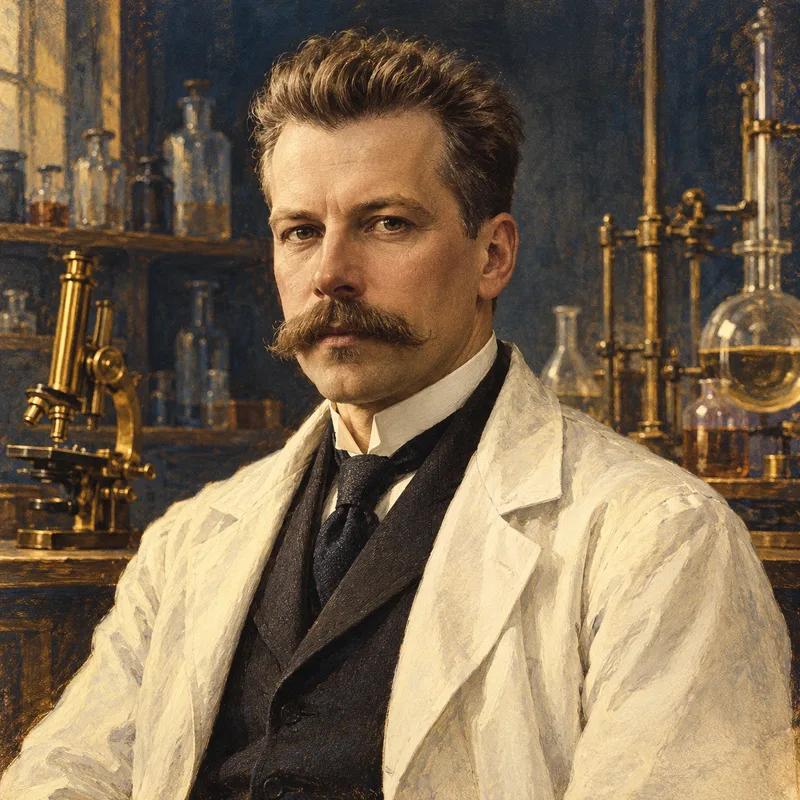
Eduard Buchner
1860-1917 · Germany · Nobel Chemistry 1907
Cell-free alcoholic fermentation