The discovery, explained · Chemist no. 101 of 350
Eduard Buchner and the Discovery of Cell-Free Fermentation
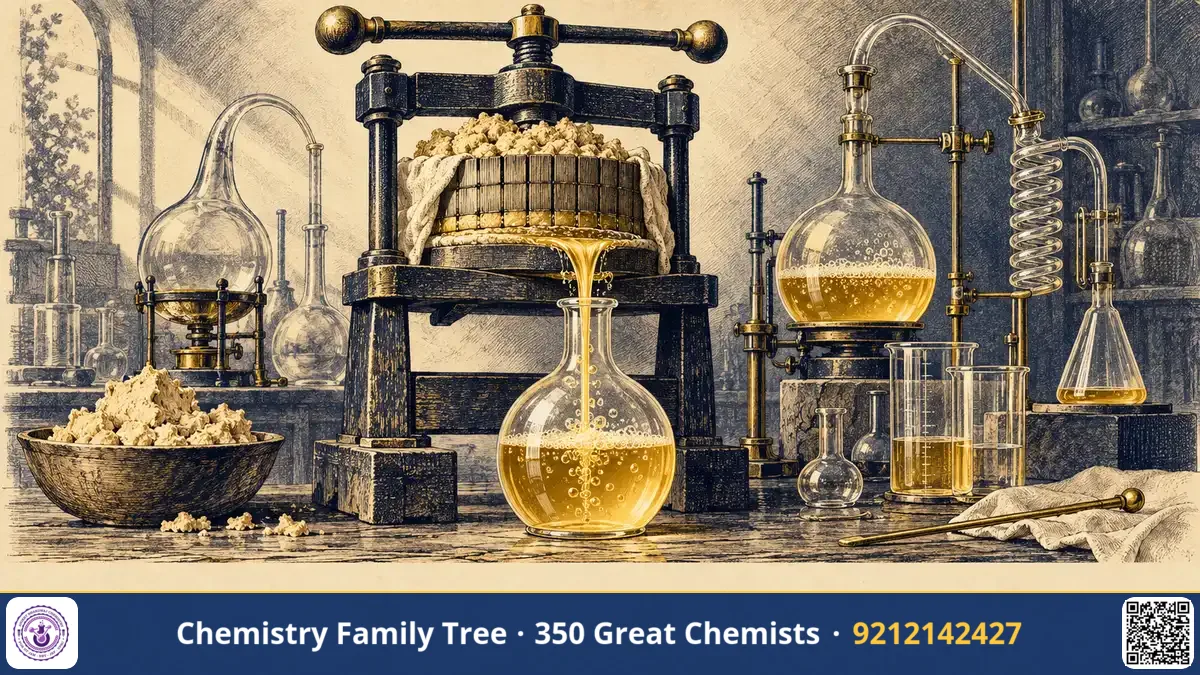
Imagine grinding yeast cells into a paste, squeezing out a clear yellowish liquid that contains no living cell at all, adding sugar, and watching it bubble with carbon dioxide. In 1896–97 the German chemist Eduard Buchner did exactly this, and in doing so he ended a debate that had divided scientists for decades. Fermentation, he showed, does not need a living cell. It needs a chemical catalyst, which he named zymase. This single result opened the door to enzymology and modern biochemistry, and it earned Buchner the Nobel Prize in Chemistry in 1907. For every student who studies glycolysis, enzyme kinetics or industrial fermentation, the story begins in Buchner's laboratory.
The Scientific Problem Before the Discovery
People had made wine, beer and bread for thousands of years without knowing what happened inside the vat. In the nineteenth century, scientists argued about the cause. Justus von Liebig and many chemists believed that fermentation was a purely chemical process, a kind of molecular decomposition set off by unstable substances. Louis Pasteur, working in the 1850s and 1860s, argued the opposite: fermentation is "life without air", the work of living yeast cells, and cannot occur without them. This view is called vitalism in the context of fermentation.
Pasteur's authority was enormous, and most biologists accepted that the living organism and the chemical change were inseparable. Chemists had already used the word "ferment" for soluble substances such as diastase, which converts starch to sugar, and pepsin, which digests protein. These soluble ferments worked in a test tube. But the ferment that turned sugar into alcohol seemed different, because nobody could extract it from yeast. Attempts to do so had failed again and again, and the dominant belief was that the process was tied to the intact, living structure of the cell.
The Discovery: Step by Step
Buchner was not originally trying to study fermentation at all. With his brother Hans Buchner, a bacteriologist, he was preparing extracts of yeast for possible medical use. The aim was to obtain the cell contents in a form that could be injected as a therapeutic preparation. To get at the contents, the cells had to be broken open without heat that would destroy the proteins.
- Grinding. Fresh brewer's yeast was ground in a mortar with fine sand and kieselguhr (diatomaceous earth) until the cells were crushed.
- Pressing. The sticky mass was wrapped in cloth and squeezed under a hydraulic press at very high pressure, giving a thick, clear liquid called yeast press juice.
- Filtering. The juice was filtered to remove any whole cells. Under the microscope it contained no intact yeast.
- Preserving. The juice spoiled quickly. Following a suggestion by his assistant, Buchner added a large quantity of cane sugar (sucrose), a common preservative like in jam. Surprisingly, the sugar did not just preserve the juice.
- Observation. Within a short time, the mixture began to evolve gas bubbles. It was fermenting. Carbon dioxide was released and alcohol was formed, with no living cell present.
Buchner reported the finding in 1897, working with his brother Hans and Martin Hahn, who had helped prepare the juice. He tested the possibility that tiny surviving cells or fragments were responsible and showed that antiseptics such as toluene did not stop the action. The conclusion was clear: a dissolved substance in the juice caused the fermentation. He called it zymase, from the Greek word for leaven.
The Chemistry Behind It
The overall change that Buchner's juice carried out is the alcoholic fermentation of glucose:
C6H12O6  →  2 C2H5OH  +  2 CO2
glucose      ethanol     carbon dioxide
Because sucrose was used, the first step is its hydrolysis by invertase (sucrase), also present in yeast:
C12H22O11 + H2O → C6H12O6 (glucose) + C6H12O6 (fructose)
Buchner's "zymase" was not one enzyme but a whole group of enzymes, the machinery of what we now call glycolysis followed by fermentation. We now know the pathway in detail:
- Glucose is phosphorylated and split into two three-carbon units (glyceraldehyde 3-phosphate).
- These are oxidised to pyruvate, giving a net gain of 2 ATP and 2 NADH per glucose.
- Pyruvate decarboxylase converts pyruvate to acetaldehyde and CO2, using thiamine pyrophosphate as coenzyme:
CH3COCOOH → CH3CHO + CO2 - Alcohol dehydrogenase reduces acetaldehyde to ethanol using NADH:
CH3CHO + NADH + H+ → C2H5OH + NAD+
The last step regenerates NAD+, which keeps glycolysis running in the absence of oxygen. This is why yeast can live and produce alcohol under anaerobic conditions. The key conceptual lesson from Buchner is that biochemical reactions follow the ordinary laws of chemistry. Enzymes are catalysts: they lower the activation energy, do not change the equilibrium position, and are not consumed. They can work outside the cell if the conditions (pH, temperature, cofactors) are right.
Later work by Arthur Harden and William Young in 1905–1906 showed that Buchner's juice lost activity on dialysis because a small, dialysable coenzyme was removed, and that inorganic phosphate was essential. This led to the discovery of sugar phosphates and eventually to the full glycolytic pathway of Embden, Meyerhof and Parnas.
Applications Today
- Brewing, wine and distilling: controlled yeast fermentation is still the base of the beverage industry.
- Bioethanol: India blends ethanol, produced by fermenting molasses and cane juice, with petrol under its national ethanol blending programme.
- Baking: CO2 from yeast makes dough rise.
- Industrial enzymes: amylases, proteases and lipases are used in detergents, textiles, food and pharmaceuticals.
- Cell-free biotechnology: modern cell-free protein synthesis and cell-free metabolic engineering are direct intellectual descendants of Buchner's idea.
- Medicine: enzyme assays in blood tests rely on the principle that enzymes work in a test tube.
Exam Corner
- Buchner received the Nobel Prize in Chemistry in 1907 "for his biochemical researches and his discovery of cell-free fermentation".
- Zymase is the name for the enzyme complex in yeast that converts glucose to ethanol and CO2. Invertase hydrolyses sucrose; pyruvate decarboxylase needs thiamine pyrophosphate (TPP).
- Net ATP in alcoholic fermentation: 2 ATP per glucose. NAD+ is regenerated in the reduction of acetaldehyde to ethanol.
- Pasteur held that fermentation needs living cells; Buchner proved it does not. Harden and Young later identified the coenzyme and phosphate requirement.
- Buchner also gave his name to the Buchner ring expansion: reaction of a carbene (from ethyl diazoacetate) with benzene to give a cycloheptatriene derivative.
Common Misconceptions
- "Buchner discovered enzymes." Enzymes such as diastase and pepsin were known earlier. Buchner proved that the enzymes of fermentation can function outside living cells.
- "Zymase is a single enzyme." It is a mixture of many enzymes and coenzymes; the name was a first approximation.
- "Fermentation needs oxygen to make ethanol." It is an anaerobic process. Oxygen actually suppresses it in yeast (the Pasteur effect).
Quick Revision Box
- Year of discovery: 1896–97; Nobel Prize in Chemistry 1907.
- Method: yeast ground with sand and kieselguhr, pressed, filtered; sucrose added as preservative.
- Result: cell-free juice evolved CO2 and formed ethanol.
- Name given: zymase (a complex of enzymes).
- Reaction: C6H12O6 → 2C2H5OH + 2CO2.
- Opposed vitalism of Pasteur; supported chemical view of Liebig.
FAQ
Why did the sugar not stop the juice from spoiling?
Sugar did act as a preservative against bacteria, because high sugar concentration inhibits their growth. But the enzymes in the juice were still active, and they fermented the sugar. That accident revealed the cell-free fermentation.
Did Buchner prove Pasteur wrong?
Partly. Pasteur was right that yeast carries out fermentation in nature. Buchner showed that the actual agent is a chemical catalyst, not the "vital force" of the living cell. Both views are reconciled: living cells make the enzymes, but the enzymes do the work.
What is the connection between Buchner's work and glycolysis?
Buchner's juice contained all the enzymes of the glycolytic pathway plus pyruvate decarboxylase and alcohol dehydrogenase. Studying it step by step led later biochemists to map the entire pathway.
Why is this topic important for IIT-JAM, CSIR-NET and GATE?
Enzymes, catalysis, glycolysis and the roles of coenzymes such as NAD+ and TPP are standard biochemistry and organic chemistry topics. Questions often ask about the fermentation reaction, the enzyme names and the historical contributors.
Published by ABC Chemistry — IIT-JAM | CSIR-NET | GATE Chemistry Coaching. Visit abcchemistry.com
About the chemist
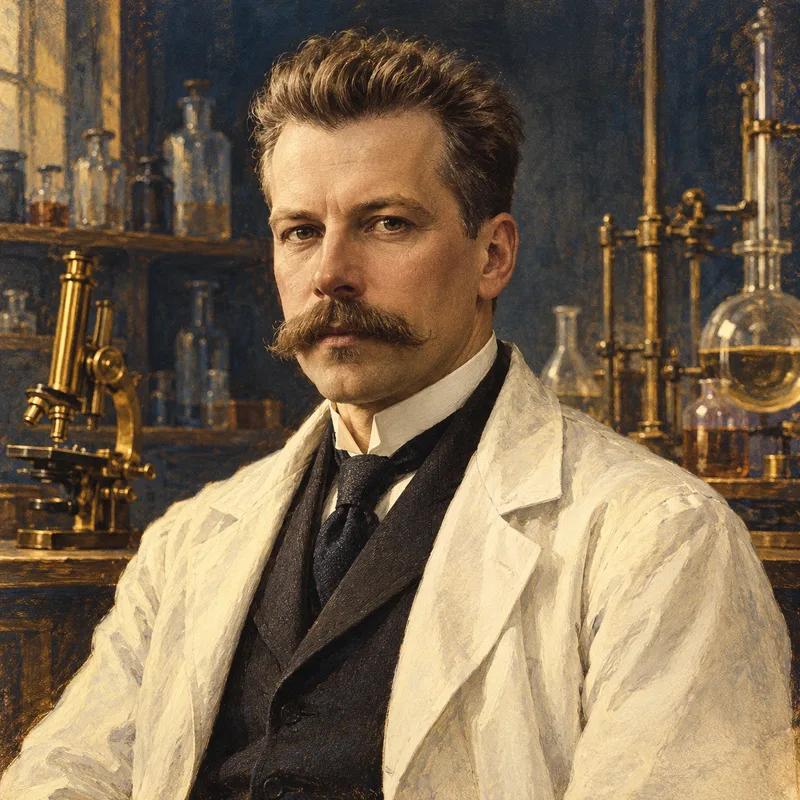
Eduard Buchner
1860-1917 · Germany · Nobel Chemistry 1907
Cell-free alcoholic fermentation