Biography · Chemist no. 251 of 350
Sir Edward Frankland (1825-1899): Founder of Organometallic Chemistry and Valency
Introduction
Edward Frankland was an English chemist who prepared the first organometallic compounds, introduced the idea of valency, helped to name helium and carried out important studies on water quality and the energy value of food. He was a leader of British chemistry in the Victorian age. His legacy in one line: the man who showed that atoms have fixed combining power.
Early Life and Family
Frankland was born on 18 January 1825 at Catterall, near Garstang, in Lancashire, England. He grew up in a family of modest means and attended local schools, later in Lancaster. His early life was marked by limited means, and his schooling ended early so that he could earn a living.
Education and Mentors
At the age of fifteen he was apprenticed to a druggist in Lancaster, and he stayed in this trade for six years. While working there he became interested in chemistry, and he studied in his spare time. In 1845 he obtained a post at the Museum of Practical Geology in London as an assistant to Lyon Playfair, and Playfair supported his education. In 1847 he went to Marburg, Germany, to study under Robert Bunsen, and took his doctorate in 1849. In Marburg he worked alongside Hermann Kolbe, and the two became friends.
Career Timeline
| Year | Event |
|---|---|
| 1825 | Born at Catterall, Lancashire |
| 1840 | Apprenticed to a druggist in Lancaster |
| 1845 | Assistant to Lyon Playfair in London |
| 1847 | Goes to Marburg; works with Bunsen |
| 1847 | With Kolbe, hydrolyses nitriles to acids (propionic acid from ethyl cyanide) |
| 1849 | Prepares diethylzinc; doctorate from Marburg |
| 1851 | Professor of chemistry at Owens College, Manchester |
| 1852 | States the idea of combining power (valency) |
| 1853 | Elected Fellow of the Royal Society |
| 1857 | Moves to St Bartholomew's Hospital, London, as lecturer |
| 1863 | Professor at the Royal Institution |
| 1865 | Succeeds Hofmann at the Royal College of Chemistry (later Royal School of Mines) |
| 1868 | Works with Lockyer on the solar yellow line leading to helium |
| 1894 | Awarded the Copley Medal; made KCB |
| 1899 | Dies in Norway on 9 August |
Major Scientific Contributions
- Organometallic compounds: Diethylzinc and dimethylzinc, the first alkyl derivatives of a metal that could be isolated and studied.
- Valency: A general law of the combining power of elements, stated in 1852.
- Nitrile hydrolysis with Kolbe: Converting ethyl cyanide to propionic acid, an early step in synthetic acid chemistry.
- Combustion and flames: He burnt candles on Mont Blanc and in compressed air and showed that the brightness of a flame depends on pressure, and he studied the luminosity of burning gases.
- Water analysis: He developed methods to find organic carbon and nitrogen in drinking water, and as a member of a Royal Commission he helped to study the pollution of rivers and supply of water in London.
- Energy of food: By burning foods in a calorimeter and comparing the heat with the energy used by the body, he measured the energy values of foods (in the 1860s), a start of the science of nutrition.
- Helium: Work on spectra at different pressures, helping to show that the solar yellow line was a new element.
Zn(C2H5)2 + 2 H2O -> Zn(OH)2 + 2 C2H6           (1849)
C2H5CN + 2 H2O + H+ -> C2H5COOH + NH4+           (nitrile hydrolysis)
Awards, Honours and Nobel Prize
Frankland became a Fellow of the Royal Society in 1853, was awarded a Royal Medal in 1857, and received the Copley Medal in 1894. He was a founder and first president of the Institute of Chemistry (1877-1880), and president of the Chemical Society from 1871 to 1873. He was knighted (KCB) in 1897. He died before the Nobel Prizes were first awarded in 1901.
Personality, Struggles and Lesser-Known Facts
- He rose from the position of a druggist's apprentice with little schooling to become president of the great chemical societies. His later career shows how much he valued education.
- He studied how flames burn at different pressures, including the burning of candles on Mont Blanc, and showed that the brightness of a flame depends strongly on the pressure of the surrounding gas.
- He insisted that the water supply of London should be tested chemically, and he served on the Rivers Pollution Commission of 1868.
- He taught at Queenwood College in Hampshire in the late 1840s, where he and Tyndall were colleagues and became friends.
- He married Sophie Fick in 1851, who died in 1874, and then Ellen Grenside in 1875. His son Percy Frankland also became a chemist, who worked on microbiology of water and on stereochemistry.
- He died while on a holiday in Norway at the age of 74.
Legacy and Influence on Modern Chemistry
Frankland's organozinc compounds led to Grignard's reagents and then to the entire field of organometallic chemistry, which today covers catalysts, polymerisation (Ziegler-Natta) and cross-coupling reactions awarded Nobel Prizes. His valency concept is the basis of structural formulas. His methods in water analysis became standard in public health, and his food calorimetry helped to establish the study of nutrition. The name helium reminds us of his role in the history of the noble gases.
Lessons for Students
- Educational background does not decide your future. Frankland began as a druggist's apprentice.
- Be curious about odd results. A flammable liquid in a sealed tube led to a whole new field.
- Apply science to society: clean water and good nutrition.
- Look for the pattern. From a few compounds he drew a general law of combining power.
Quick Facts Box
- Born: 18 January 1825, Catterall, Lancashire, England
- Died: 9 August 1899, Golaa, Norway
- Nationality: English (British)
- Field: Organic and organometallic chemistry, water analysis
- Famous for: Organozinc compounds; valency; naming helium
- Nobel Prize: None; Copley Medal 1894
FAQ
What did Frankland discover?
He made the first organometallic compounds, such as diethylzinc, stated the theory of valency, and helped to propose and name the element helium.
Who taught Frankland?
He studied under Lyon Playfair in London and Robert Bunsen at Marburg, and he worked closely with Hermann Kolbe.
What did Frankland do for public health?
He developed methods to test the purity of water and served on a Royal Commission on river pollution.
Is Percy Frankland related to him?
Yes, Percy Faraday Frankland was his son and also a chemist.
Published by ABC Chemistry — IIT-JAM | CSIR-NET | GATE Chemistry Coaching. Visit abcchemistry.com
About the chemist
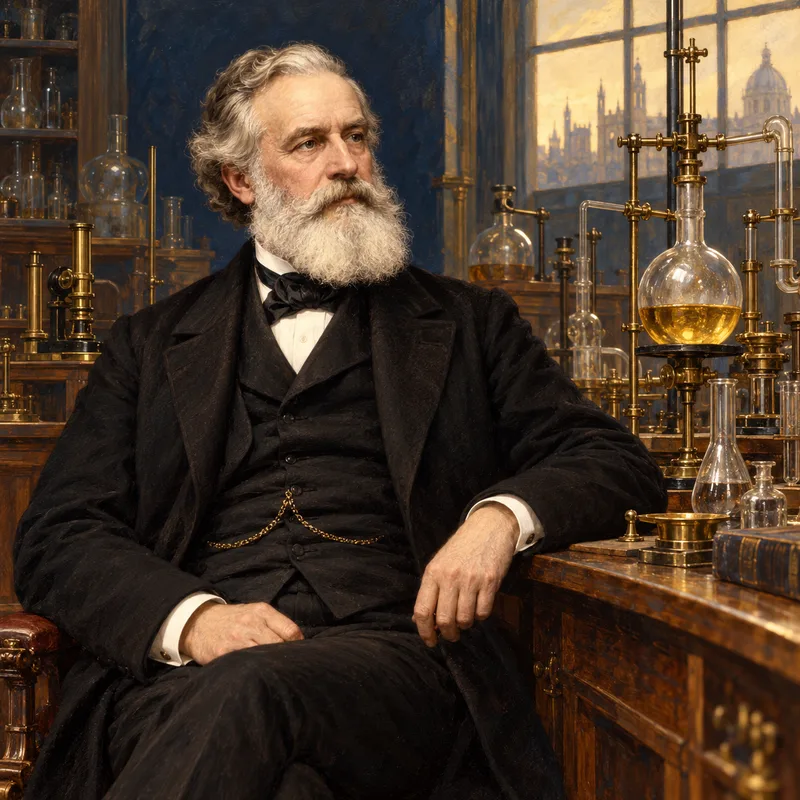
Edward Frankland
1825-1899 · United Kingdom
Valence concept; organozinc compounds