The discovery, explained · Chemist no. 251 of 350
Edward Frankland: The First Organometallics and the Idea of Valency
Modern organic chemistry depends on organometallic reagents such as Grignard reagents and organolithiums. The first compounds with a metal-carbon bond that were isolated and understood were the organozinc compounds made in 1849 by the English chemist Edward Frankland (1825-1899). From studying them, Frankland concluded in 1852 that each element has a fixed "combining power," the idea we now call valency. This idea is the foundation of structural formulas. Frankland also took part in the discovery of helium, helping to name the new element that Norman Lockyer found in the solar spectrum in 1868. This post explains the experiments, the chemistry and what you must remember for your exams.
The Scientific Problem Before the Discovery
In 1840s chemists still debated the "radical" theory. According to it, groups like methyl or ethyl were radicals that could exist alone and pass unchanged from compound to compound. Bunsen's work on the cacodyl compounds of arsenic had shown that a group of carbon, hydrogen and arsenic could behave as a unit. So the great question was: can a free ethyl radical be isolated?
The second problem was why atoms combine in fixed proportions. Dalton's atomic theory explained the law of multiple proportions, but not why nitrogen combines with three atoms of hydrogen in ammonia and phosphorus with three atoms of chlorine in PCl3, or five in PCl5. There was no general idea that an atom has a definite capacity to combine.
The Discovery / Experiment
Organozinc compounds (1849)
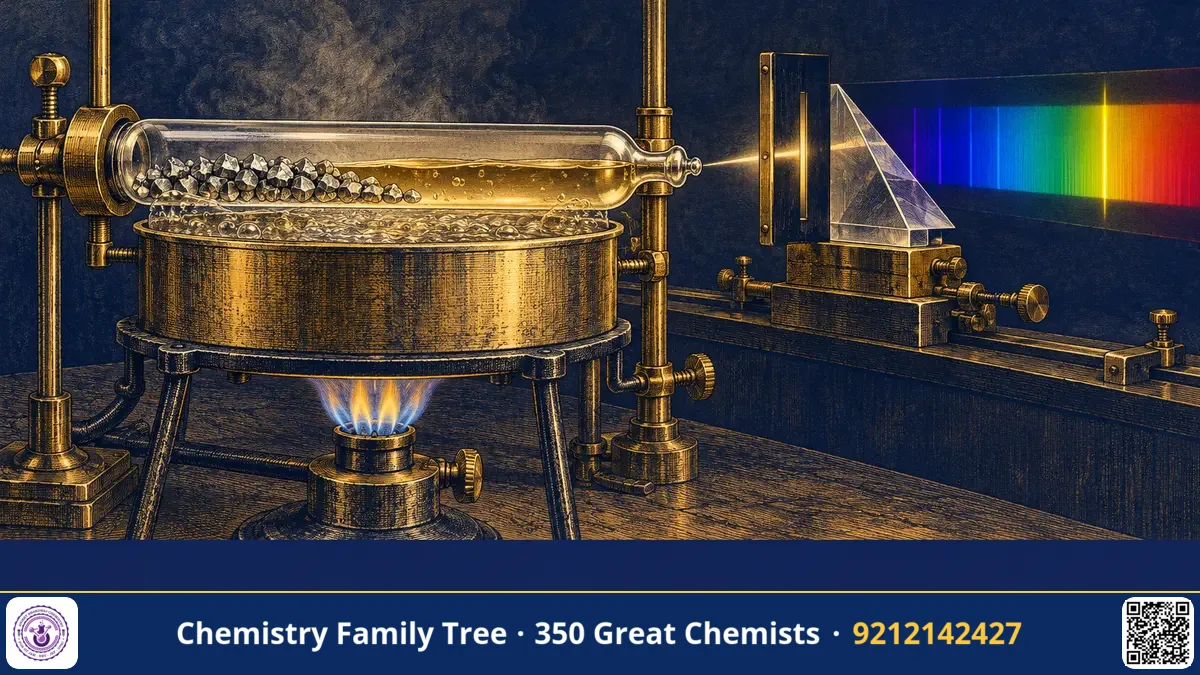
Frankland, working at Marburg in Bunsen's laboratory and then in London, tried to remove the iodine from ethyl iodide using a metal in order to obtain the ethyl radical. First he used zinc, in a sealed glass tube heated in a bath.
- Zinc turnings and ethyl iodide were sealed in a thick glass tube and heated to about 150 C.
- The zinc dissolved, and a white crystalline solid, zinc ethyl iodide, formed.
- On stronger heating, a colourless, volatile liquid distilled from the mixture. It caught fire in air with a bright flame and a green-blue colour. It was diethylzinc.
2 C2H5I + 2 Zn -> C2H5ZnI + ZnI2 + ...   (on heating)
2 C2H5ZnI  --(heat)-->  Zn(C2H5)2 + ZnI2
Zn(C2H5)2 + 2 O2 -> ZnO + CO2 + ... (spontaneously flammable in air)
Frankland first thought he had isolated free ethyl radicals (C2H5), but molecular weight and vapour density measurements and further study showed that the ethyl groups were bound to zinc. He then prepared dimethylzinc and related compounds, and extended the study to organic derivatives of mercury, tin, boron and other elements. In 1849 he also treated diethylzinc with water:
Zn(C2H5)2 + 2 H2O -> Zn(OH)2 + 2 C2H6 (ethane)
Valency, or combining power (1852)
When he looked at organometallic compounds of tin, arsenic, antimony and zinc, Frankland saw a pattern. In 1852, he wrote that the atoms of nitrogen, phosphorus, antimony and arsenic tend to combine with three or five equivalents of other atoms, and that "the combining power of the attracting element, if I may be allowed the expression, is always satisfied by the same number of these atoms".
NH3, PH3, AsH3      combining power 3
NH4Cl, PCl5, SbCl5  combining power 5
Zn(C2H5)2           zinc: combining power 2
Sn(C2H5)4           tin: combining power 4
This is the theory of valency. It was soon used by Kekule and Couper, who took the next step of linking carbon atoms with a valency of four to form chains in 1858.
Helium (1868)
In 1868, during a solar eclipse, spectroscopic observations by Janssen and Lockyer revealed a bright yellow line near the sodium D lines at 587.6 nm, which did not match any known element. Lockyer and Frankland worked together in laboratory experiments to check whether the line could come from hydrogen under different conditions of pressure and temperature. Frankland's experiments on the spectra of gases at different pressures showed that it could not. They proposed that it was a new element, named helium after the Greek helios, the sun. Helium was found on Earth in 1895 by William Ramsay.
The Chemistry Behind It
Organozinc compounds contain a polar covalent carbon-zinc bond: carbon is more electronegative than zinc, so the carbon atom carries a partial negative charge and behaves as a carbanion-like nucleophile. They are strong bases and react with water, acids and oxygen.
R2Zn + 2 HX -> 2 RH + ZnX2
R2Zn + R'COCl -> R-CO-R' + RZnCl     (ketone synthesis)
R2Zn + CH2I2 -> carbenoid  (Simmons-Smith type chemistry uses Zn-Cu and CH2I2)
Frankland's reagents were used by chemists in the next decades: Butlerov used dimethylzinc to make tertiary alcohols, and Saytzeff used alkylzinc compounds with ketones. They were later replaced by Grignard reagents (1900), which are easier to make and handle. But organozinc compounds have returned in modern chemistry in the Reformatsky reaction and the Negishi coupling (Nobel Prize 2010), where organozinc reagents tolerate many functional groups.
On valency, remember the modern view: valency is the number of bonds an atom can form, and for main group elements it relates to the number of electrons in the valence shell. Frankland's variable valency of nitrogen and phosphorus (3 and 5) is now explained by the availability of d orbitals or hypervalent bonding for phosphorus, and the lack of such for nitrogen, which is why NCl5 does not exist but PCl5 does.
Applications Today
- Organozinc reagents: Used in the Negishi cross-coupling to build carbon-carbon bonds in pharmaceuticals, and in Reformatsky and Simmons-Smith reactions.
- Organometallic industry: Diethylzinc is used as a precursor in semiconductor manufacture, for depositing zinc oxide and other films, and as a deoxidising agent in some industries.
- Helium: Used in MRI machines for cooling superconducting magnets, in welding, and in balloons. India imports most of its helium.
- Valency: The base of how we draw Lewis structures and write chemical formulas.
Exam Corner
- Frankland (1849) prepared diethylzinc from ethyl iodide and zinc; first organometallic compound isolated and recognised.
- Diethylzinc is pyrophoric and reacts with water to give ethane and zinc hydroxide.
- Reformatsky reaction: alpha-bromoester + Zn + aldehyde or ketone gives beta-hydroxy ester.
- Negishi coupling uses organozinc with palladium or nickel catalysts (Nobel 2010, Negishi, Heck, Suzuki).
- Helium named after the Sun (Greek helios); first seen in the solar spectrum as a yellow line at 587.6 nm in 1868; found on earth by Ramsay, 1895.
Common Misconceptions
- "Frankland discovered helium." He and Lockyer proposed the name and the idea of a new element in the Sun. Helium was isolated on Earth later by Ramsay.
- "Frankland's compound was a free ethyl radical." It was first thought to be, but it was diethylzinc.
- "Valency of an element is always fixed." Many elements show variable valency, such as P (3 and 5) and Sn (2 and 4).
Quick Revision Box
- Edward Frankland (1825-1899), English chemist.
- 1849: diethylzinc, the first organometallic compound recognised.
- 1852: combining power (valency) of N, P, As, Sb is 3 or 5.
- 1868: with Lockyer proposed the name helium.
- Zn(C2H5)2 + 2H2O gives Zn(OH)2 + 2C2H6.
- Modern use: Negishi, Reformatsky.
FAQ
What is Frankland known for?
For creating the first organozinc compounds, formulating the theory of valency in 1852, and helping to name helium.
Why does diethylzinc catch fire in air?
The Zn-C bond is polar and weak, and the carbon end is a strong reducing centre which reacts quickly with oxygen.
How are Frankland's reagents different from Grignard reagents?
Organozinc compounds are less reactive and more tolerant of functional groups, while Grignard reagents are stronger nucleophiles and bases.
Why do N and P differ in valency?
Nitrogen cannot expand its octet, since it lacks d orbitals in its valence shell, so it forms NCl3 but not NCl5; phosphorus can form both PCl3 and PCl5.
Published by ABC Chemistry — IIT-JAM | CSIR-NET | GATE Chemistry Coaching. Visit abcchemistry.com
About the chemist
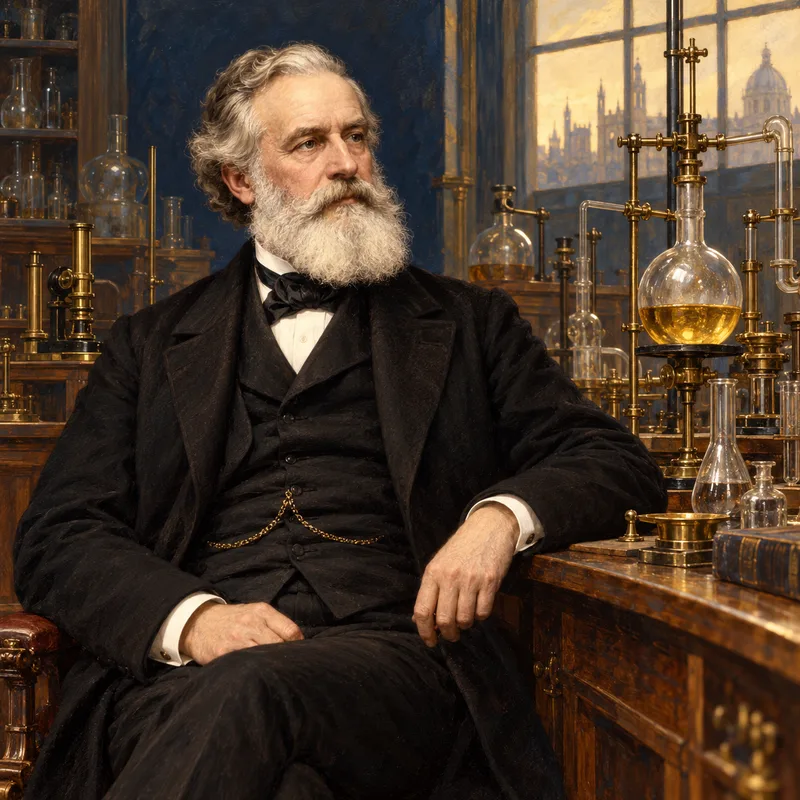
Edward Frankland
1825-1899 · United Kingdom
Valence concept; organozinc compounds