Biography · Chemist no. 127 of 350
Edwin McMillan (1907-1991): The Physicist Who Added Element 93 to the Periodic Table
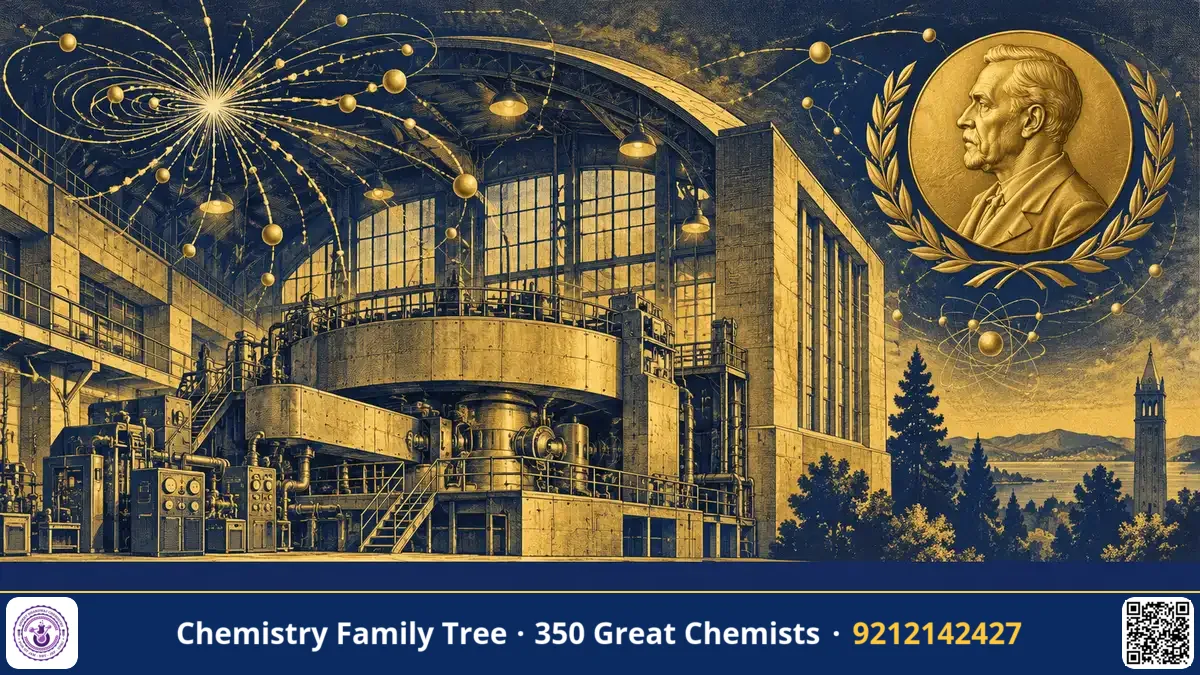
Edwin Mattison McMillan was an American experimental physicist whose work crossed freely into chemistry. In 1940 he discovered neptunium, the first element beyond uranium; in 1945 he invented the principle of phase stability that made the synchrotron possible; and in 1951 he shared the Nobel Prize in Chemistry with Glenn Seaborg. He later led the Lawrence Berkeley Laboratory for fifteen years. His legacy is simple to state: he pushed the periodic table past uranium and he built the idea behind the machines that push particles to high energy.
Early Life and Family
McMillan was born on 18 September 1907 in Redondo Beach, California, and grew up in Pasadena. His father, Edwin Harbaugh McMillan, was a physician. His family was comfortable and valued education, and young Edwin grew up near the California Institute of Technology, which shaped his early interests. As a boy he enjoyed building and experimenting, a habit that later made him very good at designing apparatus.
Education and Mentors
McMillan studied at Caltech, earning a bachelor's degree in 1928 and a master's degree in 1929 in physics. He then went to Princeton University, where he completed his PhD in 1932 under Edward Condon, working on the molecular beam method and the study of hydrogen halide molecules. After a period as a National Research Council fellow, he joined the University of California, Berkeley, in 1934 at the invitation of Ernest Lawrence, the inventor of the cyclotron. Lawrence became his most important mentor and a close family connection, because McMillan married Elsie Blumer, the sister of Lawrence's wife Molly, in 1941.
Career Timeline
| Year | Event |
|---|---|
| 1907 | Born in Redondo Beach, California |
| 1932 | PhD, Princeton University |
| 1934 | Joins the Radiation Laboratory at Berkeley |
| 1940 | With Philip Abelson, discovers neptunium (element 93) |
| 1940-41 | Takes part in the discovery of plutonium with Seaborg, Kennedy and Wahl |
| 1940-45 | War work on radar at MIT, sonar in San Diego, and the Manhattan Project at Los Alamos |
| 1945 | Proposes the phase stability principle for the synchrotron |
| 1951 | Shares the Nobel Prize in Chemistry with Glenn Seaborg |
| 1958-1973 | Director of the Lawrence Radiation Laboratory, Berkeley |
| 1991 | Dies at El Cerrito, California |
Major Scientific Contributions
1. Neptunium. Using the Berkeley cyclotron, McMillan noticed a 2.3-day beta activity that remained in an irradiated uranium sample instead of flying away as a fission fragment. Philip Abelson's chemical analysis showed that it was a new element. The reaction chain was ²³⁸U + n → ²³⁹U → ²³⁹Np + β⁻. This is the topic of our companion discovery article.
2. Plutonium and the actinide era. McMillan and Abelson's neptunium led directly to Pu-238 and then Pu-239. Seaborg later arranged the heavy elements in the actinide series.
3. Phase stability and the synchrotron. In a cyclotron, particles are accelerated in a fixed-frequency electric field while moving in a magnetic field with cyclotron frequency f = qB / (2πm). At high speed the relativistic mass rises, the frequency falls, and the particles fall out of step. McMillan realised that particles slightly out of step can be kept bunched automatically if the accelerating field is applied on the correct part of its cycle. This principle of phase stability (found independently by the Soviet physicist Vladimir Veksler) allows the radio frequency or the magnetic field to be changed gradually, which led to synchrocyclotrons and synchrotrons. Today's large accelerators, including those at CERN, rely on this idea.
Awards, Honours and Nobel Prize
McMillan and Glenn T. Seaborg received the 1951 Nobel Prize in Chemistry "for their discoveries in the chemistry of the transuranium elements". McMillan was elected to the US National Academy of Sciences in 1947, and he also received the National Medal of Science in 1990. He shared the Atoms for Peace Award in 1963 with Vladimir Veksler for the phase stability work.
Personality, Struggles and Lesser-Known Facts
- McMillan was trained as a physicist but is a Nobel laureate in chemistry, a good example of how nuclear science crosses disciplines.
- During the Second World War he did not stay in one place: he worked on microwave radar at the MIT Radiation Laboratory, then on underwater sound detection for the Navy in San Diego, and later at Los Alamos on the atomic bomb project.
- He was known as a quiet, modest man who preferred careful, hands-on experimental work. His colleagues described him as someone who let results speak.
- When he saw the strange 2.3-day activity, he realised that the physical separation by recoil was the clue; the discovery came from asking what a fission fragment could not do.
- His Nobel Prize came in a year when his colleague Seaborg also won; the two had worked side by side, but McMillan was the first to find a transuranium element.
Legacy and Influence on Modern Chemistry
Every new superheavy element discovered since, from americium and curium to oganesson, followed the path that McMillan opened: bombard a heavy target with neutrons or ions and identify the product by its radiation and chemistry. As director of the Lawrence Berkeley Laboratory from 1958 to 1973, he guided the lab through the era of large accelerators and big science. His synchrotron idea still powers medical proton therapy facilities, synchrotron light sources used in X-ray crystallography, and the high-energy colliders of particle physics. Indian students may note that the Indus synchrotron radiation sources at RRCAT, Indore, work on the same principle of keeping charged particles in phase with an accelerating field.
Lessons for Students
- Look at what an experiment leaves behind, not only what it produces. McMillan found element 93 by studying the material that stayed in the target.
- Collaborate across fields. A physicist and a chemist together proved the existence of a new element.
- Understand basic equations deeply. The failure of the simple cyclotron formula at relativistic speeds led to a new invention.
- Be modest and keep working; great science often looks quiet from the outside.
Quick Facts Box
- Born: 18 September 1907, Redondo Beach, California, USA
- Died: 7 September 1991, El Cerrito, California
- Nationality: American
- Field: Nuclear physics and nuclear chemistry
- Famous for: Neptunium (element 93), phase stability and the synchrotron
- Nobel Prize: Chemistry, 1951 (shared with Glenn T. Seaborg)
FAQ
Was Edwin McMillan a chemist or a physicist?
He was trained as a physicist, but his Nobel Prize was in Chemistry because his discoveries concerned new chemical elements.
What is the phase stability principle?
It is the idea that particles in an accelerator stay bunched and in step with the accelerating field automatically, so the field frequency or magnetic field can be varied to reach high energies.
Who shared the 1951 Nobel Prize in Chemistry?
Edwin McMillan and Glenn T. Seaborg.
Where did McMillan work?
Mainly at the University of California, Berkeley, where he became director of the Lawrence Radiation Laboratory, with wartime work at MIT, San Diego and Los Alamos.
Published by ABC Chemistry — IIT-JAM | CSIR-NET | GATE Chemistry Coaching. Visit abcchemistry.com
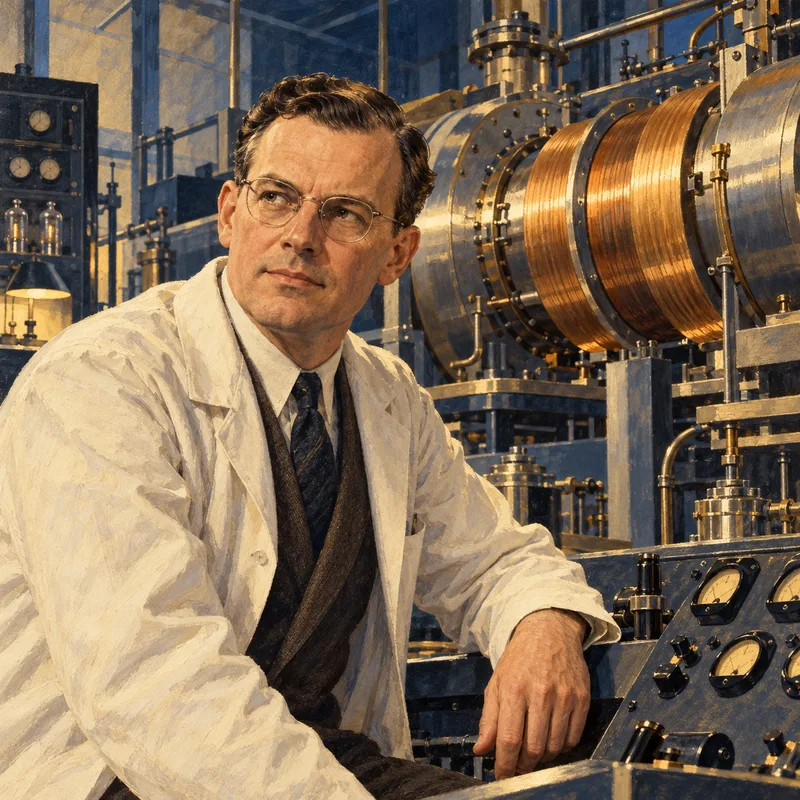
About the chemist
Edwin McMillan
1907-1991 · United States · Nobel Chemistry 1951
Discovery of neptunium