The discovery, explained · Chemist no. 127 of 350
Edwin McMillan and the Discovery of Neptunium: The First Transuranium Element
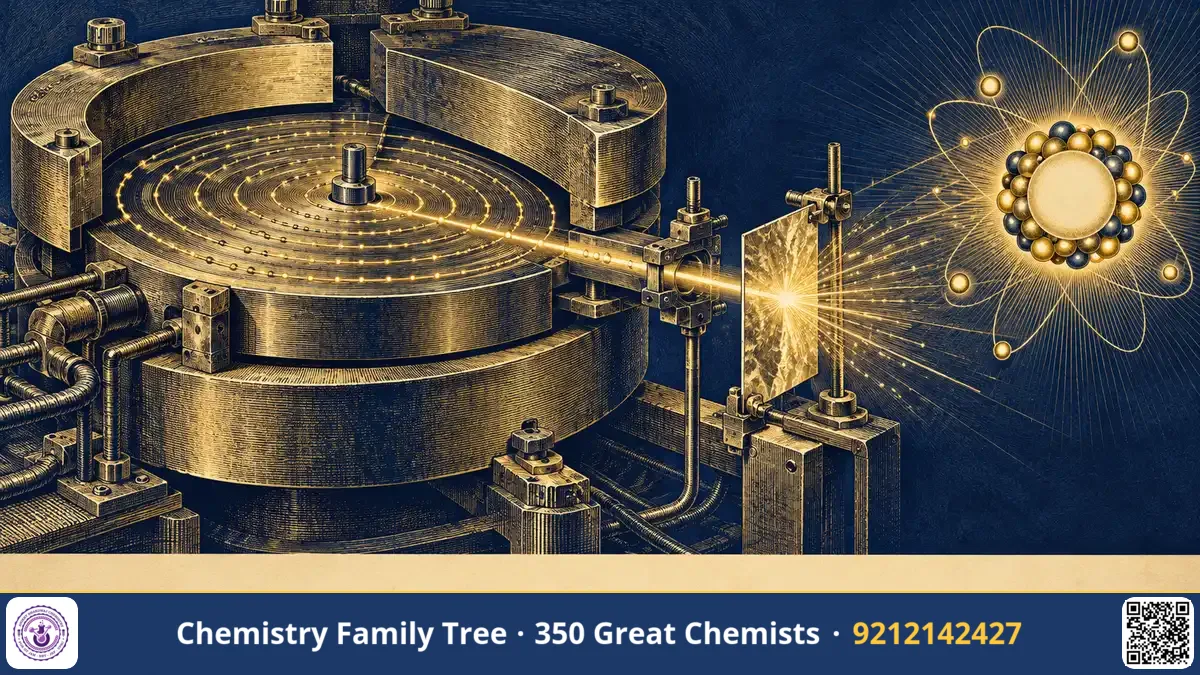
For almost eighty years the periodic table ended at uranium, element 92. Many chemists believed that nature had simply run out of stable heavy atoms. In 1940, at the University of California, Berkeley, Edwin McMillan and Philip Abelson proved that belief wrong. They identified neptunium (Np, Z = 93), the first element heavier than uranium ever made by humans. This one discovery opened the whole transuranium and actinide field, led to plutonium within months, and earned McMillan a share of the 1951 Nobel Prize in Chemistry (with Glenn Seaborg). In this post we follow the experiment step by step and see the chemistry that every IIT-JAM, CSIR-NET and GATE student should know about it.
The Scientific Problem Before the Discovery
After James Chadwick found the neutron in 1932, Enrico Fermi bombarded many elements with neutrons and obtained new radioactive isotopes. In 1934 he irradiated uranium and saw several activities. Some scientists suggested that he had made elements 93 and 94. The claim was confusing, because the products behaved chemically in unexpected ways. In 1938-39 Otto Hahn and Fritz Strassmann showed that uranium actually splits into medium-sized fragments such as barium, and Lise Meitner and Otto Frisch explained this as nuclear fission. Suddenly the picture was messy: uranium bombarded with neutrons gave dozens of fission products, and any true element 93 would be hidden among them.
The question was therefore sharp: does neutron capture by uranium-238 ever produce a heavier element, or does every neutron cause fission? To answer it, one needed a way to separate a possible new activity from the crowd of fission fragments, and then to prove by chemistry that it was a new element.
The Discovery: Step by Step
McMillan, a young physicist working with the 60-inch cyclotron at the Berkeley Radiation Laboratory, used an elegant physical trick. He placed thin uranium oxide on a sheet of paper and exposed it to a neutron beam produced when the cyclotron's deuterons struck beryllium. Fission fragments are produced with great energy and fly out of the uranium layer, so they recoil onto catcher foils placed in front. Anything that stayed behind in the uranium layer was not a high-energy fission fragment.
- Irradiation. Uranium was exposed to neutrons from the cyclotron.
- Recoil separation. The fission fragments flew out into the catcher foils. McMillan measured the radioactivity left in the uranium itself.
- A surprise. Besides the known 23-minute activity of U-239, he found a second beta activity with a half-life of about 2.3 days that stayed in the uranium layer.
- Chemistry. Philip Abelson, a chemist visiting Berkeley, carried out the chemical tests. The 2.3-day activity did not follow the chemistry of uranium or of the elements near it, and Abelson showed that it behaved like a new element in a reduced state, with rare-earth-like properties in some steps.
- Conclusion. The activity belonged to element 93. They published the result in the Physical Review in 1940 under a title announcing radioactive element 93.
The element was named neptunium, because Neptune is the planet beyond Uranus, just as element 93 follows uranium (element 92).
The Chemistry Behind It
The nuclear reactions can be written in a few lines:
²³⁸U + n → ²³⁹U            (neutron capture, radiative)
²³⁹U (t½ = 23.5 min) → ²³⁹Np + e⁻ + antineutrino   (β⁻ decay)
²³⁹Np (t½ = 2.36 days) → ²³⁹Pu + e⁻ + antineutrino  (β⁻ decay)
In beta-minus decay a neutron inside the nucleus changes into a proton, so atomic number rises by one while mass number stays the same. Uranium-239 (Z = 92) becomes neptunium-239 (Z = 93), and neptunium-239 in turn becomes plutonium-239 (Z = 94). The 2.3-day activity that McMillan saw was neptunium-239.
Important facts for students:
- Neptunium has several oxidation states, from +3 to +7. The +5 state, as the NpO₂⁺ ion, is the most stable in water. This is typical of the early actinides, where 5f electrons take part in bonding.
- The longest-lived isotope, Np-237, has a half-life of about 2.14 million years. It belongs to the 4n + 1 (neptunium) decay series, the only one of the four radioactive series whose parent has disappeared from the Earth's crust; the series ends at stable bismuth-209.
- Because Np-237 is gone from nature, traces of neptunium on Earth exist only because uranium ores capture neutrons.
Plutonium followed quickly. In late 1940 and early 1941 Glenn Seaborg, McMillan, Joseph Kennedy and Arthur Wahl bombarded uranium with deuterons to make Np-238, which decays to Pu-238. McMillan's neptunium was the doorway for this discovery, and the whole group of elements from actinium to lawrencium was later arranged as the actinide series, a concept developed by Seaborg.
Applications Today
- Plutonium-238 production. Neutron irradiation of Np-237 gives Np-238, which decays to Pu-238. Pu-238 is the heat source in radioisotope thermoelectric generators (RTGs) that power deep-space probes such as Voyager, where solar panels are useless.
- Nuclear waste science. Np-237 is a long-lived component of spent nuclear fuel, so its chemistry decides how safely waste can be stored. The mobility of NpO₂⁺ in groundwater is a major research topic in repository design.
- Fundamental science. Neptunium compounds are used to study 5f-electron bonding, which is relevant for advanced inorganic chemistry and for fuel reprocessing methods.
- India context. India's three-stage nuclear programme, planned by Homi Bhabha, depends on uranium-plutonium-thorium fuel cycles. Understanding the actinide chemistry that started with neptunium is essential in the work of BARC and related institutions.
Exam Corner
- Neptunium (Z = 93) was the first transuranium element, discovered by McMillan and Abelson in 1940 at Berkeley.
- Reaction: ²³⁸U(n,γ)²³⁹U → β⁻ → ²³⁹Np → β⁻ → ²³⁹Pu. Know both half-lives (about 23 minutes and 2.3 days).
- Np-237 is the longest-lived isotope (about 2.14 × 10⁶ years) and starts the 4n + 1 series, which ends at ²⁰⁹Bi.
- Actinides show a wide range of oxidation states because 5f, 6d and 7s orbitals are close in energy; Np shows +3 to +7.
- McMillan and Seaborg shared the 1951 Nobel Prize in Chemistry for discoveries in the chemistry of the transuranium elements.
Common Misconceptions
- "McMillan won the Nobel Prize for the synchrotron." No. The synchrotron principle (phase stability) was a separate achievement of 1945. The 1951 Nobel Prize in Chemistry was for the transuranium elements.
- "Neptunium occurs freely in nature." Only in vanishing traces. Primordial neptunium has decayed away.
- "All elements beyond uranium are made in reactors only." Many are made in accelerators using heavy-ion bombardment; only the lighter ones such as Np and Pu are produced in large amounts in reactors.
Quick Revision Box
- Element 93, neptunium, named after the planet Neptune.
- Found in 1940 by Edwin McMillan and Philip Abelson at Berkeley using cyclotron neutrons.
- Key idea: activity that stayed in the uranium layer was not a fission fragment.
- ²³⁸U + n → ²³⁹U → ²³⁹Np → ²³⁹Pu by two beta decays.
- Np-237 half-life about 2.14 million years; 4n + 1 series ends at Bi-209.
- Nobel Prize in Chemistry 1951, shared with Glenn Seaborg.
FAQ
Who discovered neptunium?
Edwin McMillan and Philip Abelson discovered it in 1940 at the University of California, Berkeley.
Why is it called neptunium?
Uranium was named after Uranus. Neptune is the next planet, so element 93, the next element, was named neptunium.
How is Np-239 formed?
Uranium-238 captures a neutron to form uranium-239, which undergoes beta-minus decay to neptunium-239.
Did McMillan also discover plutonium?
He was part of the Berkeley team led by Glenn Seaborg, with Joseph Kennedy and Arthur Wahl, that identified plutonium in 1940-41, and his neptunium work made that possible.
Published by ABC Chemistry — IIT-JAM | CSIR-NET | GATE Chemistry Coaching. Visit abcchemistry.com
About the chemist
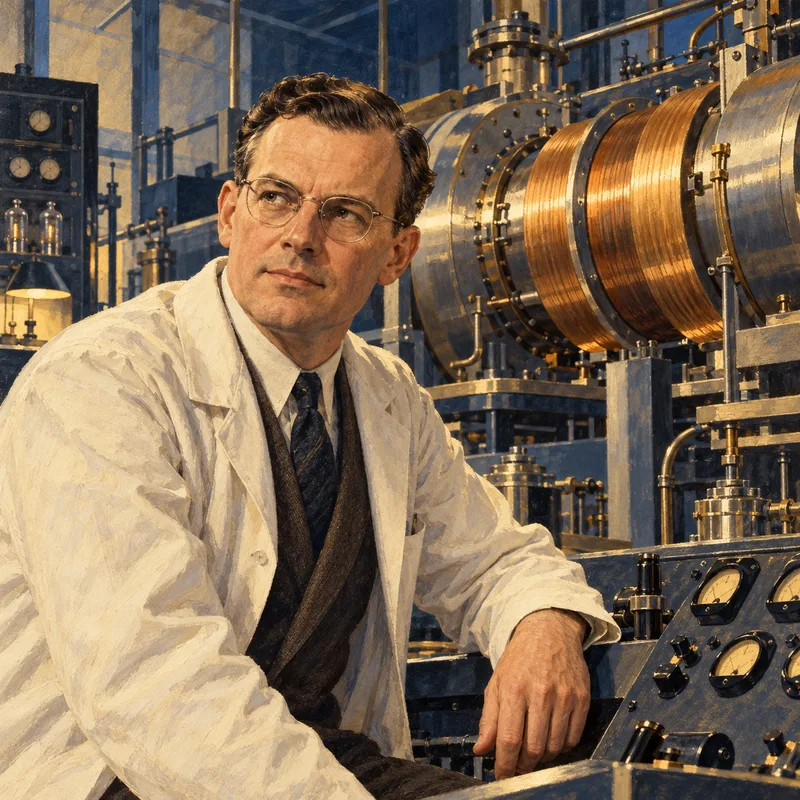
Edwin McMillan
1907-1991 · United States · Nobel Chemistry 1951
Discovery of neptunium