Biography · Chemist no. 96 of 350
Ei-ichi Negishi: From a Japanese Industrial Chemist to a Nobel Laureate in Indiana
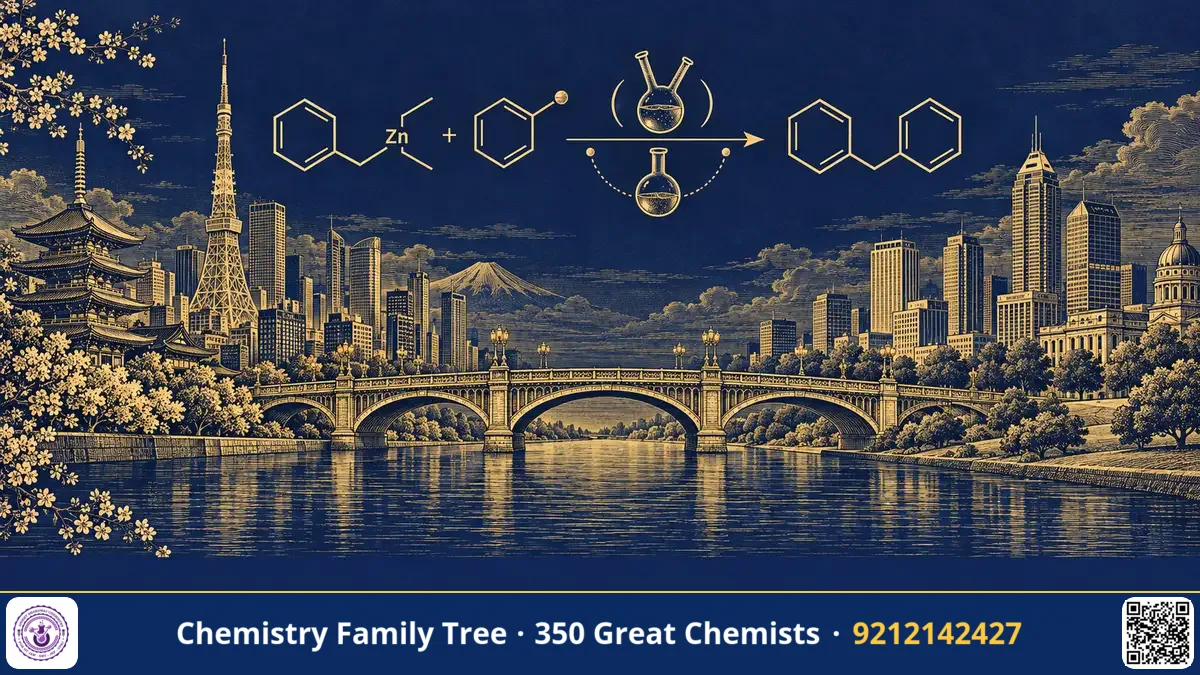
Ei-ichi Negishi (1935-2021) was a Japanese-born chemist who spent most of his research career in the United States, mainly at Purdue University. He developed the palladium- and nickel-catalysed coupling of organozinc compounds with organic halides, now called the Negishi coupling, and he shared the 2010 Nobel Prize in Chemistry with Richard Heck and Akira Suzuki. His legacy in one line: he proved that careful comparison of different metals can reveal the best tool for forming carbon-carbon bonds.
Early Life and Family
Negishi was born on 14 July 1935 in Changchun, a city then in Manchukuo, which is now part of northeastern China. His family was Japanese, and after the Second World War they returned to Japan, where he grew up near Yokohama. He studied in Japan and later chose to build his research career abroad. This unusual background, born in one country, raised in another and working in a third, made him a true global scientist.
Education and Mentors
Negishi studied at the University of Tokyo, where he completed his bachelor's degree in 1958. He then took a position at the Japanese company Teijin, a chemical and fibre maker, and while employed there he won a Fulbright scholarship to study in the United States. At the University of Pennsylvania he worked for his PhD under Alan G. MacDiarmid, an inorganic chemist who later won the Nobel Prize in Chemistry in 2000 for conducting polymers. Negishi received his doctorate in 1963. After a short return to Teijin, he went to Purdue University in 1966 as a postdoctoral associate with Herbert C. Brown, the discoverer of hydroboration and a Nobel laureate in 1979. He remained close to Brown for many years, and became his research associate and later his colleague.
Career Timeline
| Year | Event |
|---|---|
| 1935 | Born in Changchun, then Manchukuo (now China) |
| 1958 | Graduated from the University of Tokyo; joined Teijin |
| 1963 | PhD, University of Pennsylvania (with Alan MacDiarmid) |
| 1966 | Postdoctoral associate with H. C. Brown at Purdue |
| 1972 | Became assistant professor at Syracuse University |
| 1976-1977 | Developed Ni- and Pd-catalysed couplings of organoaluminium and organozinc reagents |
| 1979 | Returned to Purdue University as professor |
| 2010 | Nobel Prize in Chemistry (with Heck and Suzuki) |
| 2021 | Died on 6 June in Indiana, USA |
Major Scientific Contributions
1. Negishi coupling. The reaction forms a C–C bond between an organozinc reagent and an organic halide, with a palladium or nickel catalyst:
R–ZnX + R'–X' --[Pd or Ni catalyst]--> R–R' + ZnXX'
Because zinc compounds tolerate many functional groups and react smoothly, the method became a tool of choice for complex molecules. See our discovery post on Negishi coupling for the catalytic cycle and exam points.
2. Zirconium-catalysed carboalumination. With Dale Van Horn, he developed a method to add a methyl group and aluminium across an alkyne with high regio- and stereoselectivity, giving alkenylalanes, which are useful building blocks.
3. Organozirconium chemistry. Negishi did extensive work on zirconocene-based reagents such as Cp₂ZrCl₂ and their use in organic synthesis, including cyclisation reactions.
4. Applications in total synthesis. His group used these reactions to prepare natural products with polyene chains, and the strategy of building complex molecules from small fragments by cross-coupling has become standard.
Awards, Honours and Nobel Prize
The Nobel Prize in Chemistry 2010 was awarded jointly to Richard F. Heck, Ei-ichi Negishi and Akira Suzuki "for palladium-catalyzed cross couplings in organic synthesis". Negishi held the title of H. C. Brown Distinguished Professor of Chemistry at Purdue University. He received various honours from the Japanese government and from chemical societies; if you need a precise list for writing or interviews, check an official source. A noteworthy detail for students: his two mentors, MacDiarmid and Brown, were themselves Nobel laureates, which shows how a strong scientific lineage supports great research.
Personality, Struggles and Lesser-Known Facts
- A lifelong learner: He crossed borders and fields, from industry in Japan to academia in the United States, and from inorganic chemistry to organic synthesis.
- Bold career move: He left an industrial position in Japan to join Brown as a postdoctoral associate in the United States, choosing research over the safer path.
- Comparing metals systematically: His success came from testing aluminium, zirconium and zinc in one conceptual framework, rather than guessing. This is a model of how to do research.
- Nobel in the same year as a compatriot: Both Negishi and Suzuki were Japanese-born, and both had worked with H. C. Brown, so the 2010 prize was in a sense also a tribute to Brown's laboratory.
- Passion for teaching: Negishi trained many students and postdoctoral fellows who now teach and work in industry worldwide.
Legacy and Influence on Modern Chemistry
Cross-coupling reactions are now routine, and the Negishi coupling is one of the pillars. It remains important when other reactions fail, for example in coupling alkyl groups or sensitive heterocycles. In drug discovery laboratories, organozinc reagents are often prepared in a flask, used in situ and discarded after a single use. He also helped to establish the idea that organometallic reagents from main-group metals can be combined with transition-metal catalysts, which is a cornerstone of modern synthesis. For Indian students, learning about the three Nobel laureates of 2010 is useful in itself: Heck, Negishi and Suzuki are often compared in objective questions.
Lessons for Students
- Dare to go abroad for learning. Negishi's moves between Japan and the United States shaped his career.
- Compare systematically. Testing several metals led to the best reagent.
- Choose good mentors. Both MacDiarmid and Brown guided him.
- Persist. The Nobel Prize came decades after the original work.
Quick Facts Box
- Born: 14 July 1935, Changchun (then Manchukuo, now China)
- Died: 6 June 2021, Indiana, USA
- Nationality: Japanese (long-time resident of the United States)
- Field: Organometallic and organic chemistry
- Famous for: Negishi coupling; Zr-catalysed carboalumination
- Nobel: Chemistry 2010 (shared with Heck and Suzuki)
FAQ
Where was Negishi born?
In Changchun, then part of Manchukuo and now in China, in 1935. He grew up in Japan.
Who supervised Negishi's PhD?
Alan G. MacDiarmid at the University of Pennsylvania, who later won the Nobel Prize in Chemistry in 2000.
How was Negishi connected to H. C. Brown?
He worked with Brown at Purdue University as a postdoctoral associate and later returned to Purdue as a professor, eventually holding the H. C. Brown Distinguished Professorship.
What made the Negishi coupling special?
The use of organozinc compounds, which are reactive enough to transmetalate but gentle enough to tolerate many functional groups.
Published by ABC Chemistry — IIT-JAM | CSIR-NET | GATE Chemistry Coaching. Visit abcchemistry.com
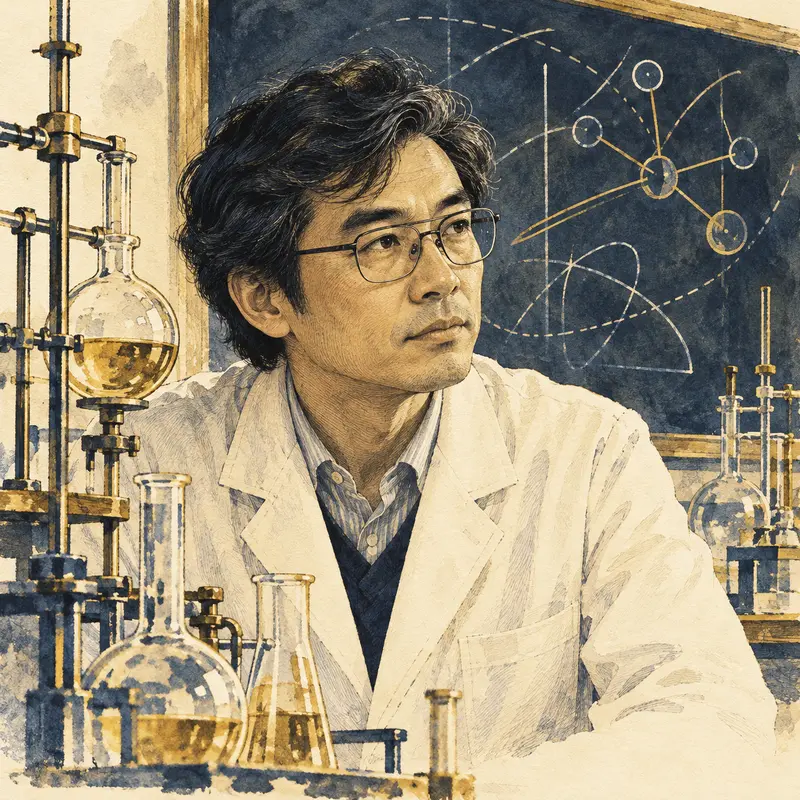
About the chemist
Ei-ichi Negishi
1935-2021 · Japan · Nobel Chemistry 2010
Negishi palladium cross-coupling