The discovery, explained · Chemist no. 96 of 350
Ei-ichi Negishi and the Zinc Reagents That Joined Carbon Fragments Cleanly
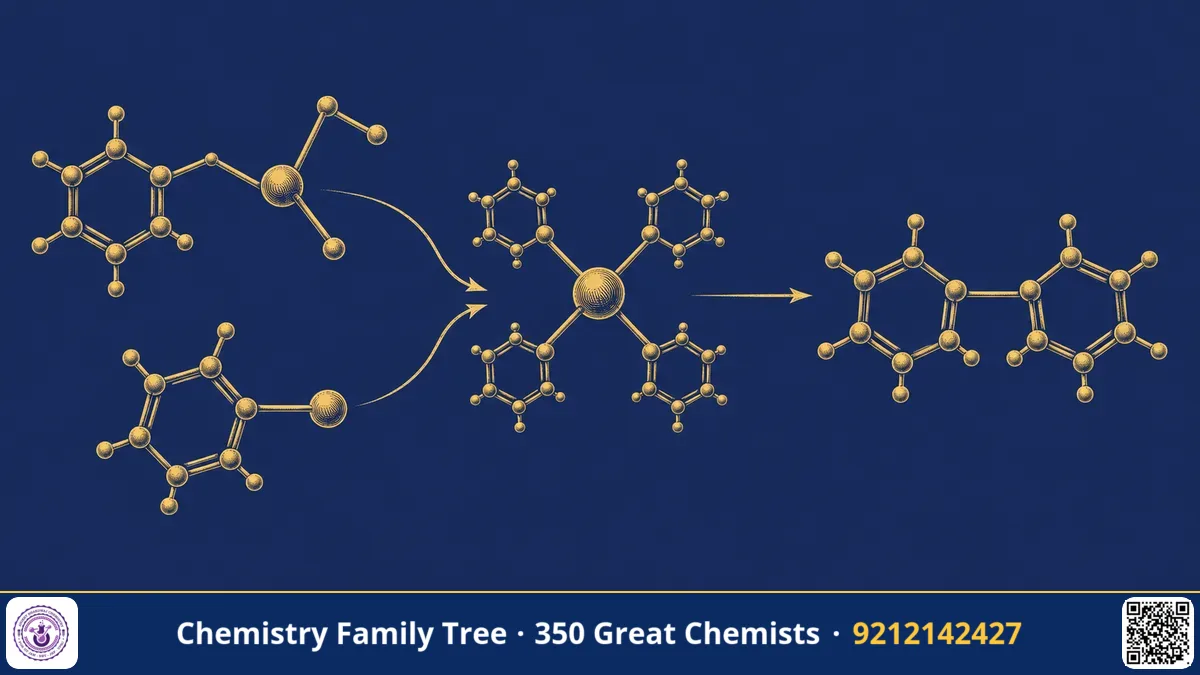
Making a bond between two carbon atoms is the basic job of organic synthesis, but not every carbon-carbon bond is easy to make. Ei-ichi Negishi (1935-2021) developed a powerful solution in the 1970s: a palladium- or nickel-catalysed reaction between an organozinc compound and an organic halide. The Negishi coupling is known for its broad scope. It works for sp, sp² and sp³ carbon partners, tolerates many functional groups, and is often fast at mild temperatures. In 2010 Negishi shared the Nobel Prize in Chemistry with Richard Heck and Akira Suzuki. This post explains the reaction in the style needed for IIT-JAM, CSIR-NET and GATE.
The Scientific Problem Before the Discovery
By the early 1970s chemists knew that Grignard reagents (RMgX) could be coupled with organic halides using nickel or palladium (the Kumada-Corriu coupling). The problem was that Grignard reagents are so reactive that they attack esters, nitriles, ketones and other groups. This limited the reaction to simple molecules. Chemists wanted a carbon nucleophile that was reactive enough to transfer its organic group to palladium, yet tolerant of functional groups. The older stoichiometric coupling reactions based on copper (Ullmann) and the Wurtz reaction gave mixtures and poor yields, especially when two different groups had to be joined (cross-coupling). The main trouble was selectivity: how can one join R and R' without also forming R–R and R'–R'?
The Discovery: Step by Step
- Using alkenylaluminium reagents (1976-77). Negishi's group studied organometallic compounds of main-group and early transition metals. Working with co-workers, he found that alkenylalanes (organoaluminium compounds) coupled with aryl halides in the presence of nickel or palladium catalysts to give products with retention of alkene geometry.
- Systematic comparison of metals. He then tried several metals in the organometallic partner: aluminium, zirconium and zinc. Zinc proved to be outstanding. Organozinc compounds are less basic than Grignard reagents, so they tolerate ester, nitrile and ketone groups, but they still transmetalate readily to palladium.
- The reaction. A typical Negishi coupling is:
R–ZnX + R'–X' --[Pd(PPh₃)₄ or Ni catalyst]--> R–R' + ZnXX'
where R and R' can be aryl, alkenyl, alkynyl or alkyl, and X' is I, Br, Cl or OTf. Organozinc halides can be made from the corresponding organolithium or Grignard reagent by adding ZnCl₂, or by direct insertion of activated zinc metal into R–I.
Negishi also contributed another key tool: the zirconium-catalysed carboalumination of alkynes (the Negishi-Van Horn reaction, sometimes called ZACA when used asymmetrically). This reaction adds a methyl group and aluminium across a C≡C bond to give a trisubstituted alkenylalane in a stereoselective way, and the alkenylalane can be coupled by the Negishi reaction.
The Chemistry Behind It
The catalytic cycle resembles other palladium cross-couplings:
- Oxidative addition: Pd(0) + R'–X' → R'–Pd(II)–X'.
- Transmetalation: R'–Pd–X' + R–ZnX → R'–Pd–R + ZnXX'. Zinc transfers its organic group to palladium. No external base is needed, unlike the Suzuki coupling, because the organozinc is already nucleophilic enough.
- Reductive elimination: R'–Pd–R → R'–R + Pd(0). Both organic groups must be cis on palladium for this step to occur.
One difficulty with sp³ partners is beta-hydride elimination. An alkyl–Pd species with a hydrogen on the beta carbon can lose an alkene and form a Pd–H species, which ruins the reaction. Careful ligand choice and the use of nickel catalysts, a field advanced by later researchers, help to avoid this.
Comparison of named cross-couplings
| Reaction | Nucleophilic partner | Notes |
|---|---|---|
| Kumada | R–MgX | Very reactive; poor functional group tolerance |
| Negishi | R–ZnX | High reactivity and good tolerance; moisture-sensitive; sp, sp², sp³ partners |
| Stille | R–SnR₃ | Tolerant but organotin is toxic |
| Suzuki | R–B(OH)₂ | Needs a base; stable, low toxicity reagents |
| Sonogashira | Terminal alkyne with Cu(I) co-catalyst | Forms C(sp)–C(sp²) bonds |
Applications Today
- Natural product synthesis: The Negishi coupling is used to join complex fragments late in a synthesis because it works under mild conditions and does not need harsh reagents. Negishi's own group applied the method to polyene natural products such as carotenoids.
- Pharmaceutical chemistry: Biaryl and heteroaryl-alkyl bonds can be made, including those where Suzuki coupling is difficult, such as certain sp³-sp² couplings.
- Materials: Conjugated oligomers and polymers for electronics can be prepared by Negishi coupling.
- Academic labs in India: Cross-couplings are common in research and are a favourite of CSIR-NET organic questions.
- Green chemistry angle: Because the reaction is catalytic and efficient, less waste is made than in older stoichiometric couplings, though the use of dry solvents and sensitive reagents is a limit.
Exam Corner
- Negishi coupling: organozinc (R–ZnX) + organic halide/triflate with Pd(0) or Ni(0) catalyst gives R–R'. No base is needed.
- Steps: oxidative addition, transmetalation, reductive elimination. Pd(0)/Pd(II) cycle.
- Organozinc reagents are less reactive and more selective than Grignard reagents, so they tolerate esters and nitriles.
- Nobel Prize in Chemistry 2010: Heck (alkene + halide), Negishi (organozinc), Suzuki (organoboron).
- Reductive elimination requires a cis arrangement of the two organic groups on palladium; beta-hydride elimination is a side reaction for alkyl–Pd species.
Common Misconceptions
- "Negishi coupling needs a base like Suzuki." It does not; the organozinc transmetalates on its own.
- "Organozinc compounds are air-stable." They are sensitive to moisture and oxygen and must be handled under inert conditions.
- "Only sp² carbons can be coupled." One strength of the Negishi reaction is that sp³ and sp carbons also couple.
Quick Revision Box
- Negishi coupling = R–ZnX + R'–X' with Pd or Ni catalyst.
- Developed in the 1970s; Negishi Nobel Prize 2010.
- Organozinc: reactive enough to transmetalate, mild enough to tolerate functional groups.
- No external base needed.
- Works for sp, sp² and sp³ carbons.
- Zr-catalysed carboalumination of alkynes is another Negishi tool.
FAQ
What is the Negishi coupling?
It is a metal-catalysed cross-coupling in which an organozinc compound reacts with an organic halide or triflate to form a new C–C bond.
Why use zinc instead of magnesium?
Zinc reagents are less basic and less nucleophilic than Grignard reagents, so they do not attack sensitive functional groups, and yet they transmetalate smoothly to palladium.
Does the Negishi coupling use palladium only?
No. Palladium is common, but nickel catalysts are also used, particularly for alkyl halides.
What is the difference between the Negishi and Suzuki couplings?
Negishi uses organozinc compounds and needs no base. Suzuki uses organoboron compounds and needs a base to activate them.
Published by ABC Chemistry — IIT-JAM | CSIR-NET | GATE Chemistry Coaching. Visit abcchemistry.com
About the chemist
Ei-ichi Negishi
1935-2021 · Japan · Nobel Chemistry 2010
Negishi palladium cross-coupling