Biography · Chemist no. 58 of 350
E. J. Corey: The Life of the Chemist Who Taught the World to Plan Syntheses
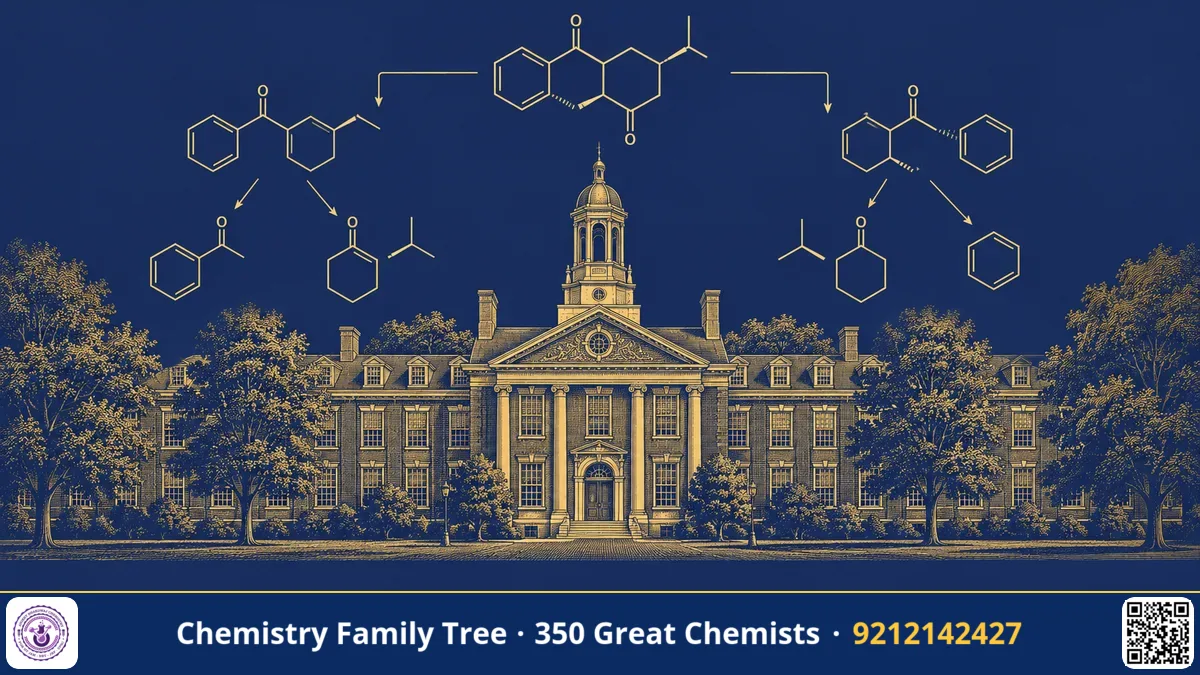
Elias James Corey (born 1928) is an American organic chemist who spent most of his career at Harvard University. He is the creator of retrosynthetic analysis, the logic that chemists use to plan the synthesis of complex molecules, and he received the Nobel Prize in Chemistry in 1990. He has made hundreds of natural products and invented a large number of reagents and reactions. Many of his students became professors around the world. This biography describes his life from a modest family in Massachusetts to the top of world chemistry.
Early Life and Family
Corey was born on 12 July 1928 in Methuen, Massachusetts, USA, to Lebanese immigrant parents. His father died when he was a baby, only about a year and a half old. His mother raised the family in difficult conditions and worked hard to support her children. Corey was originally named William, and his mother later changed his name to Elias, after his father. He grew up in a working-class neighbourhood and showed great ability in school. The family's struggle with money gave him a strong work ethic.
Education and Mentors
Corey attended the Massachusetts Institute of Technology (MIT), where he received his B.S. in 1948 and his Ph.D. in 1951. His doctoral supervisor was John C. Sheehan, a chemist known for his work on penicillin synthesis. In 1951 Corey joined the University of Illinois at Urbana-Champaign, where he quickly rose to professor. In 1959 he moved to Harvard University, where he remained for the rest of his career and where he is now an emeritus professor.
Career Timeline
| Year | Event |
|---|---|
| 1928 | Born in Methuen, Massachusetts (12 July) |
| 1948 | B.S. from MIT |
| 1951 | Ph.D. from MIT under John C. Sheehan; joined University of Illinois |
| 1959 | Moved to Harvard University |
| 1961 | Synthesis of longifolene |
| 1965 | Corey-Seebach dithiane umpolung chemistry |
| 1969 | Prostaglandin syntheses via the Corey lactone |
| 1975 | Introduced pyridinium chlorochromate (PCC) with J. W. Suggs |
| 1987 | Introduced the CBS oxazaborolidine catalyst for ketone reduction |
| 1988 | Synthesis of ginkgolide B |
| 1989 | Published The Logic of Chemical Synthesis |
| 1990 | Nobel Prize in Chemistry |
Major Scientific Contributions
1. Retrosynthetic analysis
The method of working backwards from a target by disconnections, synthons and functional group interconversions. See our companion post for full examples. It converted synthesis planning from an intuitive skill into a teachable method.
2. Total syntheses
Corey and his group completed syntheses of more than a hundred natural products, including longifolene, prostaglandins (important hormone-like compounds), gibberellic acid, ginkgolide B and many others. The prostaglandin route used the "Corey lactone" as a key intermediate and made these compounds available for medicine.
3. Reagents and reactions
Many reagents carry his name or were developed in his laboratory:
- PCC (Corey-Suggs): a mild oxidant stopping at the aldehyde stage.
- Corey-House synthesis: lithium dialkylcuprates (R2CuLi) react with alkyl halides to form alkanes: R2CuLi + R'X → R-R' + RCu + LiX.
- Corey-Fuchs reaction: converts an aldehyde into a terminal alkyne.
- Corey-Chaykovsky reaction: sulfur ylides convert ketones and aldehydes to epoxides.
- Corey-Winter olefination: converts 1,2-diols into alkenes stereospecifically.
- CBS reduction: an oxazaborolidine catalyst for enantioselective reduction of ketones.
- Silyl protecting groups: the TBS (tert-butyldimethylsilyl) ether, introduced with TBSCl and imidazole.
4. Computer-aided synthesis
In the late 1960s his group began the LHASA project, one of the first attempts to use computers for planning organic syntheses.
Awards, Honours and Nobel Prize
The Nobel Prize in Chemistry 1990 was awarded to E. J. Corey "for his development of the theory and methodology of organic synthesis". Among his other honours are the US National Medal of Science (1988), the Priestley Medal of the American Chemical Society (2004) and the Wolf Prize in Chemistry (1986). He is a member of the US National Academy of Sciences and has received many honorary degrees from universities around the world.
Personality, Struggles and Lesser-Known Facts
- Fatherless child: He lost his father at a very early age, and his mother brought up the children through hard times.
- Name change: He was born William and renamed Elias by his mother in memory of his father.
- Prolific mentor: Over many decades, hundreds of students and postdocs have worked in his group. Many have become professors and industrial leaders, forming one of the largest "academic families" in chemistry.
- Fast mover: He became a full professor at Illinois at a very young age and then moved to Harvard in 1959, when he was only thirty.
- Beyond the lab: He has worked on enzymes and medicinal chemistry, including anticancer compounds and anti-inflammatory targets related to the prostaglandin and leukotriene families, and has also used his methods for drug discovery.
Legacy and Influence on Modern Chemistry
Retrosynthetic thinking is now a basic skill for every organic chemist. Textbooks present synthesis problems in the language of disconnection and synthons. Corey's reagents are found in almost every laboratory. His influence spreads through his students: former group members lead research groups at universities in the United States, Europe, Japan, China and India. Modern artificial intelligence tools for synthesis planning are in a sense the successors of LHASA. And in the pharmaceutical industry, efficient synthesis of drugs relies directly on the approach he established.
Lessons for Students
- Think backwards: When faced with a hard synthesis question, start from the product and ask "what bond could I have made last?"
- Learn reactions as tools: Knowing named reactions is not enough; you must know when each is useful.
- Hard beginnings are not a barrier: Corey's early life was difficult, but hard work and good mentors took him to the top.
- Share knowledge: By writing books and training students, Corey multiplied the impact of his own ideas.
Quick Facts Box
- Born: 12 July 1928, Methuen, Massachusetts, USA
- Died: Living
- Nationality: American
- Field: Organic chemistry, total synthesis
- Famous for: Retrosynthetic analysis, PCC, CBS reduction, Corey-House, Corey-Fuchs and Corey-Chaykovsky reactions
- Nobel Prize: Chemistry 1990
FAQ
Where did E. J. Corey work?
He worked at the University of Illinois from 1951 to 1959, and then at Harvard University.
What is the Corey-House reaction?
It is the coupling of a lithium dialkylcuprate with an alkyl halide to give a higher alkane: R2CuLi + R'X → R-R'. It is also called the Corey-House or Posner-Whitesides-Corey-House synthesis.
What is PCC used for?
Pyridinium chlorochromate oxidises primary alcohols to aldehydes and secondary alcohols to ketones in anhydrous dichloromethane without over-oxidation.
Which Nobel Prize did Corey win?
The 1990 Nobel Prize in Chemistry, for the theory and methodology of organic synthesis.
Published by ABC Chemistry — IIT-JAM | CSIR-NET | GATE Chemistry Coaching. Visit abcchemistry.com
About the chemist
Elias James Corey
1928- · United States · Nobel Chemistry 1990
Retrosynthetic analysis