The discovery, explained · Chemist no. 58 of 350
Retrosynthetic Analysis: How E. J. Corey Taught Chemists to Think Backwards
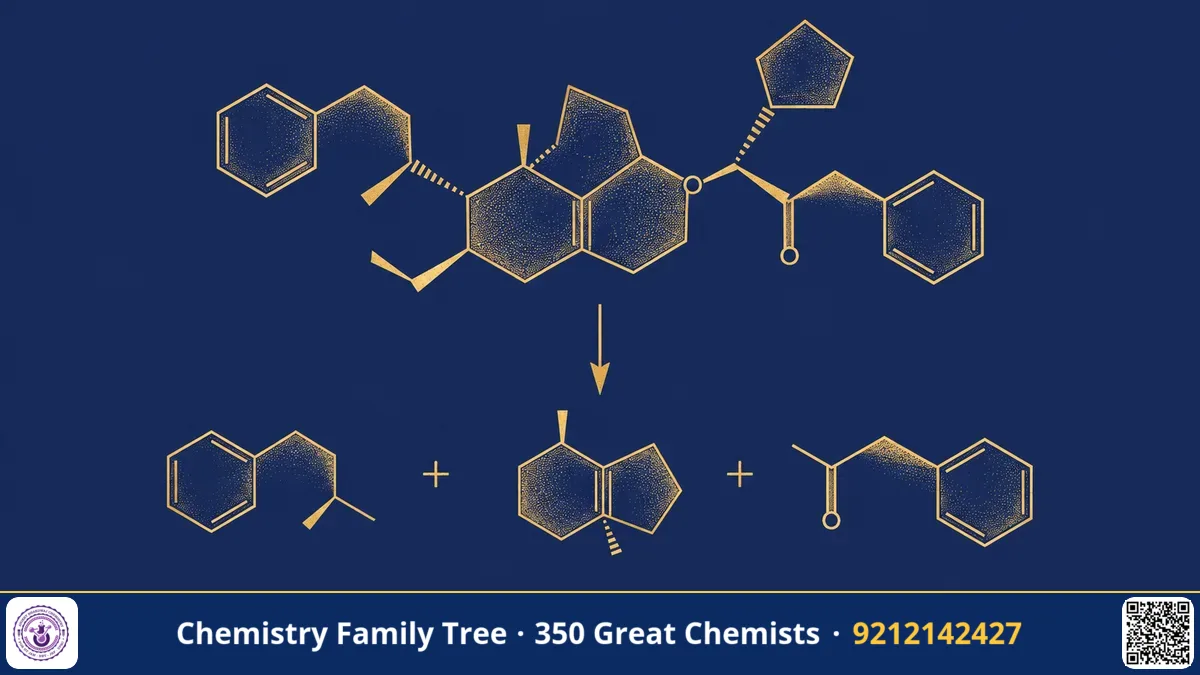
Suppose someone gives you a complex molecule and asks you to make it from simple, cheap starting materials. Where do you start? Many people would try to build it from the bottom up, but in a complicated molecule this approach quickly becomes confusing. Elias James (E. J.) Corey of Harvard University proposed a different way: start from the target and work backwards, breaking the molecule into simpler pieces until you reach compounds you can buy. He called this retrosynthetic analysis. It transformed organic synthesis from an art of intuition into a logical science, and in 1990 he received the Nobel Prize in Chemistry "for his development of the theory and methodology of organic synthesis". The same logic is used when you solve "how will you prepare X from Y?" problems in JAM, NET and GATE.
The Scientific Problem Before the Discovery
Before Corey, the best syntheses, such as those of R. B. Woodward, were planned by brilliant individuals using deep knowledge and experience. There was no general method for planning. Chemists often worked forwards: they chose a starting material and tried a series of reactions, hoping to reach the target. For molecules with many rings and stereocentres, the number of possible routes is enormous, and a forward search is like walking through a maze with no map.
Students faced the same problem. They learned many named reactions, but did not know how to combine them logically to build a molecule.
The Discovery: Step by Step
Corey developed the retrosynthetic approach through the 1960s, beginning with syntheses of natural products such as longifolene (1961), and formalised the ideas in the book The Logic of Chemical Synthesis (1989, with Xue-Min Cheng). The key elements are:
- Target molecule (TM): The compound you wish to make. Draw it and identify its functional groups.
- Disconnection: Imagine breaking a bond of the target. This is the reverse of a known reaction.
- Synthons: The idealised fragments (often charged) produced by the disconnection, such as a carbocation and a carbanion.
- Synthetic equivalents: Real reagents that act as the synthons. For example, a carbanion synthon may be supplied by a Grignard reagent.
- Functional group interconversion (FGI): Change one functional group into another on paper to allow a disconnection, for example an alcohol to a ketone.
- Repeat: Keep disconnecting until simple starting materials are reached.
The retrosynthetic arrow is a double-line arrow written as ⇒. It is read as "can be made from".
The Chemistry Behind It
Example 1: Grignard disconnection
Ph3C-OH  ⇒  Ph2C=O + PhMgBr
Forward:  Ph2C=O + PhMgBr → Ph3C-OMgBr → (H3O+) → Ph3C-OH
The C-C bond next to the alcohol carbon is disconnected. The synthons are Ph- (nucleophile) and a carbonyl electrophile.
Example 2: Aldol disconnection
PhCH(OH)CH2COCH3 ⇒ PhCHO + CH3COCH3
A β-hydroxy ketone is recognised as an aldol product. The bond between the α- and β-carbon is cut.
Example 3: Retro-Diels-Alder
cyclohexene derivative ⇒ diene + dienophile
A cyclohexene ring suggests a Diels-Alder reaction, giving a very quick simplification of ring systems with control of stereochemistry. This is one of Corey's favourite strategies.
Example 4: Umpolung (polarity reversal)
Normally the carbonyl carbon is electrophilic. Some targets require it to act as a nucleophile. Corey and Seebach (1965) used 1,3-dithianes to reverse this polarity. An aldehyde is converted to a dithiane, which is deprotonated by butyllithium to give a carbanion (an "acyl anion equivalent") that attacks electrophiles. Hydrolysis then regenerates the carbonyl group:
RCHO + HS(CH2)3SH → 2-R-1,3-dithiane
dithiane + n-BuLi → lithiated dithiane (acyl anion equivalent)
lithiated dithiane + R'X → 2-R-2-R'-dithiane → (HgCl2, H2O) → RCOR'
Strategic ideas
- Retron: A structural unit that signals a particular transform, such as a cyclohexene for Diels-Alder.
- Convergent synthesis: Make two halves separately and join them, giving better overall yield than a long linear route.
- Protecting groups: Temporary masks (such as TBS ethers, introduced by Corey) allow reactions to be done selectively.
Applications Today
- Drug manufacturing: Pharmaceutical companies plan routes to drugs by retrosynthesis. Corey's own syntheses include prostaglandins (the Corey lactone route), ginkgolide B and later the antiviral oseltamivir (Tamiflu).
- Computer-aided synthesis planning: Corey's group developed LHASA, one of the first computer programs to plan syntheses. Modern AI planning programs follow the same principle.
- New reagents: Corey's name is attached to many reagents used daily in laboratories, such as pyridinium chlorochromate (PCC), the Corey-Bakshi-Shibata (CBS) catalyst for enantioselective reduction of ketones, and Corey-Fuchs alkyne synthesis.
- Education: The disconnection approach is taught in every advanced organic chemistry course in India and abroad, and it is the basis of exam questions on multi-step synthesis.
- Natural product discovery: Efficient syntheses allow scientists to make anticancer and antibiotic molecules and their analogues in larger amounts.
Exam Corner
- Retrosynthetic arrow: ⇒. Disconnection gives synthons; reagents that behave as synthons are synthetic equivalents.
- Grignard reagent is the synthetic equivalent of a carbanion synthon; alkyl halide is the equivalent of a carbocation synthon.
- Umpolung: 1,3-dithiane with BuLi acts as an acyl anion equivalent (Corey-Seebach reaction).
- PCC (pyridinium chlorochromate, C5H5NH+ ClCrO3-) oxidises primary alcohols to aldehydes and stops there.
- CBS reduction: oxazaborolidine catalyst with borane reduces prochiral ketones enantioselectively to chiral alcohols.
Common Misconceptions
- "Synthons are real compounds." No, they are imaginary fragments. Real reagents that behave like synthons are called synthetic equivalents.
- "Retrosynthesis is just reversing arrows." You must choose disconnections carefully, based on reliable reactions, simplification of the structure and control of stereochemistry.
- "PCC oxidises aldehydes to acids." PCC works in anhydrous dichloromethane and stops at the aldehyde stage.
Quick Revision Box
- Retrosynthetic analysis: work backwards from the target to simple starting materials.
- Key terms: disconnection, synthon, synthetic equivalent, FGI, retron, ⇒ arrow.
- Corey won the Nobel Prize in Chemistry 1990.
- Corey-Seebach dithiane chemistry gives umpolung.
- Reagents: PCC, CBS catalyst, Corey-Fuchs, Corey-Chaykovsky, Corey-Winter.
- LHASA: early computer program for synthesis planning.
FAQ
What is retrosynthetic analysis?
It is a problem-solving method in which a target molecule is mentally broken down, step by step, into simpler precursors until commercially available starting materials are reached.
What is the difference between a synthon and a reagent?
A synthon is an idealised fragment (usually an ion) produced on paper by disconnection. A reagent is the real chemical used in the laboratory to do the job of the synthon.
What is umpolung?
Umpolung is the reversal of the normal polarity of a functional group. In the Corey-Seebach method a carbonyl carbon, normally electrophilic, is made nucleophilic through a dithiane.
Why did Corey get the Nobel Prize?
For developing the theory and methodology of organic synthesis, mainly retrosynthetic analysis, and for his syntheses of many complex natural products.
Published by ABC Chemistry — IIT-JAM | CSIR-NET | GATE Chemistry Coaching. Visit abcchemistry.com
About the chemist
Elias James Corey
1928- · United States · Nobel Chemistry 1990
Retrosynthetic analysis