Biography · Chemist no. 279 of 350
Emil Erlenmeyer (1825–1909): The Chemist Behind the Famous Flask
Introduction
Emil Erlenmeyer was a German chemist of the great nineteenth-century generation that turned organic chemistry into a structural science. He is remembered by students all over the world for the conical flask that bears his name, but in his own time he was respected as a theorist, a teacher, an editor and a tireless debater. His rule about unstable enols, his work on amino acids and his championing of structural formulas for compounds like naphthalene earned him a lasting place in textbooks. In one line: he gave chemistry a flask for the bench and a rule for the blackboard.
Early Life & Family
Richard August Carl Emil Erlenmeyer was born on 28 June 1825 in Wehen, in the Duchy of Nassau, in what is now the state of Hesse in Germany. His father was a Protestant church official and the family belonged to the educated middle class of the region. Little reliable detail survives about his childhood, but it is clear that he grew up in a household that valued learning and that he received a solid grammar-school education before turning to the sciences.
Education & Mentors
Erlenmeyer first studied medicine and pharmacy, a common path in those days for young men who wanted a career in chemistry before chemistry had its own degree structure. He studied at Giessen, where the great Justus von Liebig ran the most famous teaching laboratory in Europe, and he later studied at Heidelberg, where he came into the circle of Robert Bunsen and August Kekulé. He trained as a pharmacist and worked in that profession before devoting himself fully to research. His doctorate was completed at Giessen in the early 1850s. The exposure to Liebig's practical approach and Kekulé's structural thinking shaped his entire career.
Career Timeline
| Year | Event |
|---|---|
| 1825 | Born in Wehen, Duchy of Nassau |
| Early 1850s | Studies at Giessen and Heidelberg; completes doctorate |
| 1850s | Works as a pharmacist and runs a private laboratory in Heidelberg |
| 1860 | Designs the conical laboratory flask that bears his name |
| 1862 | Becomes a lecturer at Heidelberg |
| 1868 | Appointed professor of chemistry at the Polytechnic School in Munich |
| 1880 | Formulates the rule on unstable enols |
| 1883 | Retires from the chair; continues research and writing |
| 1909 | Dies on 22 January in Aschaffenburg |
Major Scientific Contributions
Erlenmeyer's scientific output was broad. Among his key contributions:
- The enol rule: compounds with an OH group on a doubly bonded carbon are unstable and rearrange to carbonyl compounds. This is the basis of keto-enol tautomerism in introductory courses and the reason alkyne hydration gives aldehydes and ketones.
- Structural theory: he was among the first to propose that naphthalene consists of two fused benzene rings (1866) and he promoted the use of double and triple bonds in structural formulas.
- Amino acids: he worked on the structure of amino acids and, with Lipp, reported syntheses of phenylalanine and tyrosine. The azlactone synthesis bearing his name (Erlenmeyer–Plöchl) became a standard method.
- Glassware: the Erlenmeyer flask, designed in 1860, is now universal.
- Chemical journalism: he edited chemical journals and wrote textbook material, helping to spread structural ideas across Germany.
For the detailed chemistry of the enol rule and azlactone synthesis, see our companion discovery post on Emil Erlenmeyer.
Awards, Honours & Nobel Prize
Erlenmeyer did not win a Nobel Prize; the prize was first awarded in 1901 when he was already in retirement. His honours were primarily academic. He held a professorial chair at one of Germany's leading technical institutions, served in learned societies, and received lasting recognition through the eponyms that bear his name: the Erlenmeyer flask, the Erlenmeyer rule and the Erlenmeyer–Plöchl azlactone synthesis. For a chemist, having a piece of equipment in every laboratory in the world is a form of honour few achieve.
Personality, Struggles & Lesser-Known Facts
- A trained pharmacist. He began in pharmacy, and his practical skill with apparatus is the likely reason he designed a better flask.
- A private laboratory. Before holding a professorship, he ran his own laboratory at Heidelberg, a typical path for ambitious German chemists of the period when university posts were scarce.
- Combative in debate. Erlenmeyer was known as a vigorous participant in the theoretical disputes of his day, and he did not hesitate to publish criticism of rivals' ideas.
- A teacher of many. His Munich laboratory trained a generation of chemists who went into industry and universities.
- His son was also a chemist. Emil Erlenmeyer Jr. (born 1864) also became a chemist, and the father and son sometimes appear together in the literature, so students should not confuse the two.
- Flask design. The shape was not a flash of genius for fashion. It solved a practical problem: a vessel that could be swirled, heated and stoppered, which a flat beaker or round-bottom flask could not do as comfortably.
Legacy & Influence on Modern Chemistry
Erlenmeyer's legacy lives in three places. First is the laboratory bench, where his flask is used daily for titrations, filtration, culturing cells and heating solutions. Second is the textbook, where the enol rule and tautomerism are core concepts that explain a large part of carbonyl chemistry, from aldol reactions to enolate alkylation. Third is the history of structural theory: the idea that molecular structure can be drawn with bonds that predict reactivity was strengthened by chemists like him who tested these pictures experimentally. His azlactone synthesis connected simple aldehydes to amino acids and still appears in modern organic chemistry courses.
Lessons for Students
- Practical tools matter. A well-designed flask changed everyday lab work for more than a century and a half.
- Rules in chemistry usually have exceptions, and understanding the exceptions (stabilised enols) is as valuable as the rule.
- Pharmacy, medicine and chemistry were once close neighbours; interdisciplinary training can open creative doors.
- Defend your ideas with experiments, but be ready to refine them.
- Learn the names behind the equipment and reactions; remembering the person helps you remember the chemistry.
Quick Facts Box
- Born: 28 June 1825, Wehen, Duchy of Nassau
- Died: 22 January 1909, Aschaffenburg, Germany
- Nationality: German
- Field: Organic chemistry
- Famous for: Erlenmeyer flask, enol rule, Erlenmeyer–Plöchl azlactone synthesis
- Nobel Prize: None
FAQ
Who invented the Erlenmeyer flask?
Emil Erlenmeyer, a German chemist, introduced the conical flask in 1860 while working in Heidelberg.
Did Emil Erlenmeyer win a Nobel Prize?
No. The Nobel Prizes began in 1901, and Erlenmeyer had already retired from his professorship by then.
What is the Erlenmeyer rule?
It states that simple alcohols with the hydroxyl group on a C=C carbon are unstable and convert to aldehydes or ketones.
Where did Erlenmeyer teach?
He lectured at Heidelberg and later served as professor of chemistry at the Polytechnic School in Munich from 1868 until his retirement.
Published by ABC Chemistry — IIT-JAM | CSIR-NET | GATE Chemistry Coaching. Visit abcchemistry.com
About the chemist
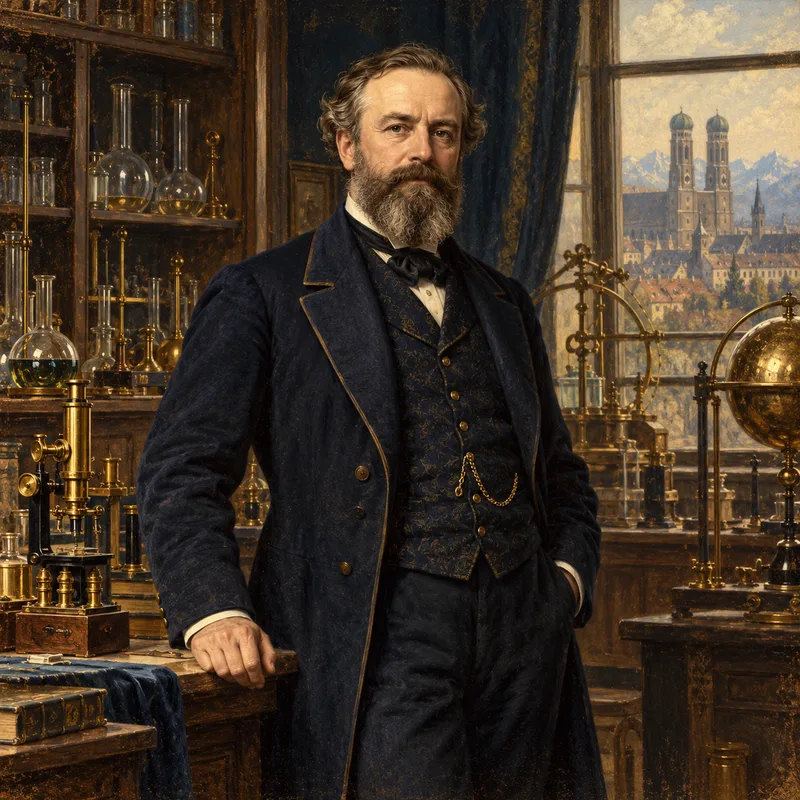
Emil Erlenmeyer
1825-1909 · Germany
Erlenmeyer flask; Erlenmeyer-Plöchl azlactone synthesis