The discovery, explained · Chemist no. 279 of 350
Emil Erlenmeyer: The Enol Rule, Azlactone Synthesis and a Flask Every Student Knows
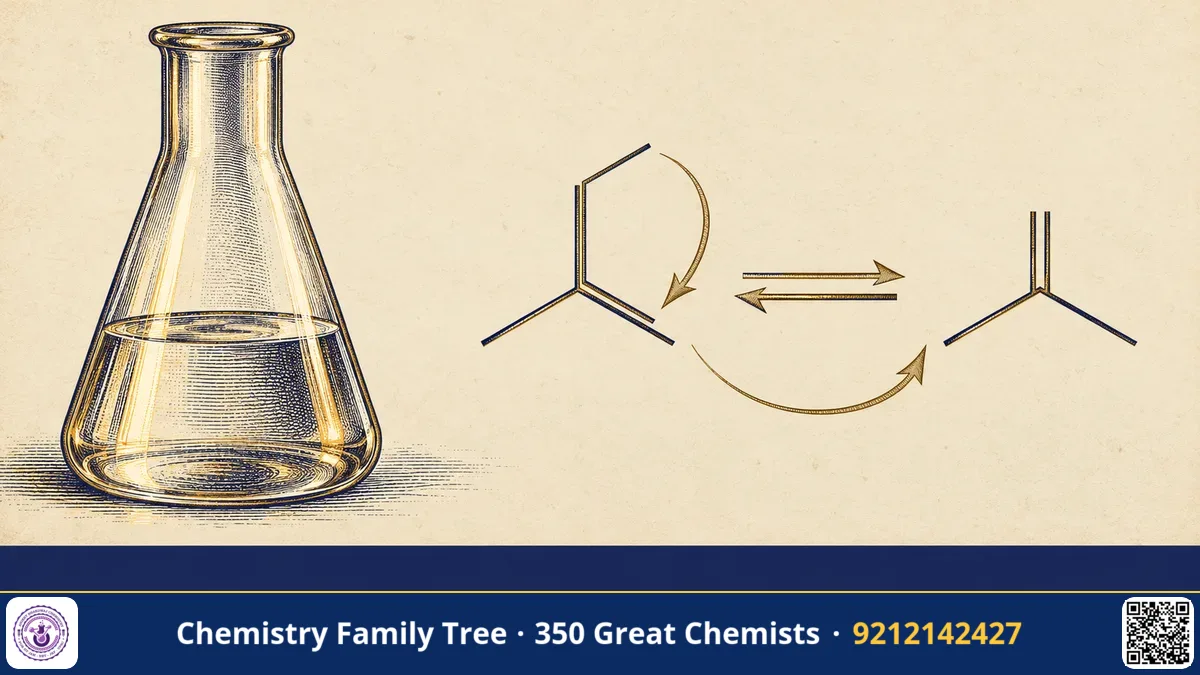
Walk into any chemistry laboratory in India, from a Class 11 school lab to an IIT research group, and you will see conical glass flasks on every bench. The name on that flask belongs to Emil Erlenmeyer, a nineteenth-century German chemist who did far more than give his name to glassware. He formulated a rule about unstable enols that every organic chemistry student uses without knowing it, he helped establish ideas about double and triple bonds in structural theory, and a reaction that carries his name is still a classic route to amino acids. This post explains his main scientific contributions in simple language with the mechanisms and exam points you need.
The Scientific Problem Before the Discovery
In the 1850s and 1860s, organic chemistry was moving from vague "types" to real structural formulas. Kekulé and Couper had shown that carbon is tetravalent and that atoms join in definite chains. But chemists still argued about many basic questions. How do multiple bonds fit into carbon skeletons? Which structures are stable and which are not? Why do some compounds that should exist on paper never appear in the flask?
One puzzle was the behaviour of compounds with a hydroxyl group on a carbon that is part of a C=C double bond. Chemists could write a formula such as CH₂=CH–OH (vinyl alcohol), yet whenever they tried to prepare such substances they always got an aldehyde or ketone instead. Without a clear rule, every case looked like a separate mystery. Another problem was how to build the amino acids found in proteins in the laboratory, since natural proteins gave only tiny amounts of these building blocks.
The Discovery / Experiment
Erlenmeyer studied the chemical behaviour of many such compounds and concluded in 1880 that alcohols in which the hydroxyl group sits directly on a doubly bonded carbon are unstable. They rearrange at once to the carbonyl isomer. This is the Erlenmeyer rule, also called the enol rule.
CH₂=CH–OH  →  CH₃–CHO       (vinyl alcohol to acetaldehyde)
CH₃–C(OH)=CH₂  →  CH₃–CO–CH₃   (propen-2-ol to acetone)
In the same period he worked on the amino acid problem. With later co-workers he developed what is now called the Erlenmeyer–Plöchl azlactone synthesis (the name also honours Plöchl, who first observed related chemistry). The steps are:
- An N-acyl glycine, usually hippuric acid (PhCO–NH–CH₂–COOH), is heated with acetic anhydride and sodium acetate.
- Acetic anhydride closes the ring to give an oxazolone, also called an azlactone, whose CH₂ group is now unusually acidic.
- This active methylene condenses with an aromatic aldehyde (a Perkin-type condensation) to give an unsaturated azlactone.
- Ring opening by hydrolysis or reduction gives an α-amino acid or an α-keto acid.
PhCO–NH–CH₂–COOH + (CH₃CO)₂O  →  2-phenyl-5-oxazolone + 2 CH₃COOH
oxazolone + ArCHO  →  4-arylidene-2-phenyloxazol-5-one + H₂O
Erlenmeyer and his collaborator Lipp also reported laboratory syntheses of the aromatic amino acids phenylalanine and tyrosine in the early 1880s, a remarkable achievement for the time because it linked laboratory synthesis to natural protein building blocks.
Finally, in 1860 he designed the conical flask with a flat base and narrow neck. It is the Erlenmeyer flask.
The Chemistry Behind It
Why is an enol unstable? An enol and its carbonyl form are tautomers: structural isomers that interconvert by moving a hydrogen and shifting a double bond. For simple carbonyl compounds, the keto form is lower in energy mainly because a C=O double bond plus a C–H bond is stronger than a C=C double bond plus an O–H bond. The energy difference is typically around 40–50 kJ/mol, so at equilibrium the keto form dominates enormously (for acetone the enol content is only about 10⁻⁶ percent).
The interconversion is catalysed by acid or base:
Base: enolate formed by removing the α-H, then protonation on O or C.
Acid: protonation of carbonyl O, then loss of α-H to form C=C.
Where the rule fails: the Erlenmeyer rule describes simple enols. Stable enols appear when extra effects help, such as hydrogen bonding in a six-membered chelate ring (acetylacetone is about 80 percent enol), conjugation with aromatic rings (phenol is the classic case, where the "enol" form is stabilised by aromaticity), or extended conjugation as in vitamin C.
The azlactone chemistry works because the oxazolone ring makes the C-4 methylene acidic: deprotonation gives an aromatic-like oxazole enolate, which attacks the aldehyde carbonyl just as in aldol and Perkin reactions.
Applications Today
- Laboratory glassware: the Erlenmeyer flask is used for titrations, because its sloping sides allow swirling without spilling, for culturing microbes and for dissolving solids. Every titration practical in Indian schools and colleges depends on it.
- Amino acid synthesis: the azlactone method remains a standard teaching and research route to dehydroamino acids and, after asymmetric hydrogenation, to enantiopure amino acids used in drugs.
- Understanding tautomerism: the enol rule underlies hydration of alkynes (terminal alkyne to methyl ketone with HgSO₄/H₂SO₄ gives the ketone through an enol) and many name reactions.
- Pharmaceuticals: amino acid derivatives made by azlactone routes appear in drug intermediates such as those for peptide-based medicines.
Exam Corner
- Erlenmeyer rule: enols with OH on a C=C carbon are generally unstable and tautomerise to aldehydes or ketones.
- Hydration of propyne with Hg²⁺/H₂SO₄ gives acetone through the unstable enol propen-2-ol.
- Name the product of heating hippuric acid with benzaldehyde, acetic anhydride and sodium acetate: an unsaturated azlactone (4-benzylidene-2-phenyloxazol-5-one).
- Acetylacetone and phenol are exceptions in which the enol form is stabilised (H-bonding, aromaticity).
- Keto-enol tautomerism involves a shift of an H atom and a double bond, not resonance; the two forms are different compounds.
Common Misconceptions
- "Tautomers are resonance structures." No. Resonance structures differ only in electron placement, while tautomers differ in atom position and exist as real, separate species in equilibrium.
- "Enols can never be isolated." The rule is a strong tendency, not an absolute law. Stabilised enols such as those of 1,3-diketones and phenols are common.
- "Erlenmeyer flasks are for measuring volume." The markings on them are only approximate; use a volumetric flask or burette for accuracy.
Quick Revision Box
- Erlenmeyer rule (1880): simple vinyl alcohols rearrange to carbonyl compounds.
- Keto form is favoured because C=O + C–H is more stable than C=C + O–H.
- Erlenmeyer–Plöchl azlactone synthesis: N-acylglycine + aldehyde + Ac₂O/NaOAc gives an unsaturated azlactone, then an amino acid.
- Stable enols: acetylacetone (H-bonded), phenol (aromatic).
- Erlenmeyer flask designed in 1860 with narrow neck and flat bottom.
- Alkyne hydration always passes through an enol.
FAQ
What is the Erlenmeyer rule in simple words?
A hydroxyl group attached directly to a carbon-carbon double bond makes the compound unstable. It quickly changes into an aldehyde or ketone through tautomerism.
Why does the Erlenmeyer flask have a conical shape?
The wide base keeps it stable, the sloping walls let you swirl liquids without spilling, and the narrow neck reduces evaporation and allows a stopper or cotton plug.
Is the azlactone synthesis relevant for CSIR-NET?
Yes. It appears among condensation name reactions along with Perkin, Knoevenagel and Claisen–Schmidt, and the mechanism through an acidic oxazolone methylene is a favourite question.
How does the enol rule help with alkyne hydration?
Because the vinyl alcohol formed by adding water to an alkyne cannot persist, it tautomerises to a carbonyl compound, which explains why alkyne hydration gives aldehydes or ketones and not alcohols.
Published by ABC Chemistry — IIT-JAM | CSIR-NET | GATE Chemistry Coaching. Visit abcchemistry.com
About the chemist
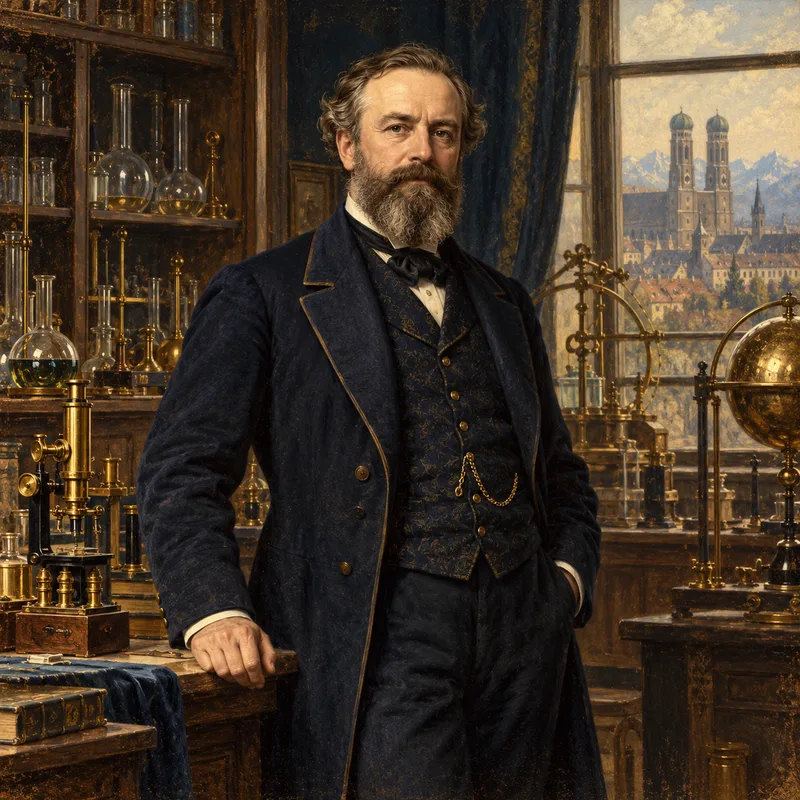
Emil Erlenmeyer
1825-1909 · Germany
Erlenmeyer flask; Erlenmeyer-Plöchl azlactone synthesis