Biography · Chemist no. 24 of 350
Emil Fischer: The Master of Sugars and Proteins
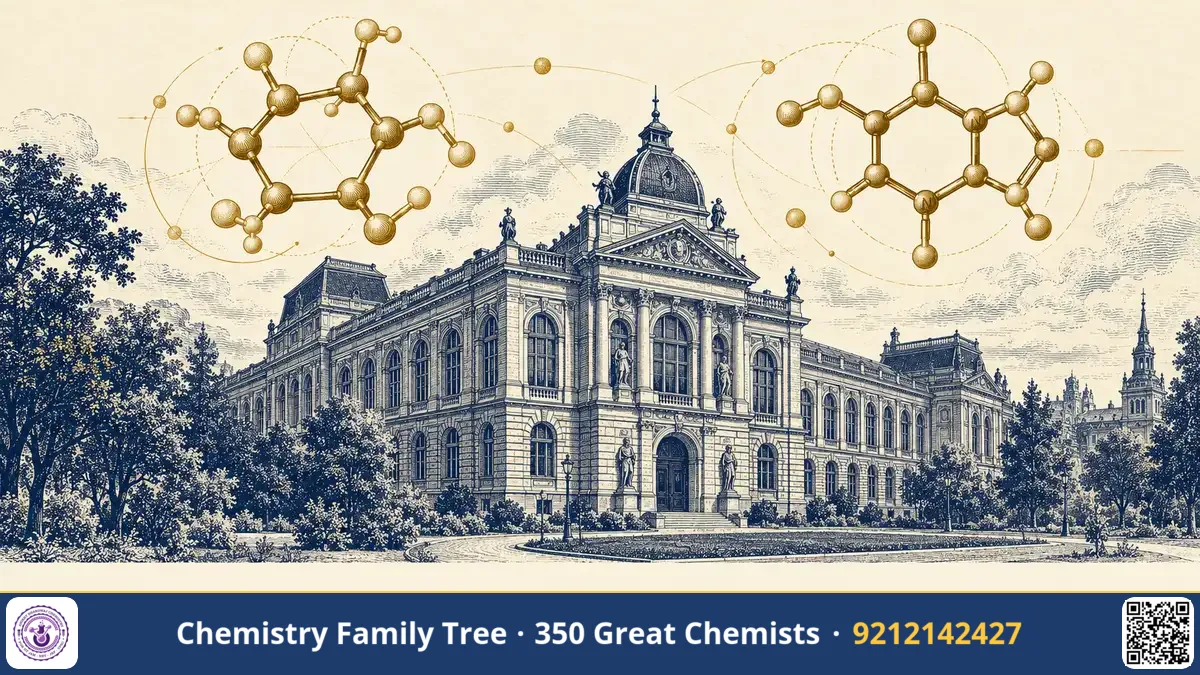
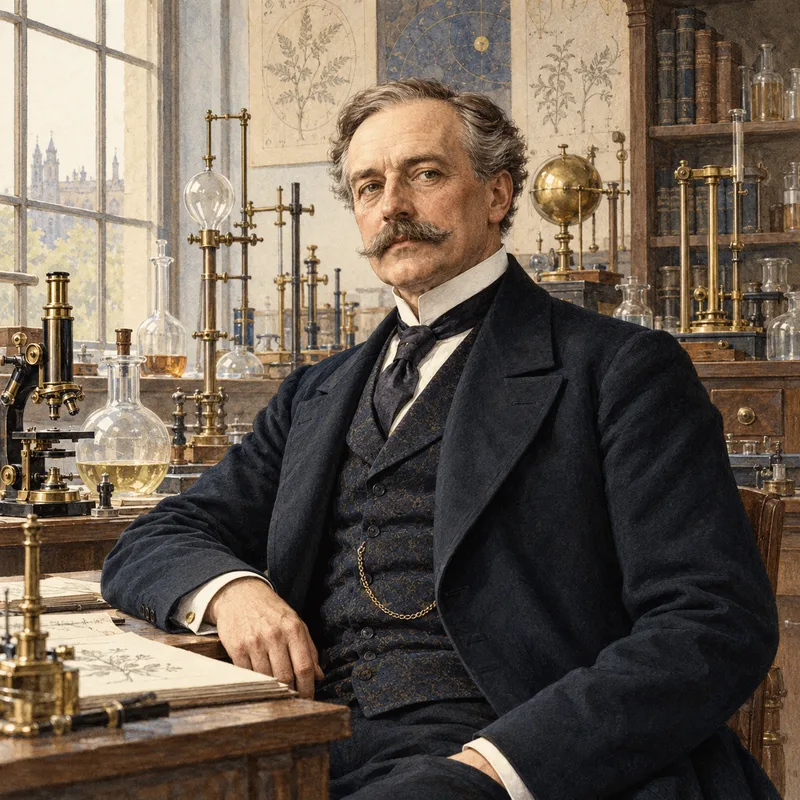
Hermann Emil Fischer (1852–1919) was a German organic chemist who worked out the structure of sugars, synthesised purines such as caffeine, and made the first synthetic peptides. He received the Nobel Prize in Chemistry in 1902, and is often called the father of biochemistry because he linked organic chemistry with the molecules of life. His legacy appears in the Fischer projection, the D/L system and the lock-and-key model of enzymes, and he also trained a large number of brilliant students.
Early Life and Family
Emil Fischer was born on 9 October 1852 at Euskirchen, near Bonn, in the Rhineland of Germany. His father, Laurenz Fischer, was a successful businessman. Emil was the only son among several daughters, and his father expected him to join the family business. However, the young Emil showed little interest in commerce, and Laurenz is said to have remarked that he was too stupid for business and might as well study. Emil chose science, and his father supported the move. His cousin Otto Fischer also became a chemist.
In 1888 he married Agnes Gerlach, daughter of an anatomy professor at Erlangen. She died in 1895, leaving him with three sons. The family suffered terribly in the First World War: two of his sons died in the conflict. His third son, Hermann Otto Laurenz Fischer, became a well-known biochemist.
Education and Mentors
Fischer first studied chemistry at the University of Bonn in 1871, where he heard Kekulé's lectures, though he was not much attracted by them. Then he moved to the new University of Strasbourg to work under Adolf von Baeyer. He received his doctorate there in 1874 with a thesis on fluorescein and related dyes. In 1875 he followed Baeyer to Munich, where he worked as his assistant and became a lecturer. During these years, he discovered phenylhydrazine.
Career Timeline
| Year | Event |
|---|---|
| 1852 | Born in Euskirchen, 9 October |
| 1874 | Doctorate at Strasbourg under Baeyer |
| 1875 | Discovers phenylhydrazine; moves to Munich |
| 1882 | Professor at Erlangen |
| 1883 | Fischer indole synthesis |
| 1885 | Professor at Würzburg |
| 1891 | Establishes the configuration of glucose and related sugars |
| 1892 | Professor and director of the Chemical Institute at Berlin |
| 1894 | Lock-and-key model of enzyme action |
| 1901–1907 | Peptide synthesis, from glycylglycine to an 18-unit chain |
| 1902 | Awarded the Nobel Prize in Chemistry |
| 1919 | Dies in Berlin, 15 July |
Major Scientific Contributions
- Sugar chemistry. He determined the structures and configurations of glucose, fructose, mannose and the other hexoses, and synthesised glucose, fructose and mannose from simple starting materials.
- Purines. He explained the structures of uric acid, caffeine, theobromine, xanthine, adenine and guanine, and in 1898 he made the parent compound purine. Read more about the sugar work in our discovery post on Fischer's sugar and peptide chemistry.
- Peptides and proteins. He showed that amino acids are linked by the –CO–NH– bond, and made peptides by controlled steps.
- Reactions named after him. The Fischer indole synthesis, Fischer esterification (with Speier), Kiliani–Fischer synthesis and Fischer osazone test.
- Enzyme theory. The lock-and-key hypothesis from 1894.
- Medicines. With Joseph von Mering he introduced barbital as a sleeping medicine.
Awards, Honours and Nobel Prize
Fischer received the Nobel Prize in Chemistry in 1902 "in recognition of the extraordinary services he has rendered by his work on sugar and purine syntheses". He also received the Davy Medal of the Royal Society in 1890, plus honorary degrees and membership in numerous scientific academies. After his death a medal of the German Chemical Society (the Emil Fischer Medal), and the Emil Fischer Memorial Fund were created in his honour.
Personality, Struggles and Lesser-Known Facts
- A reluctant businessman. His father wanted him to join the family timber business, but Emil preferred science. This turned out to be a great gain for chemistry.
- Health damaged by his work. Years of handling phenylhydrazine, a toxic compound, is said to have caused skin and stomach problems, and he suffered from poor health for much of his later life.
- A hard-working teacher. He was strict, and expected much from his students, but he also looked after them. Among his students and co-workers were Otto Diels, who later won the Nobel Prize in 1950, and Otto Warburg, who received the 1931 Nobel Prize in Physiology or Medicine.
- Wartime service. In the First World War he helped organise the supply of chemicals for Germany and its food supply, and developed substitutes for scarce materials. He lost two sons in the conflict.
- Help in building institutions. He was one of the scientists who supported the foundation of the Kaiser Wilhelm Society, with its research institutes, in 1911.
Legacy and Influence on Modern Chemistry
The study of carbohydrates, amino acids and proteins in every textbook is built on Fischer's foundations. He showed that natural substances could be understood and made by logical, step-by-step chemistry. The D/L convention that he began is still the standard for sugars and amino acids. His lock-and-key idea is the ancestor of modern ideas of enzyme specificity and drug–receptor binding. The Berlin chemistry institute he led, and the students who trained there, shaped German organic chemistry in the early twentieth century. The later Nobel Prize for the sequence of insulin (Sanger, 1958) and for peptide synthesis on a solid support (Merrifield, 1984) continue directly from his early work.
Lessons for Students
- Break big problems into steps. Fischer solved the 16-isomer puzzle by systematic reactions.
- Use models and simple notations; a good diagram helps thinking.
- Take care of your health in the laboratory. Use gloves, fume hoods and safe practice.
- Support the next generation by teaching and by funding.
Quick Facts Box
- Born: 9 October 1852, Euskirchen, Rhine Province, Prussia (Germany)
- Died: 15 July 1919, Berlin, Germany
- Nationality: German
- Field: Organic chemistry, biochemistry
- Famous for: Structure of glucose, Fischer projection, purines, peptide synthesis, lock-and-key model
- Nobel: Chemistry, 1902
FAQ
Who was Emil Fischer's teacher?
Adolf von Baeyer, under whom he did his doctorate at Strasbourg and worked at Munich.
What did Fischer discover in 1875?
Phenylhydrazine, which later became essential in sugar chemistry and in the Fischer indole synthesis.
Is Hermann Fischer related to Emil Fischer?
Yes, Hermann Otto Laurenz Fischer was his son and became a biochemist who worked on carbohydrates.
Why is he called the father of biochemistry?
He applied the methods of organic chemistry to biological molecules such as sugars, purines and proteins.
Published by ABC Chemistry — IIT-JAM | CSIR-NET | GATE Chemistry Coaching. Visit abcchemistry.com
About the chemist
Emil Fischer
1852-1919 · Germany · Nobel Chemistry 1902
Sugar and purine synthesis; Fischer projection