The discovery, explained · Chemist no. 24 of 350
Emil Fischer: Decoding Sugars, Purines and Proteins
Emil Fischer was a German chemist who found order in some of the most complex natural molecules: sugars, purines and proteins. By 1891 he had worked out the three-dimensional arrangement of glucose and its sixteen stereoisomers, using the tetrahedral carbon idea of van 't Hoff. He gave chemists the Fischer projection, a simple way to draw 3D molecules on paper, and later made the first synthetic peptides. In 1902 he received the Nobel Prize in Chemistry "in recognition of the extraordinary services he has rendered by his work on sugar and purine syntheses". If you study carbohydrates, amino acids or proteins for JAM, NET, GATE or boards, you are studying Fischer's chemistry.
The Scientific Problem Before the Discovery
By 1880, chemists knew that glucose, fructose and other sugars have the formula C₆H₁₂O₆ or similar, yet they behaved differently. Natural sugars were hard to purify, they would not crystallise easily, and they decomposed on heating. Compounds with the same molecular formula and the same functional groups (an aldehyde group and five –OH groups in glucose) could differ in their physical properties and in their reaction with enzymes of yeast. Van 't Hoff's 1874 theory of the asymmetric carbon suggested an explanation, but nobody had applied it to a complex molecule with several asymmetric carbons.
A second problem was proteins. They were known to be large molecules made from amino acids, but how amino acids were joined was unclear.
The Discovery: Step by Step
1. Phenylhydrazine (1875). While working with Adolf von Baeyer, Fischer discovered the compound phenylhydrazine, C₆H₅NHNH₂. Later he found that it reacts with sugars to give yellow crystalline derivatives, which could be easily purified and identified.
2. Osazone formation. One mole of a reducing sugar reacts with three moles of phenylhydrazine:
Sugar (CHO–CHOH–) + 3 C₆H₅NHNH₂ → osazone + C₆H₅NH₂ + NH₃ + 2H₂O
Both C-1 and C-2 become hydrazone groups. Because C-2 loses its asymmetry, glucose, fructose and mannose all give the same osazone, showing that they have the same configuration at C-3, C-4 and C-5.
3. Configuration of glucose (1891). An aldohexose has four asymmetric carbons (C-2 to C-5), so 2⁴ = 16 stereoisomers exist: 8 pairs of enantiomers. Fischer prepared many of them and linked them by reactions such as the Kiliani–Fischer synthesis, which lengthens the chain of an aldose by one carbon. By using oxidation to give dicarboxylic acids (aldaric acids) with or without optical activity, he assigned the arrangement of –OH groups in glucose, mannose and galactose. He had to make one arbitrary choice: he assigned the –OH on the right in the Fischer projection of (+)-glyceraldehyde and called it D. This guess was proved correct in 1951 by X-ray work of Johannes Bijvoet.
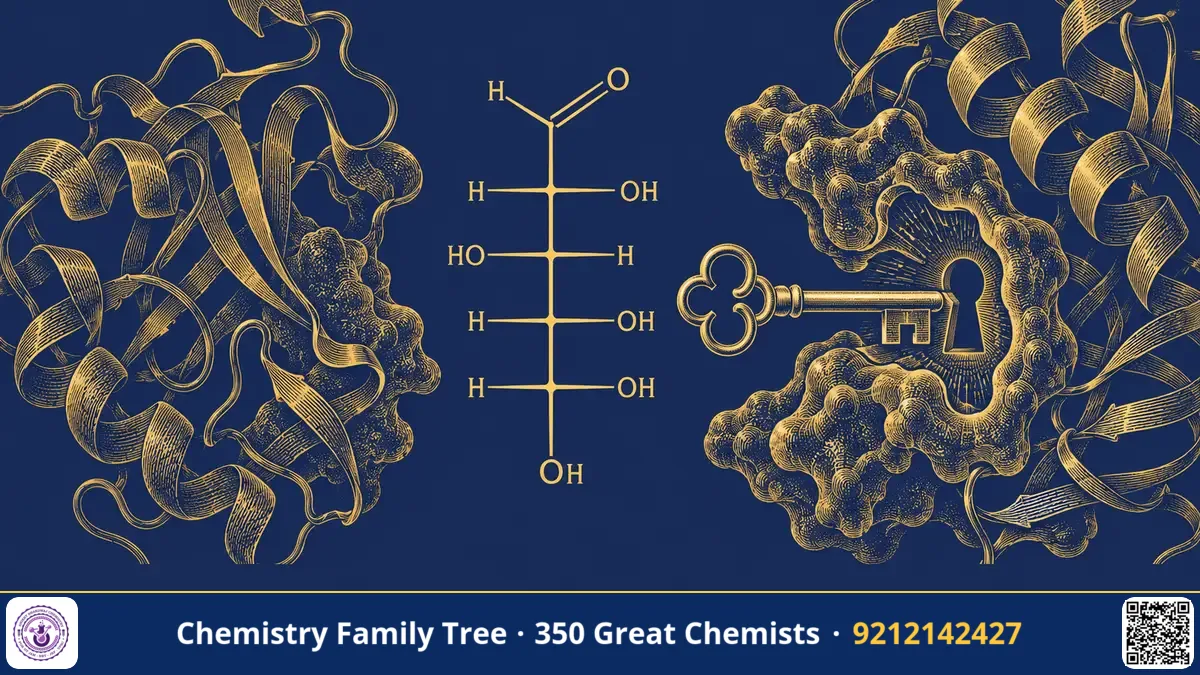
4. Lock and key (1894). He found that yeast enzymes could ferment the natural D-sugars but not the L-forms, and suggested that an enzyme and its substrate fit like a lock and key.
5. Peptides (1901–1907). Fischer synthesised glycylglycine in 1901, proposed the term "peptide" in 1902 and in 1907 built a chain of 18 amino acid units.
The Chemistry Behind It
The Fischer projection. The carbon chain is drawn vertically with the most oxidised carbon (CHO in glucose) at the top. Horizontal bonds point towards the viewer; vertical bonds point away. In D-glucose the –OH groups at C-2, C-3, C-4, C-5 are on the right, left, right, right.
   CHO
 H–C–OH      C2
HO–C–H       C3
 H–C–OH      C4
 H–C–OH      C5
   CH₂OH
   D-glucose
D and L describe the position of the –OH group on the highest-numbered stereocentre (right for D, left for L). It has no relation to the sign of optical rotation. D-(+)-glucose is dextrorotatory, with specific rotation about +52.7° at equilibrium.
| Term | Meaning | Example |
|---|---|---|
| Epimers | Differ at one stereocentre only | Glucose and mannose (C-2); glucose and galactose (C-4) |
| Anomers | Differ at the new stereocentre C-1 in ring form | α-D-glucose and β-D-glucose |
| Enantiomers | Mirror images | D-glucose and L-glucose |
Esterification and indole synthesis. With Arthur Speier, Fischer developed the acid-catalysed formation of esters, now called Fischer esterification:
RCOOH + R'OH ⇌ RCOOR' + H₂O (H₂SO₄ or dry HCl catalyst)
The Fischer indole synthesis (1883) turns an arylhydrazone of an aldehyde or ketone into an indole with loss of ammonia, using acid catalysis.
The peptide bond. Two amino acids join by condensation, losing water to form the amide linkage –CO–NH–: H₂N–CHR–COOH + H₂N–CHR'–COOH → H₂N–CHR–CO–NH–CHR'–COOH + H₂O.
Applications Today
- Medicine: the Fischer projection and the D/L system are used in drug design and in naming amino acids (natural proteins contain L-amino acids) and sugars.
- Drugs from Fischer's work: with Joseph von Mering, he introduced barbital (Veronal) in 1903, the first barbiturate sleeping drug. Caffeine and theobromine, which he synthesised, are purines.
- Peptide drugs: insulin, oxytocin and many modern therapeutics are peptides, produced by methods that grew from Fischer's work.
- Food industry: Fischer esterification gives fruit-like flavour esters such as ethyl acetate. Indian sugar and ethanol industries use sugar chemistry every day.
- Biochemistry: the lock-and-key picture is the basis of enzyme inhibitors and drug targeting, including many medicines for diabetes and infections.
- Dyes and drugs: the Fischer indole synthesis is widely used for tryptamine drugs such as sumatriptan.
Exam Corner
- Aldohexose: 4 chiral centres, 16 stereoisomers (8 D and 8 L). Ketohexose such as fructose: 3 chiral centres, 8 stereoisomers.
- Glucose, fructose and mannose give the same osazone; the reagent is excess phenylhydrazine (3 moles).
- Epimers: glucose/mannose at C-2, glucose/galactose at C-4. Anomers: α/β forms differ at C-1.
- In Fischer projection, horizontal = toward the viewer, vertical = away; rotating by 90° changes the configuration, rotating by 180° in the plane does not.
- Fischer esterification is reversible and acid catalysed; removing water or using excess alcohol shifts equilibrium forward.
Common Misconceptions
- "D means dextrorotatory." No. D refers to configuration. D-fructose, for example, is levorotatory.
- "Fischer proved the absolute configuration." He chose it by convention. It was later shown to be right.
- "Peptide synthesis was complete in 1907." Fischer built a small chain. Making large proteins took many more decades.
Quick Revision Box
- Phenylhydrazine discovered by Fischer in 1875.
- Structure of glucose and the sugar family worked out by 1891; Nobel Prize 1902.
- Fischer projection: horizontal toward viewer, vertical away.
- Osazone: C-1 and C-2 react; 3 moles of phenylhydrazine per mole of sugar.
- Lock-and-key model of enzymes, 1894.
- Term "peptide" coined in 1902; Fischer esterification with Speier (1895).
FAQ
Why do glucose and fructose give the same osazone?
Because the difference between them is at C-1 and C-2, and in osazone formation both carbons are converted into hydrazone groups. The remaining carbons C-3 to C-5 are identical.
What is the Kiliani–Fischer synthesis?
It is a method to extend an aldose by one carbon atom using cyanohydrin formation, hydrolysis and reduction.
Why is Fischer's work important for biology?
It showed that biological molecules have specific three-dimensional shapes, and it started the study of enzymes and proteins at the molecular level.
What is the difference between Fischer and Haworth projections?
The Fischer projection shows an open chain, while the Haworth projection shows the ring form of sugars in perspective.
Published by ABC Chemistry — IIT-JAM | CSIR-NET | GATE Chemistry Coaching. Visit abcchemistry.com
About the chemist
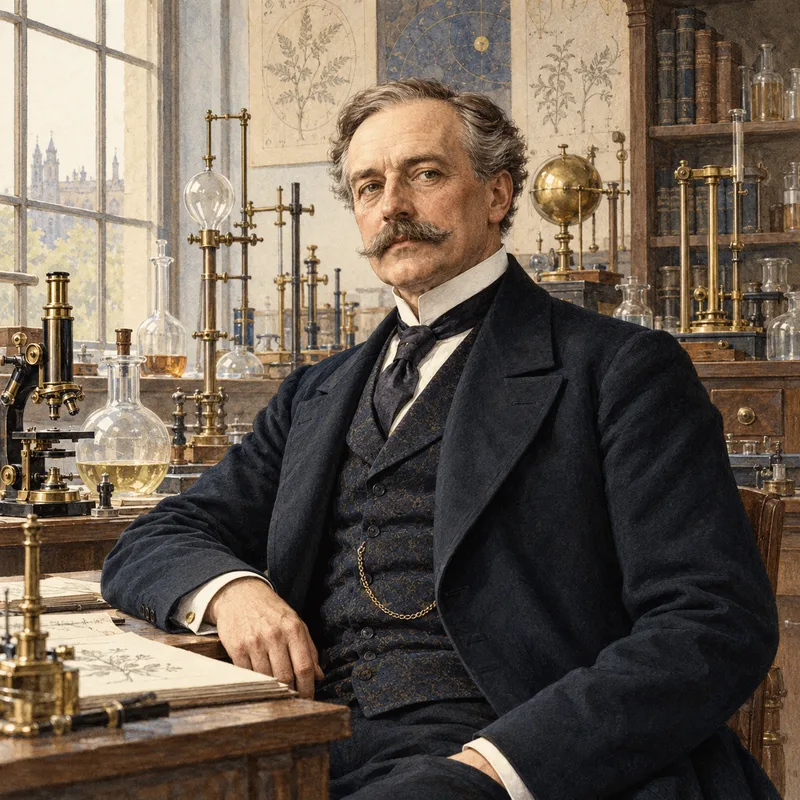
Emil Fischer
1852-1919 · Germany · Nobel Chemistry 1902
Sugar and purine synthesis; Fischer projection