Biography · Chemist no. 276 of 350
Emilio Segrè (1905–1989): From Fermi's Boys to the Antiproton
Emilio Gino Segrè was an Italian-born American physicist who made discoveries on the borderline of chemistry and physics. He discovered the elements technetium and astatine, took part in the work that proved plutonium-239 fissionable, and co-discovered the antiproton, for which he shared the 1959 Nobel Prize in Physics. His life moved from Rome to Palermo to Berkeley, shaped by the discoveries he made and also by the political events of his time.
Early Life and Family
He was born on 1 February 1905 in Tivoli, near Rome, Italy, the youngest of three sons in a Jewish family that ran a paper mill. His family was prosperous and educated, and the family moved to Rome when he was young. As a boy, he was fascinated by science and mathematics and read widely.
Education and Mentors
He began studying engineering at the University of Rome in 1922 but moved to physics after meeting Franco Rasetti and Enrico Fermi in 1927. He received his doctorate in physics in 1928 with Fermi as his supervisor. He then served in the Italian army and visited laboratories in Hamburg (with Otto Stern) and Amsterdam (with Pieter Zeeman). Back in Rome, he became part of Fermi's group, nicknamed the "Via Panisperna boys" after the street where the institute stood. The group studied the effect of neutron bombardment, including the use of slow neutrons (1934), a discovery for which Fermi received the Nobel Prize in Physics in 1938. Segrè's mentors thus included Fermi, Rasetti, and later Ernest Lawrence at Berkeley.
Career Timeline
| Year | Event |
|---|---|
| 1905 | Born in Tivoli, Italy (1 February). |
| 1928 | Doctorate in physics, University of Rome, under Enrico Fermi. |
| 1934 | Takes part in Fermi's neutron experiments in Rome. |
| 1936 | Becomes professor and director of the physics laboratory at the University of Palermo. |
| 1937 | With Carlo Perrier, discovers technetium from cyclotron-irradiated molybdenum. |
| 1938 | Visits Berkeley; Italian racial laws prevent his return, and he stays in the USA as a refugee. |
| 1940 | With Corson and MacKenzie, discovers astatine. |
| 1941 | With Seaborg, Kennedy and Wahl, shows that plutonium-239 is fissionable. |
| 1943–1946 | Works at Los Alamos on the Manhattan Project. |
| 1955 | With Chamberlain, Wiegand and Ypsilantis, discovers the antiproton at the Bevatron. |
| 1959 | Shares the Nobel Prize in Physics with Owen Chamberlain. |
| 1989 | Dies in Lafayette, California (22 April). |
Major Scientific Contributions
Technetium (1937). The first artificially produced element. From the molybdenum foil of a cyclotron deflector, he and Perrier isolated and characterised the first radioactive isotopes of element 43 (⁹⁵Tc, ⁹⁶Tc, later ⁹⁷Tc and ⁹⁸Tc).
Astatine (1940). By bombarding bismuth with alpha particles, he created element 85, the heaviest halogen:
²⁰⁹Bi + ⁴He → ²¹¹At + 2n
Plutonium-239 (1941). Segrè collaborated with Glenn Seaborg's group on the discovery that ²³⁹Pu undergoes fission with slow neutrons, which made it a candidate for reactors and weapons. He also contributed to the discovery of other nuclear isomers and to the study of the K-electron capture process.
Antiproton (1955). At the Bevatron accelerator in Berkeley, Segrè, Chamberlain, Clyde Wiegand and Thomas Ypsilantis proved the existence of the antiproton, the antimatter partner of the proton, with the same mass and opposite charge. This confirmed Dirac's prediction of antimatter.
p + p → p + p + p + p̄ (antiproton produced when a proton beam hits a target)
Awards, Honours and Nobel Prize
Segrè and Owen Chamberlain shared the 1959 Nobel Prize in Physics "for their discovery of the antiproton". This was a Physics prize, though his earlier discoveries of technetium and astatine are important to chemists. He was elected to the US National Academy of Sciences and received other honours and honorary degrees. He was a professor at the University of California, Berkeley from 1946 until retirement and later wrote scientific histories and an autobiography.
Personality, Struggles and Lesser-Known Facts
- Stranded by politics. In 1938, while in the USA, Italy passed racial laws that removed Jewish scholars from their posts. Segrè could not return to his job in Palermo, and he started again in America as a refugee at Berkeley, with a modest salary.
- The scientific rubbish bin. The discovery of technetium came from a piece of waste material, a used cyclotron deflector foil that Lawrence was willing to give away. It is a famous example of how "waste" can be a treasure.
- Strong views. Colleagues described him as a brilliant but demanding and sometimes sharp-tongued person. His writings show a candid account of the people and events of the era.
- Los Alamos work. He led a group measuring spontaneous fission rates, and helped to show that reactor-produced plutonium contained ²⁴⁰Pu, which made the plutonium gun-type design unsuitable.
- Writer and historian. He wrote popular books on the history of physics, such as From X-rays to Quarks, and a biography of Fermi.
Legacy and Influence on Modern Chemistry
Technetium-99m is used in a large fraction of all nuclear medicine procedures worldwide, including in Indian hospitals. Astatine-211 is under study for targeted alpha therapy of cancers. The method of making new elements by bombarding targets with accelerated particles opened the way to the whole transuranium series. The antiproton led to the field of antimatter physics, and positron emission tomography (PET) also relies on antimatter. Segrè's life also teaches how scientists moved across countries because of war.
Lessons for Students
- Pay attention to what others throw away. A waste foil yielded a new element.
- Collaboration across laboratories and countries (Berkeley and Palermo) led to major discoveries.
- Know the basics of both physics and chemistry; many discoveries happen in between.
- Adapt to hardship. Segrè started again in a new country and went on to win a Nobel Prize.
Quick Facts
- Born: 1 February 1905, Tivoli, Italy.
- Died: 22 April 1989, Lafayette, California, USA.
- Nationality: Italian, later American.
- Field: Nuclear physics and nuclear chemistry.
- Famous for: Technetium, astatine, antiproton.
- Nobel: Physics, 1959 (shared with Owen Chamberlain).
FAQ
Which Nobel Prize did Emilio Segrè win?
The 1959 Nobel Prize in Physics, shared with Owen Chamberlain, for the discovery of the antiproton.
Which elements did he discover?
Technetium (43) in 1937 with Carlo Perrier, and astatine (85) in 1940 with Dale Corson and Kenneth MacKenzie.
Who was his teacher?
Enrico Fermi supervised his doctorate in Rome.
Why did he move to the USA?
In 1938, he was on a visit to Berkeley when Italy introduced racial laws against Jews; he could not safely return and stayed in the USA.
Published by ABC Chemistry — IIT-JAM | CSIR-NET | GATE Chemistry Coaching. Visit abcchemistry.com
About the chemist
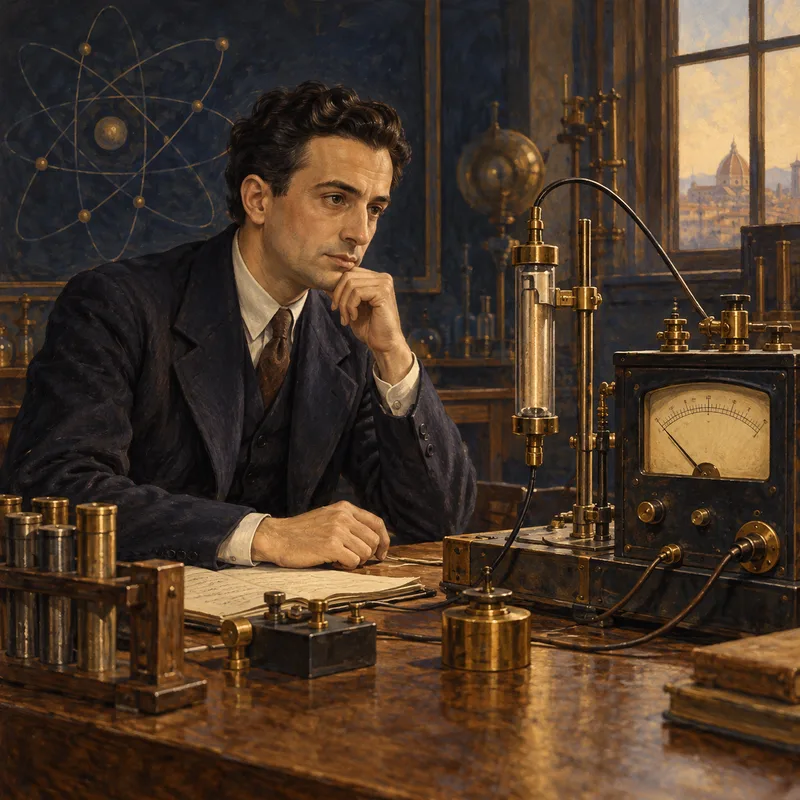
Emilio Segrè
1905-1989 · Italy · Nobel Physics 1959
Discovered technetium, astatine, antiproton